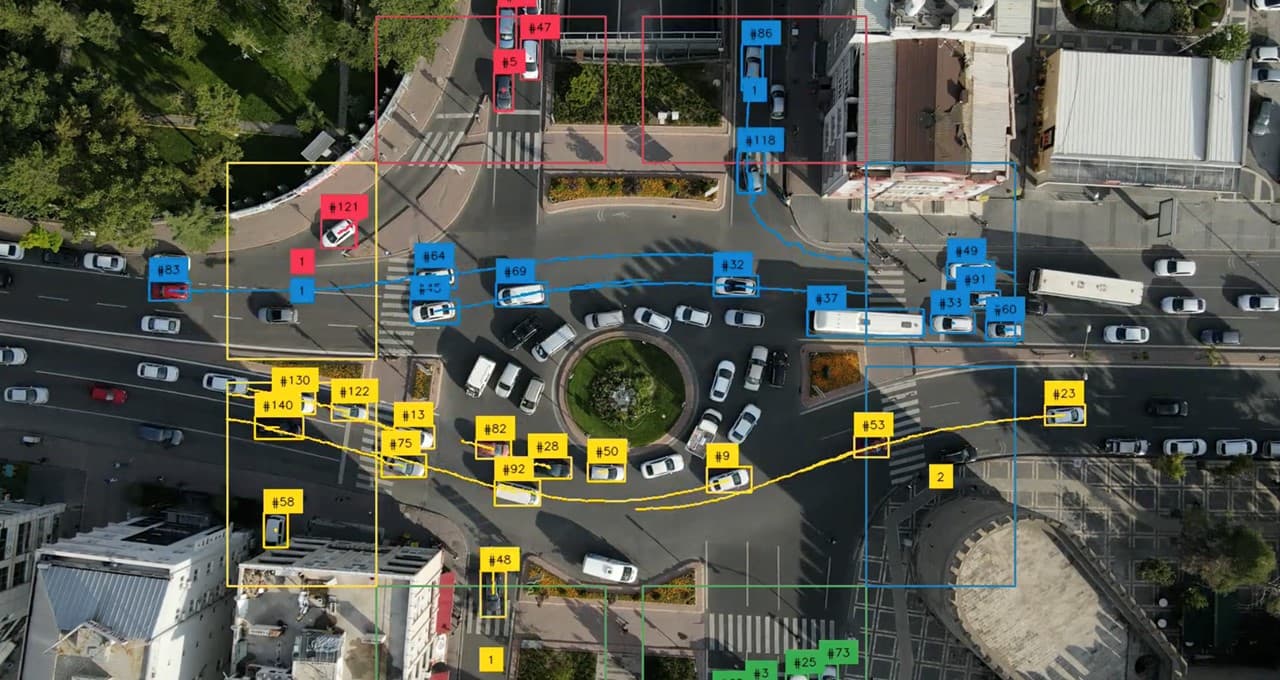
Roboflow's RF-DETR (Detection Transformer) model is now compatible with Apple's MLX machine learning framework, according to an announcement highlighted by developer Prince Canuma. This port enables developers to run real-time instance segmentation directly on Apple Silicon devices (M-series chips), bypassing the need for cloud inference or external GPUs.
The integration specifically brings RF-DETR—a real-time optimized variant of the DETR architecture—to the MLX ecosystem, which is Apple's array framework for machine learning on its silicon. This move represents a significant step in making advanced computer vision capabilities accessible for on-device applications, from robotics to real-time monitoring.
What's New: On-Device Instance Segmentation with MLX
The core development is the availability of RF-DETR within the MLX framework. Previously, running models like RF-DETR on Apple hardware required conversion through intermediate frameworks or reliance on cloud APIs. The native MLX implementation means the model can now leverage Apple's Neural Engine and unified memory architecture directly, promising lower latency and greater privacy for vision applications.
The announcement mentions two primary use cases enabled by this port:
Real-time instance segmentation on-device: The model can identify and delineate individual objects in a video stream running entirely on an Apple Silicon Mac or iPad. The tweet specifically references the "Reachy Mini" robot as a potential application, suggesting use in robotic perception and manipulation tasks where low-latency, local processing is critical.
Augmented Vision-Language Models (VLMs): The RF-DETR model can act as a preprocessing step for larger vision-language models. By first using RF-DETR to identify and crop "areas of interest" in an image or video frame, developers can then feed only those relevant regions to a VLM or Vision-Language-Action (VLA) model. This technique can reduce computational load and improve the focus and accuracy of subsequent language-based analysis.
Technical Details and Availability
The model is part of the broader mlx-vlm project, which aims to provide vision-language models for the MLX ecosystem. According to the announcement, a new release of mlx-vlm featuring this integration is "coming soon." However, developers eager to experiment immediately can install mlx-vlm from source to access the current implementation.
This follows a pattern of the MLX community rapidly integrating state-of-the-art models from the broader AI ecosystem. RF-DETR itself is known for its strong balance of accuracy and speed, making it a suitable candidate for real-time, on-device deployment. Running it on MLX eliminates Python-to-C++ bridging overhead and allows it to run as a native Metal-accelerated application.
What This Means for Developers
For AI engineers and researchers building applications for Apple platforms, this port removes a significant barrier. Developing real-time computer vision features no longer necessitates a cloud backend or a complex model conversion pipeline. A developer can now prototype a robotics perception system or a real-time video analysis tool entirely on a MacBook Pro with an M-series chip.
The augmented VLM use case is particularly noteworthy for those working with multimodal AI. The workflow of using a fast, specialized model (RF-DETR) to guide a larger, more general model (a VLM) is an efficient pattern for complex visual reasoning tasks. Having both components runnable natively on the same MLX stack simplifies architecture and deployment.
gentic.news Analysis
This development is a logical next step in the maturation of Apple's MLX framework and reflects two converging trends we've been tracking. First, Apple's push to establish MLX as a viable, performance-competitive framework for AI research and deployment on its hardware continues to gain momentum. As we covered in our analysis of the MLX 1.0 release, the framework's ease of use and performance profile are attracting model ports from across the community. The integration of a production-ready model like RF-DETR from Roboflow—a major player in the computer vision tools space—validates MLX's growing relevance beyond academic prototypes.
Second, this aligns with the broader industry trend of shifting inference from the cloud to the edge, driven by latency, cost, and privacy concerns. Roboflow's decision to support MLX is a strategic move to position its models at this new on-device frontier. It also creates a fascinating competitive dynamic. While companies like Google have been pushing on-device AI with Gemini Nano, Apple's approach with MLX and its custom silicon offers a uniquely integrated hardware/software stack for developers. The mention of robotics (Reachy Mini) as a use case directly intersects with another trend we monitor: the increasing use of foundation model-like capabilities in embodied AI systems.
Looking at the entity relationships, Roboflow's partnership with the MLX community (an open-source project heavily influenced by Apple researchers) is a savvy bridge-building exercise. It gives Roboflow access to the lucrative Apple developer ecosystem while giving MLX a high-quality, practical model to showcase. For practitioners, the key takeaway is that the toolchain for building sophisticated, on-device AI applications on Apple hardware is rapidly falling into place, reducing dependency on cloud providers for core vision tasks.
Frequently Asked Questions
What is RF-DETR?
RF-DETR is a real-time object detection and instance segmentation model developed by Roboflow. It is based on the DETR (Detection Transformer) architecture but is optimized for faster inference speeds, making it suitable for applications like video analysis and robotics that require processing multiple frames per second.
What is Apple MLX?
MLX is a machine learning framework array developed by Apple's machine learning research team. It is designed specifically for Apple Silicon chips (M1, M2, M3, etc.), allowing models to run efficiently on the CPU, GPU, and Neural Engine. It provides a NumPy-like API and is aimed at making it easier for researchers and developers to train and run models on Apple hardware.
How do I run RF-DETR on MLX?
According to the announcement, RF-DETR is part of the mlx-vlm project. A new release with this integration is forthcoming. In the meantime, developers can install mlx-vlm from its source repository (likely on GitHub) to access and experiment with the current implementation. This typically involves cloning the repo and following its build instructions.
What are the benefits of on-device instance segmentation?
Running instance segmentation on-device (like on a Mac or iPad) offers several key benefits: Lower Latency: No network round-trip to a cloud server, enabling truly real-time interaction. Data Privacy: Sensitive image or video data never leaves the device. Cost Reduction: Eliminates cloud inference costs and bandwidth usage. Offline Operation: The application remains functional without an internet connection.
Can this be used for iOS or iPadOS apps?
While MLX itself is primarily a framework for macOS (and Linux), models optimized in MLX can be a stepping stone to deployment on iOS/iPadOS via Core ML, Apple's framework for integrating models into mobile apps. The work done to optimize RF-DETR for Apple Silicon via MLX could simplify a subsequent conversion to Core ML for mobile deployment.