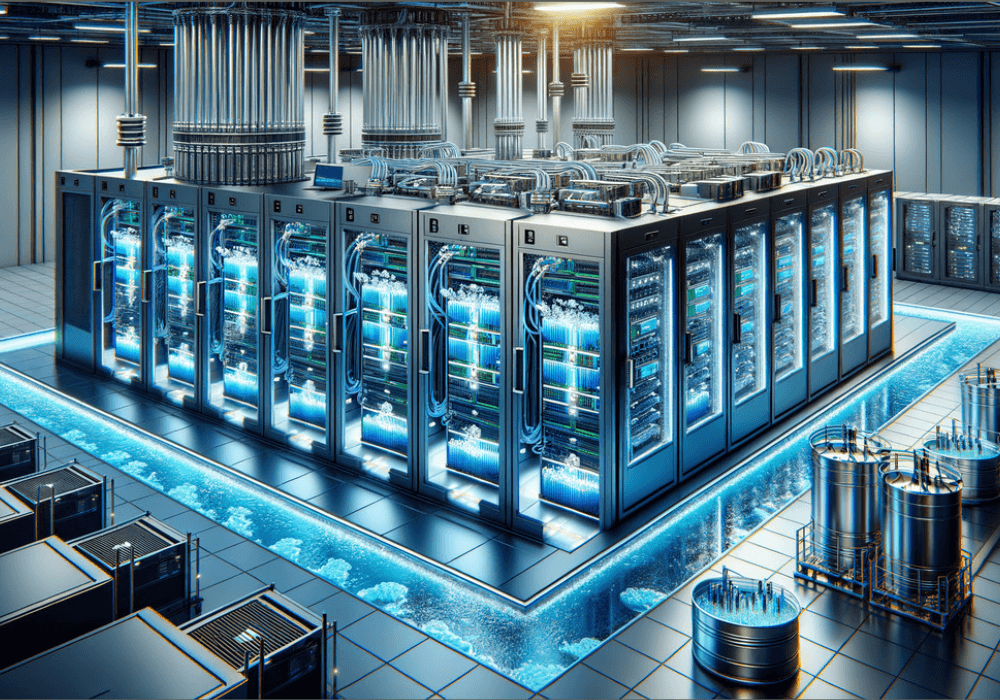
S-Oil and GST partnered on an immersion cooling system for AI data centers. The system targets a Power Usage Effectiveness (PUE) below 1.1.
Key facts
- PUE target below 1.1, 40% better than air cooling.
- Water consumption reduced by 90% versus evaporative cooling.
- First deployment planned for 2026 in Korea.
- Supports rack densities up to 100 kW per rack.
- South Korean AI cooling market estimated at $1.2B by 2028.
S-Oil, a South Korean refiner, and GST, a cooling technology firm, announced a partnership to develop and deploy immersion cooling systems aimed at AI data centers. [According to Data Center Dynamics] The collaboration targets a Power Usage Effectiveness (PUE) below 1.1, representing a 40% improvement over typical air-cooled facilities that average 1.4–1.6 PUE.
The system uses a dielectric fluid — developed by S-Oil from its refining byproducts — to directly cool server components. The partnership claims the approach reduces water consumption by 90% versus traditional evaporative cooling, a critical factor as AI data center water usage draws regulatory scrutiny.
Why this matters more than the press release suggests
The deal is notable because it brings a major oil refiner into the AI infrastructure supply chain. S-Oil's core business — petroleum refining — faces long-term demand decline. Immersion cooling fluids represent a diversification play into a high-growth market. The Korean government estimates the domestic AI data center cooling market will reach $1.2 billion by 2028, per the Korea Institute for Industrial Economics & Trade.
Technical specifics
The dielectric fluid is a synthetic hydrocarbon blend with a flash point above 250°C, meeting ASHRAE Class A1 safety standards. GST will supply the tank and circulation hardware. The system supports rack densities up to 100 kW per rack, versus 20–40 kW for air cooling. First deployment is planned for 2026 at a Korean facility, with financial terms undisclosed.
Competitive landscape
The move puts S-Oil and GST in competition with established immersion cooling vendors like GRC (Green Revolution Cooling), Submer, and LiquidStack. Major AI operators — including Microsoft, Google, and Meta — have tested immersion cooling but have not widely deployed it due to retrofitting costs and maintenance complexity. S-Oil's fluid chemistry and GST's hardware integration aim to undercut current per-rack costs by 30%, though the companies did not provide specific pricing.
Key Takeaways
- S-Oil and GST partner on immersion cooling for AI data centers, targeting 1.1 PUE and 90% water reduction.
- First deployment 2026 in Korea.
What to watch

Watch for the 2026 deployment milestone and whether S-Oil can secure additional customers beyond the initial Korean facility. The key metric is per-rack cost versus GRC and Submer. Also track regulatory developments in Korea on AI data center water usage, which could accelerate adoption.