The Innovation
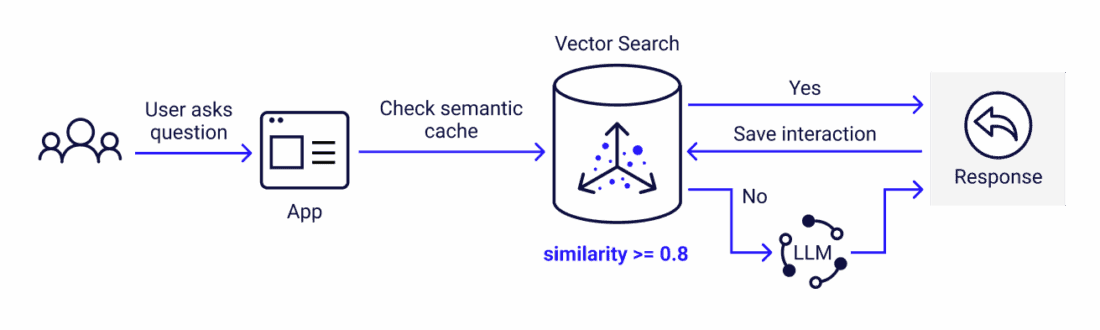
Semantic caching is a novel optimization technique designed specifically for applications powered by Large Language Models (LLMs). Unlike traditional caches that store and retrieve data based on exact keyword matches, a semantic cache stores the meaning of a user's query using vector embeddings. When a new query arrives, the system calculates its embedding and searches the cache for previously answered queries that are semantically similar (e.g., "Show me black evening gowns" and "I need a dark dress for a gala"). If a sufficiently similar cached response is found, it is returned instantly, bypassing the need for a costly and slower call to the LLM API (like OpenAI's GPT or Anthropic's Claude).
The research paper "From Exact Hits to Close Enough: Semantic Caching for LLM Embeddings" explores the core challenge: determining the optimal policy for managing this cache. The authors prove that finding a perfect, optimal offline policy is an NP-hard problem. In response, they develop practical, polynomial-time heuristic policies for real-world systems. These policies combine classic caching strategies (like recency and frequency of use) with a novel understanding of semantic locality. Their evaluations across diverse datasets show that while frequency-based policies are strong baselines, their enhanced semantic-aware variants improve cache accuracy—meaning they more reliably identify when a cached answer is truly a valid substitute for a new query.
Why This Matters for Retail & Luxury
The direct application is to any customer-facing AI interface where speed and cost are barriers to scale. For luxury retail, this translates to several high-value scenarios:
- AI-Powered Personal Shopping Assistants: A conversational AI on your website or app that answers detailed product questions, provides styling advice, and handles complex requests. Without caching, each unique conversational turn incurs an LLM API cost, making 24/7 service prohibitively expensive.
- Enhanced Semantic Search: Moving beyond keyword search to understand customer intent (e.g., "a bag for a weekend in Capri" should surface totes, crossbodies, and vacation-ready styles). Processing every nuanced search query through an LLM is costly; semantic caching reuses results for similar intents.
- Automated Clienteling & CRM: AI that drafts personalized outreach emails or summarizes client notes based on natural language prompts from sales associates. Caching ensures common requests from associates across different boutiques are served instantly and cheaply.
- Content Generation at Scale: Automatically generating product descriptions, marketing copy, or social media posts with brand-specific tone. Caching can store and reuse high-quality outputs for similar product categories or campaign themes.
The core benefit is economic: it transforms powerful LLMs from a premium, sparingly-used tool into a viable backbone for mass, real-time customer interaction.
Business Impact & Expected Uplift
The impact is measured in hard cost savings and performance gains.
- Cost Reduction: The primary financial benefit is a direct reduction in LLM API consumption costs. Industry benchmarks from early adopters in tech (like startups using libraries like
gpt-cache) suggest reductions of 20-40% in token usage for conversational applications. For a brand spending $50,000 monthly on LLM APIs for customer service, this equates to $10,000-$20,000 in monthly savings. - Latency Improvement: Response times can drop from seconds to milliseconds for cache hits, dramatically improving user experience. This is critical for maintaining the premium, seamless feel expected in luxury digital interactions.
- Scalability: The cost savings directly enable scaling AI features to more users, more markets, and more use cases without exponential cost increases.
- Time to Value: Once implemented, savings and performance gains are immediate and compound with usage. The cache becomes more valuable as it learns common queries.
Implementation Approach
- Technical Requirements: You need an existing application that calls an LLM API (e.g., using OpenAI, Azure OpenAI, or Anthropic). The core requirement is a vector database (like Pinecone, Weaviate, or Qdrant) to store and query the embeddings of past queries and their corresponding LLM responses. Your engineering team must be comfortable working with embeddings and similarity search (cosine similarity).
- Complexity Level: Medium. This is not a plug-and-play SaaS product but a system to be built into your AI application logic. It requires custom development to integrate the caching layer, define similarity thresholds, and implement eviction policies (e.g., the heuristics from the research).
- Integration Points: The semantic cache acts as a middleware layer between your application and the LLM provider. It intercepts outgoing queries, checks the vector database cache, and either returns a cached response or forwards the query to the LLM, storing the new pair. It must integrate with your application's backend and your chosen vector database.
- Estimated Effort: For a skilled AI/ML engineering team, a robust proof-of-concept can be built in 4-8 weeks. Reaching a production-grade, monitored system integrated into a core customer journey (like search or chat) would likely take 2-3 quarters, depending on existing infrastructure.
Governance & Risk Assessment
- Data Privacy & Consent: Queries and responses stored in the cache may contain personal data (PII) or customer preferences. This cache is subject to GDPR and other data protection regulations. You must ensure cached data is encrypted, access-controlled, and part of a data retention and deletion policy. If your LLM use case requires explicit customer consent, the caching of their interactions should be covered under the same consent mechanism.
- Model Bias & Accuracy Risk: The major risk is a "false hit"—where the cache returns a response that is semantically similar but contextually incorrect or outdated. For example, a cached response about "last season's collection" might be returned for a query about new arrivals. Rigorous testing of similarity thresholds and cache invalidation strategies (especially for time-sensitive data like inventory or pricing) is crucial to maintain brand integrity and accuracy.
- Maturity Level: Prototype / Early Production. The underlying concept is proven in computer science, and open-source libraries exist. However, the specific policies for optimal management in a luxury retail context—with its unique, high-stakes language around style, exclusivity, and product—require careful tuning and validation. The referenced research paper provides advanced heuristics but is itself an academic preprint, indicating the field is still evolving.
- Strategic Recommendation: Luxury brands currently experimenting with or planning LLM-powered features should architect with semantic caching in mind from the start. Begin with a pilot in a lower-risk, internal-facing use case (e.g., assisting copywriters with product descriptions) to tune the system. The technology is not yet a commoditized "buy" solution but a strategic "build" competency that can create a significant long-term cost and performance advantage for customer experience AI.