The Innovation
MAGE (Meta-Reinforcement Learning for Language Agents toward Strategic Exploration and Exploitation) represents a significant advancement in creating adaptive AI agents for dynamic environments. Developed by researchers and published on arXiv, this framework addresses a critical limitation of current Large Language Model (LLM) agents: their inability to internalize adaptive learning capabilities in non-stationary environments with feedback.
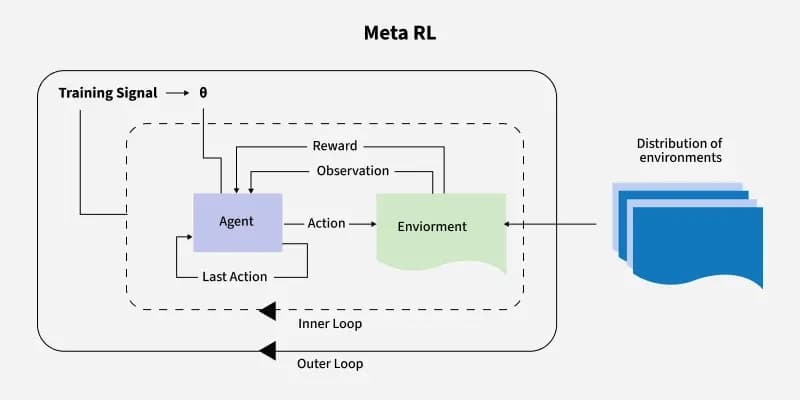
Traditional LLM agents rely on In-Context Learning and external memory, which provide some flexibility but fail to develop true adaptive intelligence. MAGE employs Meta-Reinforcement Learning (meta-RL) to embed the learning process directly within the model itself. The framework uses a multi-episode training regime where interaction histories and reflections are integrated into the context window, with the final episode reward serving as the optimization objective.
The technical approach combines population-based training with agent-specific advantage normalization to enrich agent diversity and ensure stable learning. This enables agents to refine their strategies based on past experiences rather than simply recalling them. Crucially, MAGE balances both exploration (trying new approaches) and exploitation (leveraging known successful strategies), which is essential for multi-agent environments where competitors are also adapting.
Experimental results demonstrate that MAGE outperforms existing baselines in both exploration and exploitation tasks and exhibits strong generalization to unseen opponents. This suggests the framework successfully internalizes strategic thinking capabilities rather than merely memorizing patterns.
Why This Matters for Retail & Luxury
Retail and luxury environments are inherently dynamic, multi-agent systems where success requires continuous adaptation. MAGE's capabilities translate directly to several critical business functions:
Dynamic Pricing & Promotion Optimization: In competitive markets where multiple brands adjust prices simultaneously, MAGE-powered agents can learn optimal pricing strategies that balance short-term revenue (exploitation) with long-term market positioning (exploration). This is particularly valuable for luxury brands managing price integrity while responding to market fluctuations.
Inventory Management & Allocation: For retailers with multiple channels (flagship stores, boutiques, e-commerce, wholesale), MAGE agents can optimize stock allocation by learning from sales patterns, competitor actions, and seasonal trends across different regions and customer segments.
Personalized Marketing & Clienteling: In client relationship management, agents can adapt communication strategies based on customer responses, learning which approaches work best for different client segments while exploring new engagement tactics.
Competitive Intelligence Systems: MAGE enables agents that continuously monitor competitor actions (product launches, marketing campaigns, pricing changes) and adapt strategic responses, creating a more sophisticated alternative to rule-based competitive monitoring systems.
Business Impact & Expected Uplift
While the research paper doesn't provide specific retail metrics, industry benchmarks for similar adaptive systems suggest significant potential impact:

Dynamic Pricing Optimization: According to McKinsey research, companies implementing advanced pricing optimization typically achieve 2-5% revenue uplift and 5-10% margin improvement. MAGE's strategic exploration/exploitation balance could push these toward the higher end by better navigating competitive responses.
Inventory Optimization: Boston Consulting Group reports that AI-driven inventory optimization typically reduces stockouts by 20-30% and excess inventory by 15-25%. MAGE's ability to adapt to changing demand patterns and competitor actions could improve these figures by 5-10 percentage points.
Marketing Personalization: Gartner indicates that advanced personalization engines typically increase conversion rates by 10-15% and average order value by 5-10%. MAGE's adaptive learning could enhance these by better navigating the exploration/exploitation trade-off in customer engagement.
Time to Value: Initial implementation would likely show measurable improvements within 2-3 months of deployment, with optimization continuing over 6-12 months as the agent accumulates more environmental experience.
Implementation Approach
Technical Requirements:
- Base LLM (GPT-4, Claude 3, or open-source alternatives like Llama 3)
- Reinforcement learning infrastructure (Python, PyTorch/TensorFlow, RL libraries)
- Historical interaction data (pricing decisions, inventory movements, marketing responses)
- Real-time feedback mechanisms (sales data, competitor monitoring feeds, customer response tracking)
Complexity Level: High (research-to-production). While the code is available on GitHub, implementing MAGE requires significant ML engineering expertise, particularly in reinforcement learning and LLM fine-tuning.
Integration Points:
- Pricing engines and revenue management systems
- Inventory management and allocation platforms
- CRM and marketing automation systems
- Competitive intelligence dashboards
- E-commerce platforms for real-time adaptation
Estimated Effort: 3-6 months for a minimum viable implementation with a dedicated team of 3-5 ML engineers and data scientists. Full production deployment across multiple business functions would require 9-12 months.
Governance & Risk Assessment
Data Privacy Considerations: MAGE requires extensive historical interaction data, which may include customer purchase histories, pricing decisions, and competitive responses. GDPR compliance necessitates careful anonymization and aggregation of personally identifiable information. Customer consent for data usage in adaptive systems should be explicitly obtained where required.

Model Bias Risks: In retail applications, bias could manifest in several ways:
- Pricing algorithms that inadvertently discriminate against certain customer segments
- Inventory allocation that favors high-value regions at the expense of emerging markets
- Marketing personalization that reinforces existing customer stereotypes rather than exploring new engagement opportunities
Regular bias audits and fairness testing are essential, particularly for luxury brands where brand equity depends on perceived fairness and inclusivity.
Maturity Level: Research/Prototype. While the paper demonstrates strong experimental results, MAGE hasn't been deployed at scale in production retail environments. The framework represents cutting-edge research rather than a turnkey solution.
Honest Assessment: This technology is promising but experimental for immediate retail deployment. Luxury companies with advanced AI capabilities (LVMH's AI Lab, Kering's digital initiatives) could consider pilot programs in controlled environments (test markets, specific product categories). Most retailers should monitor developments and consider implementation in 12-18 months as the technology matures and best practices emerge.
The strategic exploration/exploitation balance makes MAGE particularly valuable for luxury brands navigating the tension between exclusivity and accessibility, tradition and innovation. However, the high implementation complexity means this is currently a competitive advantage opportunity for early adopters with substantial technical resources.