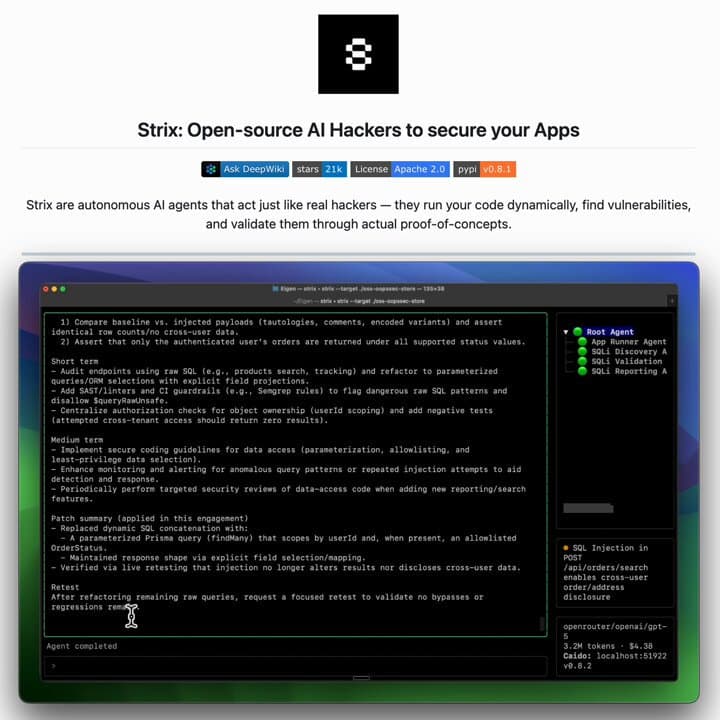
A new open-source security tool called Strix is targeting a critical blind spot in modern, AI-accelerated software development: the inability to detect business logic vulnerabilities and abuse paths that traditional testing and code reviews consistently miss.
The tool emerges in response to a growing pattern of security incidents linked to applications built with AI assistance—where code functions correctly but exposes dangerous attack surfaces. Examples highlighted include Moltbook exposing 1.5 million authentication tokens, Tea App leaking 72,000 government IDs from an open database, and a researcher taking control of a journalist's computer through a vulnerability in a "vibe-coded" game.
"The code ran fine in all three cases, tests passed, reviews looked clean, and nothing raised a flag," notes security researcher Akshay Pachaar. "That's the problem nobody is talking about."
The core issue is that the development bottleneck has shifted. AI can generate functional code rapidly, CI/CD pipelines catch build failures, and unit tests catch regressions. However, these processes do not answer the fundamental security question: What can an attacker do with this application, right now?
Traditional security tools and practices are ill-equipped for this new reality. PR reviews often miss authentication edge cases, unit tests don't probe for broken access control, staging environments don't simulate adversarial behavior, and business logic flaws appear perfectly functional until exploited.
What Strix Does
Strix approaches application security from an attacker's perspective. Instead of static code analysis or dependency scanning, it interacts with a running application dynamically. Its methodology involves:
- Crawling and Mapping: It automatically crawls the application to discover every exposed route, endpoint, and user flow, building a complete map of the attack surface.
- Dynamic Probing for Abuse Paths: It actively probes these discovered paths for potential abuse scenarios and business logic vulnerabilities (e.g., privilege escalation, IDOR, mass assignment) that would never trigger a unit test failure.
- Actionable Findings: It returns verified findings complete with proof-of-concept exploits and concrete suggestions for fixes, moving beyond theoretical warnings.
Benchmark Results and Design Philosophy
In benchmark testing against 200 real companies and open-source repositories, Strix discovered over 600 verified vulnerabilities, including issues that received assigned CVEs. This demonstrates its efficacy in finding real, exploitable flaws that slip through conventional devsecops pipelines.
The tool is designed for integration into modern development workflows. Teams can run Strix as a step in their CI/CD pipeline before a release, after major feature changes, or even continuously in a monitoring role as the application evolves.
Its value proposition is clearest for teams heavily utilizing AI code generation. If a team is shipping code faster than ever but lacks a systematic way to answer "what does this actually expose?" Strix aims to fill that critical security gap.
gentic.news Analysis
The launch of Strix highlights a fundamental and growing tension in the AI-powered software development era. We have optimized the production of code to an extraordinary degree, but the understanding of that code's runtime behavior and security implications has not kept pace. Tools like GitHub Copilot and ChatGPT can generate syntactically correct and functionally adequate code at high velocity, but they have no inherent model of security semantics, attacker mindset, or business logic consequences. This creates a dangerous asymmetry: development speed increases exponentially, while security assessment remains a slow, manual, and often incomplete process.
Strix's dynamic, runtime-focused approach is a necessary evolution from traditional SAST (Static Application Security Testing) and DAST (Dynamic Application Security Testing). While SAST looks at code without executing it and DAST often uses generic attack payloads, Strix's method of mapping application flows and then probing them for logic flaws is more akin to automated penetration testing. It's targeting the layer of vulnerabilities that exist not in the syntax or libraries, but in the interaction between features—precisely where AI-generated code, written without a holistic understanding of the system, is most likely to introduce flaws.
For engineering leaders, the implication is clear: incorporating AI into your development workflow necessitates a commensurate upgrade to your security tooling. Relying solely on pre-AI era security gates is inadequate. Tools like Strix represent the beginning of a new category of security automation designed not to check code for known bugs, but to reason about the novel attack surfaces created by the assembly of AI-generated components. The benchmark of 600+ findings across 200 codebases suggests this gap is not theoretical; it's widespread and currently unaddressed.
Frequently Asked Questions
What kind of vulnerabilities does Strix find that traditional tools miss?
Strix specializes in finding business logic vulnerabilities and abuse paths. These are flaws where the code works exactly as programmed, but the logic can be exploited. Examples include: exploiting a "forgot password" flow to enumerate valid user emails, manipulating API parameters to access another user's data (IDOR), or chaining low-privilege actions to achieve a high-privilege outcome. Traditional SAST tools look for code patterns linked to known vulnerability classes (like SQLi), and DAST tools often use generic payloads. Strix dynamically explores the unique flows of your application to find logic errors specific to your implementation.
How does Strix differ from a normal DAST scanner?
While both are dynamic tools, a typical DAST scanner is often a "black-box" tester that fires a predefined set of attack payloads (e.g., SQL injection strings, XSS payloads) at a list of URLs. Strix operates more intelligently: it first crawls and learns your application's unique structure—all user roles, states, and workflows. It then reasons about how those flows could be abused, probing for logic flaws rather than just injecting generic malicious strings. It's building a model of your app's behavior and then testing that model for security flaws.
Can Strix be integrated into a CI/CD pipeline for AI-generated code?
Yes, this is a primary design goal. Strix is built to run against a deployed instance of your application (e.g., a staging or preview environment). It can be triggered automatically after a deployment in your CI/CD pipeline, providing a security report before promoting a build to production. This creates a critical safety net for teams using AI coding assistants, allowing them to "ship fast" while still answering the essential security question of what new capabilities or data each release exposes.
Is Strix only useful for applications built with AI?
No. Strix is valuable for any modern application, especially those with complex user interactions and business logic. However, its value proposition is amplified in environments using AI code generation. AI accelerates the introduction of new code and features, which in turn rapidly expands the attack surface. Manual security review becomes a bottleneck. Strix automates the discovery of logic flaws in this new, evolving code, making it a particularly strategic tool for teams embracing AI-assisted development.