Academic and author Ethan Mollick has highlighted a potentially major shift in the demographics of AI adoption. Citing an unspecified new study, Mollick noted on social media that the long-observed gender gap in AI use—where men consistently reported higher usage rates than women—appears to have undergone a "very significant change."
Key Takeaways
- Academic Ethan Mollick highlights a new study indicating a potential closure of the gender gap in AI use, a persistent concern in prior research.
- The source of the data is currently unclear.
What Happened

Mollick, a professor at the Wharton School who studies the impact of AI on work and education, pointed to data suggesting the persistent gender gap in AI usage may have closed. He explicitly stated a wish for more information on the data's provenance, indicating the finding comes from a source he has seen but cannot yet publicly verify or detail.
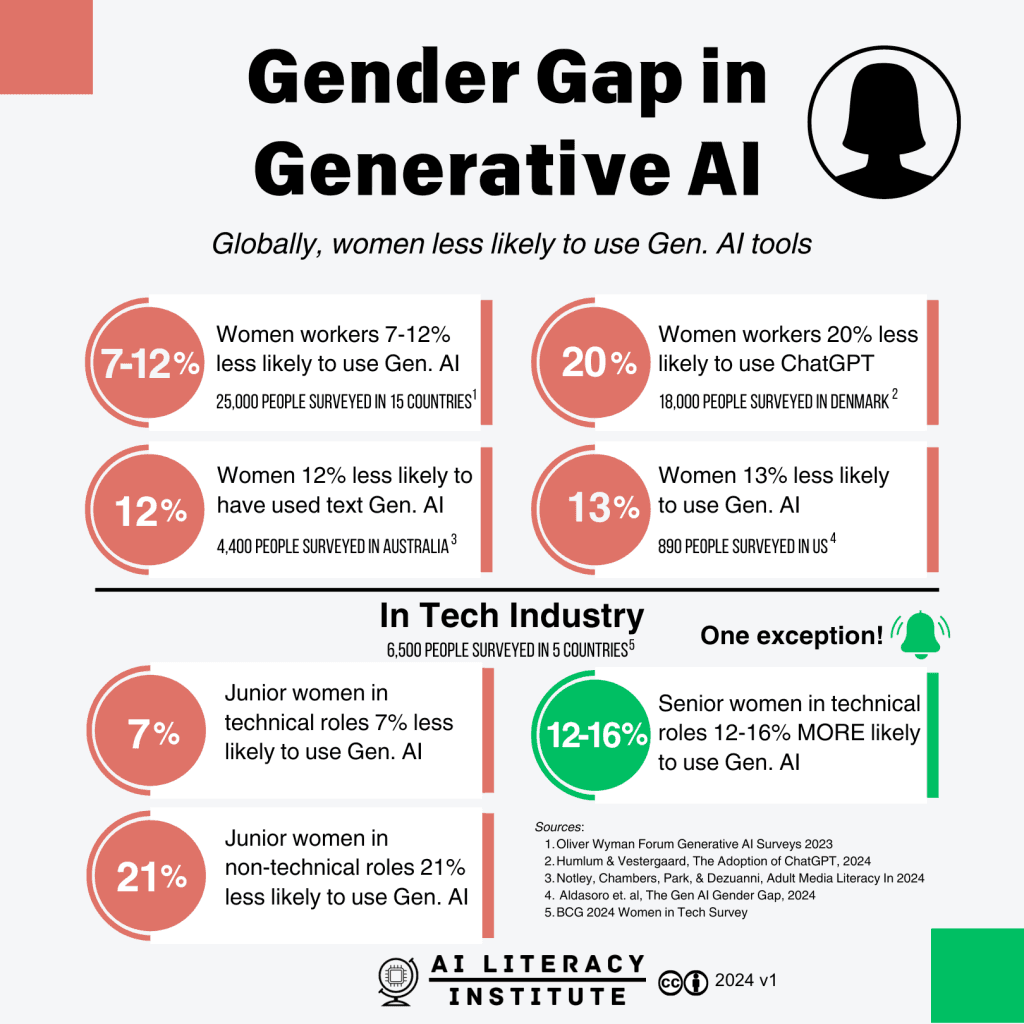
The core claim is striking because it contradicts a well-established pattern. As Mollick noted, "Since AI use comes from experience, the persistent gender gap in AI use across every study of AI was something that a lot of scholars were concerned about." Previous research, including Mollick's own work with colleagues, had consistently shown men were more likely to be early and frequent users of generative AI tools like ChatGPT in both educational and professional settings.
Context
The gender gap in technology adoption is not a new phenomenon, but its manifestation in generative AI has been a particular focus since the launch of ChatGPT in late 2022. Early surveys in 2023 and 2024 repeatedly found that men were significantly more likely to have used AI tools. Scholars hypothesized reasons ranging from differential exposure in tech-adjacent fields and confidence gaps to the marketing and framing of AI as a tool for coding and technical tasks.
If this new, uncited data is accurate, it would represent one of the fastest closings of a technology adoption gap observed. It could signal that generative AI tools have reached a utility and accessibility threshold that transcends earlier demographic divides, possibly driven by integration into commonplace applications like office suites, search engines, and social media platforms.
The Need for Verification

The major caveat, which Mollick himself raised, is the current lack of information about the study's methodology, sample size, geographic focus, and publisher. Without this, it is impossible to assess the finding's robustness. Key questions include:
- Is the gap closed globally, or in specific regions (e.g., the US, Europe)?
- Does it apply across all age groups and professions?
- Is the change driven by increased female adoption, decreased male adoption, or both?
- How is "AI use" defined—daily active use, weekly experimentation, or simple familiarity?
Until the underlying data is released, this remains a notable but unverified claim from a credible observer in the field.
gentic.news Analysis
This potential shift, if validated, would be a critical datapoint in understanding AI's societal integration. For over two years, the narrative has been one of uneven adoption risking the amplification of existing inequalities. A closure of the gender gap would fundamentally alter that risk assessment and the policy prescriptions that flow from it.
This development would align with the broader trend of generative AI moving from a novelty for tech enthusiasts to a utility for a general audience. As we covered in our analysis of Microsoft Copilot's integration into Windows (October 2025), the bundling of AI into ubiquitous software is a primary driver of democratized access. When a tool is one keystroke away in an operating system used by hundreds of millions, barriers to trial plummet. Similarly, the consumer-focused launches from companies like Apple with Apple Intelligence (June 2024) and Google's Gemini in Search are explicitly designed for mass, non-technical adoption.
The contradiction here is with the body of academic work published just last year. A 2025 Pew Research Center report we cited in March 2025 found that men in the US were nearly twice as likely as women to have used ChatGPT for work tasks. The reversal suggested by Mollick's source would therefore be remarkably swift, pointing to a possible inflection point in late 2025 or early 2026. The onus is now on the research community to publish replicable data to confirm or refute this trend. The implications for workforce training, product design, and equity audits are too significant to rely on a single, unspecified source.
Frequently Asked Questions
What was the previous gender gap in AI use?
Prior studies throughout 2023-2025 consistently showed men were more likely to use generative AI. For example, a Pew Research study in early 2025 found 31% of employed US men had used ChatGPT for work, compared to 17% of employed women—a gap of 14 percentage points.
Why would the AI gender gap close?
Potential reasons include the deep integration of AI into commonly used software (like Microsoft Office and Google Workspace), reduced "techy" branding of the tools, targeted educational outreach, and a growing recognition of AI's utility for tasks traditionally associated with diverse roles, from writing and scheduling to data analysis.
Is this gender gap claim confirmed?
No. As Ethan Mollick stated, the source of the new data is currently unclear. The claim is an observation from a respected researcher based on unseen data, not a peer-reviewed, published finding. It should be treated as a potentially significant signal requiring verification.
What should businesses take from this?
If the trend is real, it undermines the assumption that AI upskilling initiatives need to be disproportionately targeted toward women due to lower adoption. The focus may shift more squarely to skill-based training across all demographics, while continuing to monitor for new or shifting gaps in effective use and outcomes.