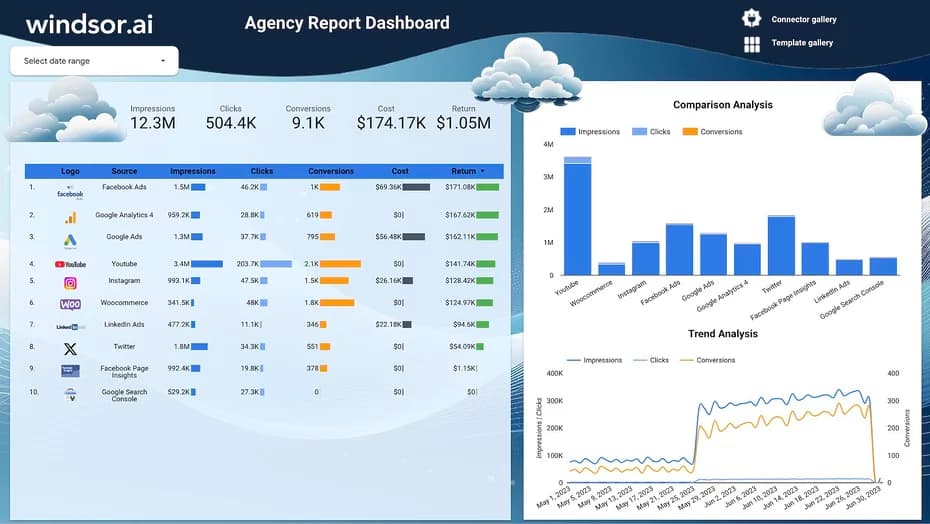
An AI product called SureThing 2.0 has been announced, claiming to be the "world's first General AI Agency." Unlike typical AI chatbots or coding terminals, it presents itself through a graphical user interface (GUI) with live memory and is described as containing "a full team inside."
The core claim is that it functions as a proactive, autonomous employee for business operations. The stated workflow is simple: a user pastes a link, and with one click, the AI agency activates, taking over tasks via its dedicated dashboard.
What Happened
The announcement was made via a social media post, framing SureThing 2.0 as a breakthrough for moving beyond conversational or command-line AI assistants. The product is positioned not as a tool you query, but as an agent you deploy. The emphasis is on autonomy and a persistent, visual working environment—a "dashboard"—implying ongoing management and execution of business processes.
Context
The launch taps directly into the rapidly evolving trend of AI agents. Over the last year, the industry has shifted from building conversational LLMs (like ChatGPT) toward creating systems that can perform multi-step tasks autonomously. Companies like Cognition Labs (with its Devin AI) and MultiOn have pushed the concept of AI that can operate software and complete workflows. SureThing 2.0 appears to be a new entrant claiming a broader, business-general scope and a distinctive GUI-first approach.
Key claimed differentiators:
- GUI & Dashboard: Operates through a visual interface with "live memory," suggesting state persistence across sessions.
- Proactivity: Described as a "proactive working employee," hinting at goal-oriented behavior beyond simple task execution.
- Link-to-Action: The one-click activation from a pasted link suggests deep integration with web-based tools and services.
What We Don't Know Yet
The announcement lacks critical technical and commercial details. No benchmarks, specific capabilities, pricing, or availability date were provided. The terms "General AI Agency" and "full team inside" are evocative but undefined. It is unclear what business functions it can perform (e.g., marketing, sales, operations, coding) or what its limits are.
gentic.news Analysis
This announcement is a direct shot across the bow of the current AI agent landscape. While companies like Cognition Labs have focused on highly capable, single-agent systems for specific domains like coding (Devin), and others like Adept and MultiOn are building agent frameworks for web interaction, SureThing 2.0 is making a bold claim of generality and business-ready packaging. The emphasis on a GUI dashboard is significant; it suggests a product designed for business managers, not just developers or tech-savvy users, potentially lowering the barrier to entry for AI automation.
However, the claim of a "General AI Agency" sets a tremendously high bar. True generality in AI—the ability to handle any arbitrary business task—remains an unsolved problem. Current state-of-the-art agents excel within constrained environments or with clear, predefined APIs. The success of SureThing 2.0 will hinge entirely on the depth and robustness of its underlying agentic architecture and its integration network. If it can reliably connect to and orchestrate a wide array of SaaS tools (like Salesforce, HubSpot, QuickBooks, etc.) from its dashboard, it could carve out a unique niche. If it's a thin wrapper over a less capable system, it will join a long list of overhyped launches.
The timing is notable. This follows a surge in venture funding for AI agent startups throughout 2025. Investors are betting heavily on the post-chatbot era of AI, searching for the platform that will deliver tangible business automation. SureThing 2.0 is entering a market where proof of real-world ROI will be the ultimate differentiator.
Frequently Asked Questions
What is SureThing 2.0?
SureThing 2.0 is a newly announced AI product described as a "General AI Agency." It is a system that runs via a graphical dashboard and is designed to autonomously execute business tasks, acting as a proactive digital employee.
How is SureThing 2.0 different from ChatGPT or Claude?
Unlike conversational AI chatbots, SureThing 2.0 is not primarily a chat interface. It is presented as an autonomous agent with a persistent GUI dashboard, designed to take action and manage processes proactively after being given a simple starting command (like a link).
What can SureThing 2.0 actually do?
Based on the initial announcement, specific capabilities are not detailed. The broad claim is that it can "run your entire business" as an AI agency. Its real-world functions will depend on its integrations and the scope of tasks its underlying AI can understand and execute.
When will SureThing 2.0 be available and how much will it cost?
The announcement did not include details on public release date, pricing, or access model (e.g., subscription, enterprise sales). This information is expected to follow in subsequent updates from the developers.