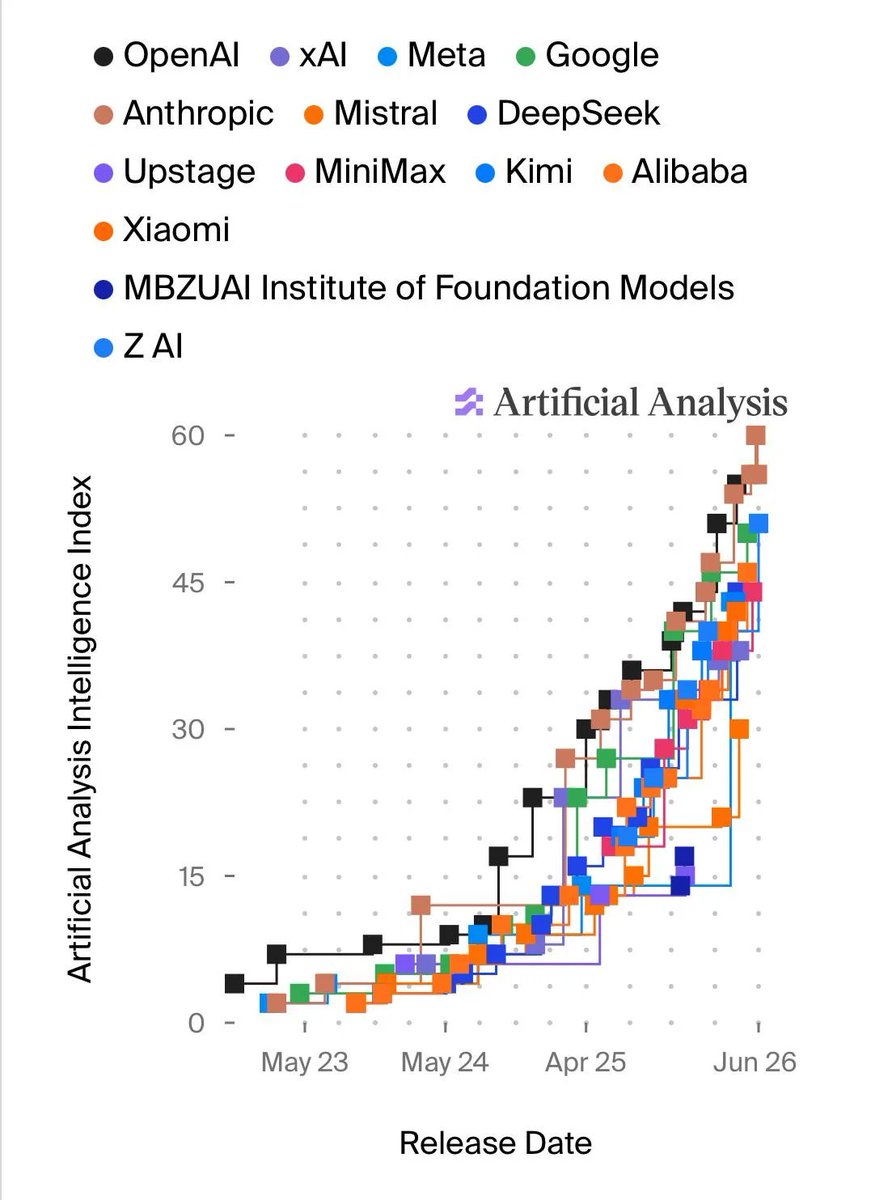
Recent analysis of benchmark performance, particularly surrounding the release of xAI's Grok 4.2 model, indicates a significant shift in the competitive landscape of frontier artificial intelligence. According to observations shared by researcher and professor Ethan Mollick, both Elon Musk's xAI and Meta's AI division appear to be falling behind the current pace set by industry leaders. This development suggests the race for supremacy in large language models (LLMs) and frontier AI is consolidating into a three-way contest, marking a potential inflection point for the industry.
The Benchmark Revelation
The core of this assessment stems from performance data, specifically benchmarks evaluating Grok 4.2. Benchmarks are standardized tests that measure AI capabilities across areas like reasoning, coding, mathematics, and general knowledge. While the specific benchmark suite or detailed scores were not enumerated in the source, the conclusion drawn is clear: Grok 4.2's performance places it outside the top tier currently defining the frontier.
This is a notable setback for xAI, which has positioned itself as a contender aiming to challenge established leaders. Similarly, Meta, despite significant investment and the release of models like Llama 3, is also characterized as not keeping pace with the very front of the pack. The term "falling behind" implies a widening gap, not just a minor lag, in raw capability as measured by these critical performance metrics.
The Emerging Three-Way Frontier
Mollick's statement that "Frontier AI models are really a three way race at this point" is the most significant takeaway. This frames the entire industry dynamic. While he does not name the three entities, the consensus within the AI community typically points to OpenAI (with GPT-4 and its successors), Anthropic (with the Claude 3 model family), and Google DeepMind (with the Gemini series) as the trio currently pushing the absolute boundaries of capability.
This triopoly represents a concentration of talent, computational resources, and algorithmic innovation. The suggestion that xAI and Meta are lagging indicates that the barriers to entry at the very peak of AI performance are becoming extraordinarily high, potentially solidifying the lead of these three organizations.
Implications for the AI Ecosystem
This consolidation has profound implications. First, it affects strategic positioning. For xAI and Meta, being outside the top tier may influence developer adoption, partnership opportunities, and perceived thought leadership. Developers and enterprises seeking the most capable models for cutting-edge applications will likely gravitate toward the leading trio.
Second, it raises questions about competitive diversity. A healthy, innovative ecosystem often benefits from multiple strong competitors. A narrowing frontier could, in theory, reduce the diversity of architectural approaches and safety philosophies being pushed to the limit. However, it could also intensify direct competition among the top three, potentially accelerating progress.
Third, it impacts the narrative and investment landscape. Perceptions of who is leading directly influence capital allocation, talent acquisition, and regulatory attention. Companies seen as falling behind may face increased pressure to demonstrate a viable path to closing the gap, whether through breakthrough research, unique data advantages, or specialized vertical applications.
Context: The Relentless Pace of Progress
This assessment must be viewed within the context of breakneck progress. "Falling behind" is a relative term in a field where state-of-the-art is redefined every few months. Meta's Llama 3 models, for instance, are widely regarded as exceptionally strong open-weight models, dominating that specific segment. xAI's Grok, prior to this benchmark, had been noted for its real-time knowledge integration and distinctive personality.
The critique is specifically about the frontier—the absolute cutting edge of capability where margins of improvement are small but meaningful. Lagging here does not render these models obsolete; they remain immensely powerful tools. However, it does relegate them to a different competitive tier for applications demanding the utmost in reasoning, accuracy, or nuanced understanding.
The Path Forward for xAI and Meta
For xAI, this may represent a challenge to its "move fast" ethos. The company may need to recalibrate expectations or double down on its unique differentiators, such as integration with the X platform's real-time data stream, to carve out a defensible niche rather than competing solely on raw benchmark performance.
For Meta, the strategy has always been broader. Its open-source approach with Llama aims to win through ecosystem ubiquity, developer goodwill, and integration across its vast suite of applications (Facebook, Instagram, WhatsApp). Being slightly off the absolute frontier may be an acceptable trade-off for its goal of widespread, efficient deployment. However, consistently trailing the frontier could eventually undermine the prestige and utility of its open model offerings.
Conclusion: A Defining Moment in AI Competition
The analysis pointing to a three-way race at the frontier signals a maturation phase in the commercial AI industry. The initial period of widespread, chaotic experimentation is giving way to a clearer hierarchy, defined by immense scale and sustained R&D investment. For observers, developers, and policymakers, understanding this hierarchy is crucial for predicting technological diffusion, market dynamics, and where the next breakthroughs might originate.
The race is far from over. Technological discontinuities, novel architectures, or strategic pivots could reshuffle the deck. But for now, the message from the benchmark data is clear: the summit of AI capability is occupied by three front-runners, and the climb for others has become significantly steeper.
Source analysis based on commentary from Ethan Mollick (@emollick) regarding benchmark performance of Grok 4.2 and the competitive state of frontier AI models.