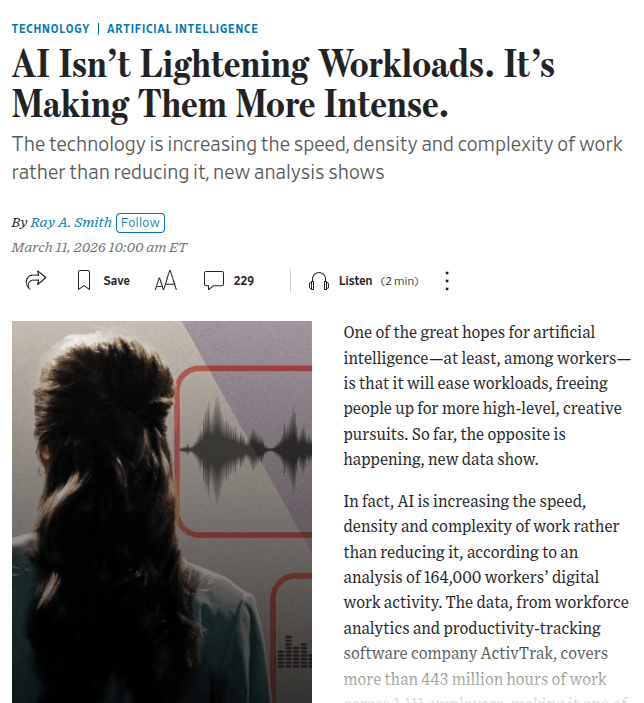
A comprehensive study tracking 164,000 workers has revealed a surprising trend in workplace AI adoption: rather than creating the promised utopia of reduced workloads and increased leisure, artificial intelligence tools are actually making jobs more intense and demanding. The research, highlighted in a Wall Street Journal report, challenges conventional wisdom about workplace automation and reveals how technology intended to streamline work is instead expanding it.
The Research Findings: More Work, Not Less
The study, which monitored employee behavior across multiple organizations, found that when workers saved time using AI tools, they immediately filled that saved time with additional tasks rather than enjoying reduced workloads. This phenomenon has created what researchers are calling the "AI productivity paradox"—where increased efficiency leads directly to increased expectations and expanded responsibilities.
Perhaps most strikingly, the data showed that email and messaging time increased by over 100% after adopting AI tools. This suggests that rather than reducing communication overhead, AI may be enabling workers to engage in more frequent and extensive correspondence. Business software usage also jumped by 94%, indicating that saved time is being reinvested in additional digital work activities.
The Cost of Constant Connectivity
One of the most concerning findings relates to the erosion of focused work time. The research revealed that uninterrupted focus time needed for deep problem solving dropped by 9% after AI adoption. This decline in concentrated work periods suggests that AI tools, while potentially helpful for certain tasks, may be contributing to a more fragmented workday with constant task-switching and reduced capacity for complex cognitive work.
"Workers take on broader scopes and work longer hours because AI makes extra assignments feel easy," the report notes. This psychological effect—where AI assistance creates a false sense of capacity—appears to be driving employees to accept more responsibilities than they would otherwise consider manageable.
The Expansion Effect: When AI Suggests More Work
An unexpected finding from the research concerns how AI tools themselves contribute to workload expansion. According to the report, "These agents often suggest additional steps outside the original project scope." This means that AI assistants aren't just helping with existing tasks—they're actively generating new work by identifying additional opportunities, optimizations, or related activities that workers might not have considered otherwise.
This expansion effect creates a self-perpetuating cycle: AI helps complete tasks faster, then suggests additional work, which workers accept because the AI makes it seem manageable, leading to even more work being generated. The result is a workplace where productivity gains are immediately consumed by expanded expectations rather than creating space for rest, creativity, or strategic thinking.
The Elusive Sweet Spot: Only 3% Find Balance
Perhaps the most telling statistic from the research is that only 3% of users hit what researchers describe as "the optimal sweet spot" of using AI for 7% to 10% of their day. This tiny minority represents those who have managed to integrate AI tools in a balanced way that enhances their work without overwhelming it.
The overwhelming majority of workers either underutilize AI tools or, more commonly, become so dependent on them that their work expands to fill all available capacity. This finding suggests that effective AI integration requires careful calibration and boundaries—skills that most organizations and workers have yet to develop.
Implications for Workplace Design and Management
These findings have significant implications for how organizations approach AI implementation. Rather than assuming that AI tools will automatically reduce workloads, managers need to actively design work systems that protect against the expansion effect. This might include:
- Setting clear boundaries on work scope and expectations
- Protecting focused work time as a non-negotiable resource
- Training workers on how to use AI tools strategically rather than reactively
- Monitoring not just productivity metrics but also work intensity and employee well-being
The research suggests that without intentional design, AI tools may exacerbate existing problems of workplace burnout and constant connectivity rather than solving them.
The Future of Work with AI
As AI tools become increasingly sophisticated and integrated into workplace systems, these findings raise important questions about the future of work. If AI doesn't automatically create more leisure time or reduced workloads, what value does it actually provide? The answer may lie in quality rather than quantity—enabling workers to tackle more complex problems, produce higher-quality outputs, or engage in more creative and strategic work.
However, achieving this potential will require a fundamental shift in how we think about work design, performance metrics, and organizational culture. The current trajectory, where AI simply enables more work in less time, may be unsustainable for both individual workers and organizations seeking to foster innovation and long-term success.
The Wall Street Journal report, based on research tracking 164,000 workers, provides crucial data points for this ongoing conversation about technology, productivity, and human well-being in the workplace.
Source: Wall Street Journal report on AI workplace impact, via @rohanpaul_ai