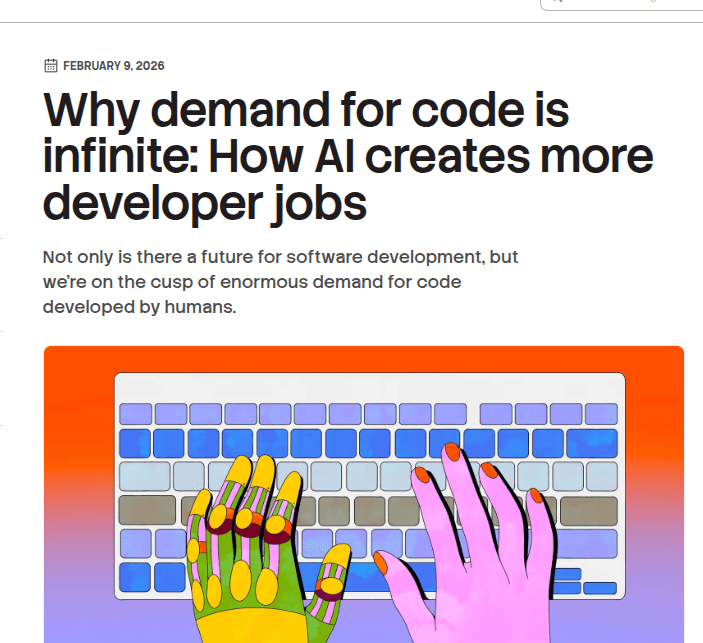
A new analysis from Stack Overflow, the definitive platform for developer knowledge, presents a compelling counter-narrative to the widespread fear that AI will automate away programming jobs. Their blog post, "Why demand for code is infinite", argues that generative AI is acting as a catalyst for a software development renaissance, expanding the scope of what's possible and creating new, specialized roles in the process.
From Coders to Orchestrators: The Evolving Developer Role
The core thesis is that AI is transforming the developer from a manual laborer, meticulously typing each line of syntax, into a high-level orchestrator and system architect. Developers are increasingly managing intelligent agents—AI coding assistants like GitHub Copilot, Cursor, or Claude Code—that handle the granular implementation. This shift elevates the developer's focus from memorization and syntax to strategic problem-solving, system design, and defining the "what" and "why" of a project.
This evolution is particularly impactful for junior developers. As noted in the analysis, newcomers can now bypass common beginner hurdles like basic syntax errors and contribute functional features much faster. This accelerates the learning curve, allowing them to engage with more complex architectural concepts earlier in their careers.
The Cambrian Explosion of AI Applications
With AI acting as a "super-powered teammate," development velocity has increased dramatically. This acceleration is not leading to a reduction in work; instead, it's triggering what Stack Overflow terms a "Cambrian explosion" of new applications. Companies are now attempting incredibly complex projects that were previously deemed too costly, time-intensive, or technically risky.
The result is a paradoxical surge in demand for engineering talent. As the barrier to building software lowers, the ambition of companies rises. They are now "frantically hunting for engineers" not to write basic code, but to manage, maintain, scale, and secure the burgeoning ecosystem of new AI-powered applications. The appetite for custom software, driven by endless human imagination and newly discovered problems, remains practically infinite.
The Rise of New, Specialized Roles
This new paradigm is giving birth to entirely novel job categories, reflecting the deepening symbiosis between human intuition and machine capability. Companies are now hiring for positions such as:
- Human-AI Collaboration Architects: Professionals who design workflows and systems that optimally integrate human oversight with AI automation, ensuring efficiency, safety, and creativity.
- Domain-Specific Prompt Engineers: Experts who master the art of communicating with AI models within specific fields (e.g., bioinformatics, fintech, game design) to generate highly accurate and relevant code or solutions.
These roles underscore that the value is shifting toward domain expertise, strategic thinking, and the ability to guide AI toward correct and innovative outcomes.
Implications for the Future of Tech
The Stack Overflow analysis suggests several key implications for the industry:
- Education Must Evolve: Coding bootcamps and computer science curricula will need to place greater emphasis on system design, problem decomposition, ethics in AI, and prompt craftsmanship alongside traditional programming fundamentals.
- The Value of Soft Skills Skyrockets: Communication, project management, and cross-domain understanding become critical as developers spend more time defining problems for AI agents and collaborating with non-technical stakeholders.
- Democratization and Specialization: While AI democratizes the creation of software, leading to more builders, it simultaneously increases the need for deep specialists who can tackle the novel challenges these powerful systems introduce.
In essence, AI is not making the developer obsolete; it is making the developer's imagination the primary limiting factor. The future belongs to those who can effectively partner with AI to dream bigger and orchestrate the translation of those dreams into reality.
Source analysis based on the Stack Overflow blog post "Why demand for code is infinite" and related commentary.