Two and a half years after its initial release as a working paper, the groundbreaking research that first coined the term "jagged frontier" and provided some of the earliest experimental evidence of real productivity gains from AI has now been formally published through academic channels. The paper, led by researchers including Ethan Mollick, represents a foundational document in understanding how artificial intelligence transforms work—and why its capabilities remain uneven across different tasks.
What the Research Revealed
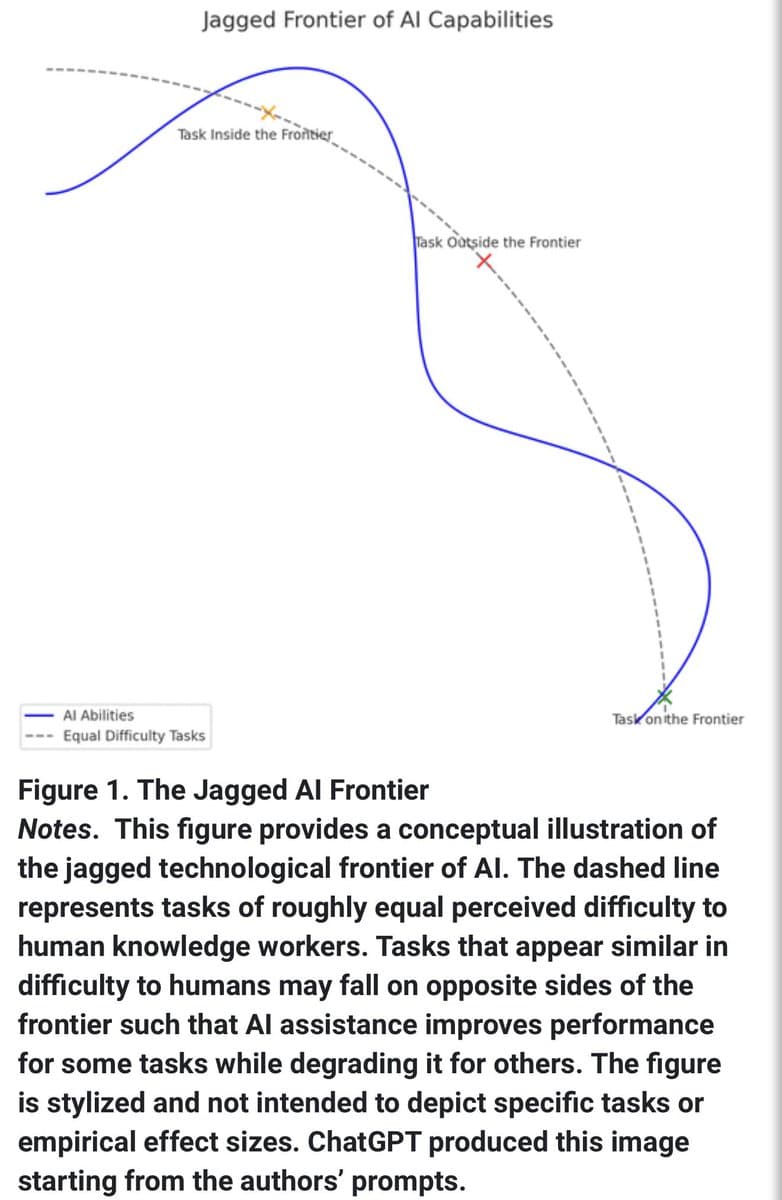
The original 2022 study conducted controlled experiments measuring how AI tools affected performance across various professional tasks. The researchers found that while AI significantly boosted productivity in certain areas—sometimes dramatically—its effectiveness varied unpredictably across different types of work. This uneven landscape of capabilities became known as the "jagged frontier," describing how AI excels at some tasks while struggling with others that might seem similarly difficult to human observers.
The experimental evidence showed concrete productivity improvements, with some participants completing tasks up to 40% faster and with higher quality when using AI assistance. These findings were among the first to move beyond speculation to measurable impact, providing empirical support for what many were beginning to experience anecdotally.
Why the Delay Matters
The 2.5-year gap between initial release and formal publication highlights both the rigor of academic review processes and the rapid pace of AI development. When the paper first circulated in 2022, tools like GPT-3.5 represented the cutting edge. Today, with GPT-4, Claude 3, and other advanced models widely available, the research findings have been validated through real-world experience even as the technology has evolved.
This publication delay creates an interesting historical artifact: a paper documenting what now seems like early AI capabilities, but which at the time represented groundbreaking evidence of a productivity revolution in its infancy. The research captures a specific moment in AI's development while establishing frameworks that remain relevant as the technology advances.
The Enduring Concept of the Jagged Frontier
The "jagged frontier" concept has proven remarkably durable as AI capabilities have expanded. The fundamental insight—that AI doesn't progress evenly across all human capabilities but develops in irregular patterns—continues to explain why some tasks become easily automated while others resist AI assistance.
This uneven development has important implications for how organizations implement AI. Rather than assuming consistent performance improvements, managers must test AI capabilities specifically for their needed tasks. The jagged frontier suggests that job roles won't be uniformly affected by AI, but will instead see certain components transformed while others remain human-dominated.
From Research to Real-World Impact
Since the paper's initial release, its findings have influenced both academic research and practical implementation. The concept of the jagged frontier has appeared in numerous subsequent studies and has been cited by organizations developing AI implementation strategies. The experimental methodology—measuring specific productivity gains rather than speculating about potential—set a standard for rigorous AI impact research.
The publication also validates the researchers' early recognition of AI's transformative potential. At a time when many were still debating whether large language models represented more than a curiosity, this research provided evidence that they could deliver measurable productivity improvements in professional contexts.
Looking Forward from a Historical Baseline
With formal publication, this research now enters the permanent academic record as a foundational document in understanding AI's impact on work. It serves as a baseline against which future developments can be measured, documenting both how much has changed and how certain fundamental patterns persist.
The paper's journey from working paper to published research mirrors AI's own transition from experimental technology to mainstream tool. Just as the academic review process adds legitimacy through rigorous evaluation, AI has moved from promising prototype to proven productivity enhancer across numerous industries.
Source: Ethan Mollick's announcement of the paper's publication after 2.5 years as a working paper, referencing research that coined "jagged frontier" and provided early experimental evidence of AI productivity gains.