What Happened
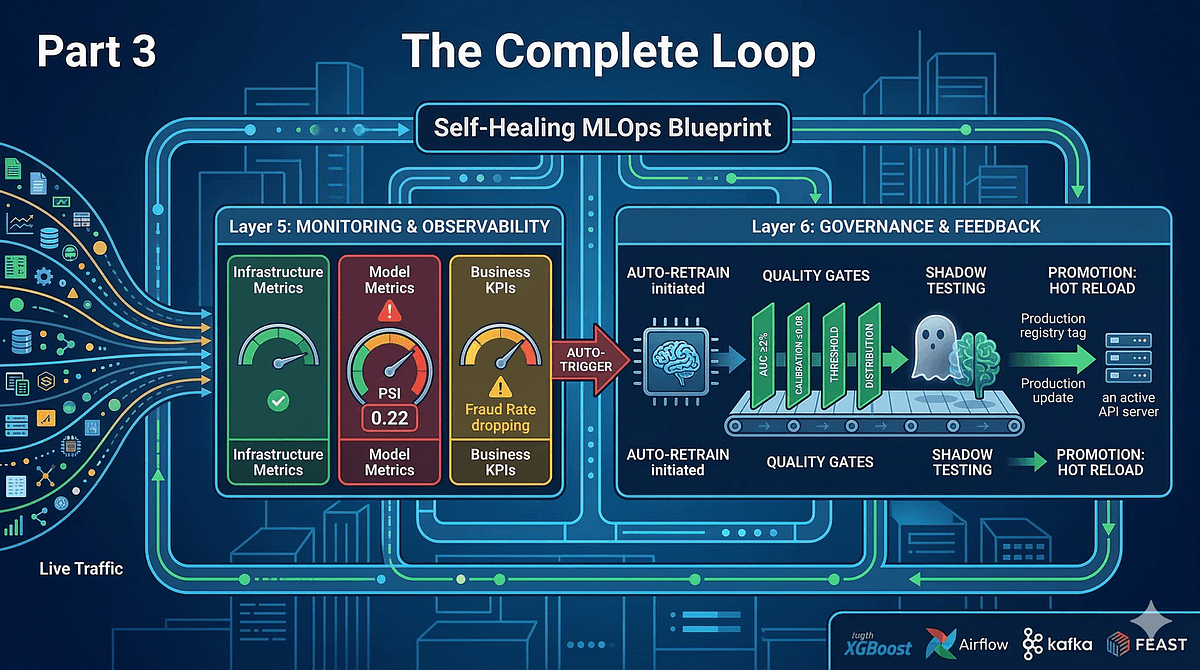
The third installment of "The Self-Healing MLOps Blueprint" series presents a hands-on proof-of-concept for a fraud detection platform designed with production-grade resilience in mind. While the full article is behind Medium's paywall, the available summary indicates this is a practical implementation guide rather than just theoretical discussion.
This PoC appears to translate self-healing MLOps concepts—where machine learning systems automatically detect, diagnose, and remediate issues—into a concrete architecture for fraud detection. The "production-inspired" description suggests the author has drawn from real-world deployment challenges and patterns.
Technical Details: What Self-Healing MLOps Entails
Self-healing MLOps represents an evolution beyond traditional MLOps practices. While standard MLOps focuses on automating the ML lifecycle (development, deployment, monitoring), self-healing systems add automated remediation capabilities.
Key components typically include:
Comprehensive Monitoring: Tracking not just model performance metrics (accuracy, precision, recall) but also data drift, concept drift, infrastructure health, and business KPIs
Automated Diagnostics: When anomalies are detected, the system automatically investigates potential root causes—whether it's data quality issues, feature distribution changes, or external factors affecting predictions
Remediation Workflows: Pre-defined actions triggered based on diagnosis, which might include:
- Retraining models with updated data
- Adjusting decision thresholds
- Switching to fallback models
- Alerting human operators for complex issues
Feedback Loops: Incorporating remediation outcomes back into the system to improve future automated responses
For fraud detection specifically, self-healing capabilities are particularly valuable because:
- Fraud patterns evolve rapidly as criminals adapt
- False positives directly impact customer experience and revenue
- Regulatory requirements demand consistent, explainable decisions
- Attack surfaces change with new payment methods and channels
Retail & Luxury Implications
While the source material focuses on fraud detection, the underlying self-healing MLOps principles have significant implications for luxury and retail AI applications:
1. Personalization Systems
Luxury personalization engines—which recommend products, curate content, and tailor experiences—face constant drift as customer preferences evolve with seasons, trends, and economic conditions. A self-healing system could:
- Detect when recommendation relevance drops below thresholds
- Automatically refresh customer embeddings or retrain models
- Adjust personalization strategies based on real-time engagement metrics
- Maintain consistency across channels despite varying data quality
2. Inventory and Demand Forecasting
Luxury inventory management balances exclusivity with availability, requiring precise demand predictions. Self-healing capabilities could:
- Identify when external events (celebrity endorsements, social media trends) invalidate historical patterns
- Automatically incorporate new data sources or adjust model parameters
- Provide confidence intervals that reflect current prediction reliability
- Trigger human review when automated adjustments exceed predefined bounds
3. Customer Service and Concierge AI
AI-powered concierge services and customer support must maintain brand voice and accuracy. Self-healing systems could:
- Monitor conversation quality and customer satisfaction metrics
- Detect when new product launches or policy changes create knowledge gaps
- Automatically update knowledge bases or retrain conversation models
- Escalate to human agents when confidence scores drop
4. Visual Search and Discovery
Computer vision models for visual search, virtual try-on, or authenticity verification can degrade as product catalogs evolve. Self-healing approaches could:
- Detect performance degradation on new product categories
- Automatically collect and incorporate new training examples
- Adjust model architectures or parameters based on emerging patterns
- Maintain accuracy across diverse luxury materials and craftsmanship
Implementation Considerations for Luxury Brands
Technical Requirements
Implementing self-healing MLOps requires:
- Observability Infrastructure: Comprehensive logging, metrics collection, and tracing across all ML components
- Orchestration Framework: Tools to manage complex remediation workflows and dependencies
- Testing Framework: Automated testing for model updates, including A/B testing capabilities
- Governance Layer: Audit trails, approval workflows, and compliance checks for automated changes
Organizational Alignment
Self-healing systems shift responsibilities:
- Data Scientists: Focus more on defining monitoring thresholds and remediation logic rather than manual model maintenance
- ML Engineers: Build and maintain the self-healing infrastructure and workflows
- Business Stakeholders: Define business rules and acceptable risk parameters for automated decisions
- Compliance Teams: Review and approve automated change protocols
Maturity Progression
Most organizations should approach self-healing MLOps incrementally:
- Level 1: Basic monitoring with manual remediation
- Level 2: Automated alerts with guided remediation steps
- Level 3: Semi-automated remediation requiring human approval
- Level 4: Fully automated remediation within predefined boundaries
Luxury brands might start with Level 2 or 3 implementations, particularly for customer-facing applications where brand reputation requires careful oversight.
Challenges and Limitations
Brand Consistency vs. Automation
Luxury brands maintain carefully crafted identities across all touchpoints. Automated model adjustments must preserve:
- Brand voice and tone in generative applications
- Aesthetic consistency in visual systems
- Service standards in customer interactions
- Exclusivity positioning in recommendations
Data Scarcity
Luxury often involves limited data:
- Limited edition products with few sales examples
- High-value customers with privacy considerations
- Seasonal collections with short lifecycles
Self-healing systems need strategies for low-data scenarios, potentially incorporating:
- Transfer learning from related domains
- Synthetic data generation with quality controls
- Human-in-the-loop validation for critical decisions
Regulatory Compliance
Luxury operates in regulated environments:
- GDPR and privacy regulations for customer data
- Financial regulations for payment and fraud systems
- Industry-specific regulations for authentication and provenance
Automated remediation must maintain audit trails and explainability, potentially limiting fully autonomous approaches in regulated domains.
Looking Ahead
The self-healing MLOps approach represents a natural evolution as AI systems move from experimental projects to core business infrastructure. For luxury retailers, the balance between automation and brand stewardship will define implementation strategies.
Future developments to watch include:
- Causal AI integration: Moving beyond correlation to understanding why models degrade
- Federated learning approaches: Maintaining model quality while preserving data privacy
- Multi-modal self-healing: Coordinating fixes across text, image, and structured data models
- Ethical AI safeguards: Ensuring automated changes don't introduce bias or fairness issues
While the specific fraud detection PoC in the source material addresses one application, the underlying blueprint provides a framework that luxury AI teams can adapt to their unique challenges—balancing automation with the meticulous attention to detail that defines luxury experiences.