Key Takeaways
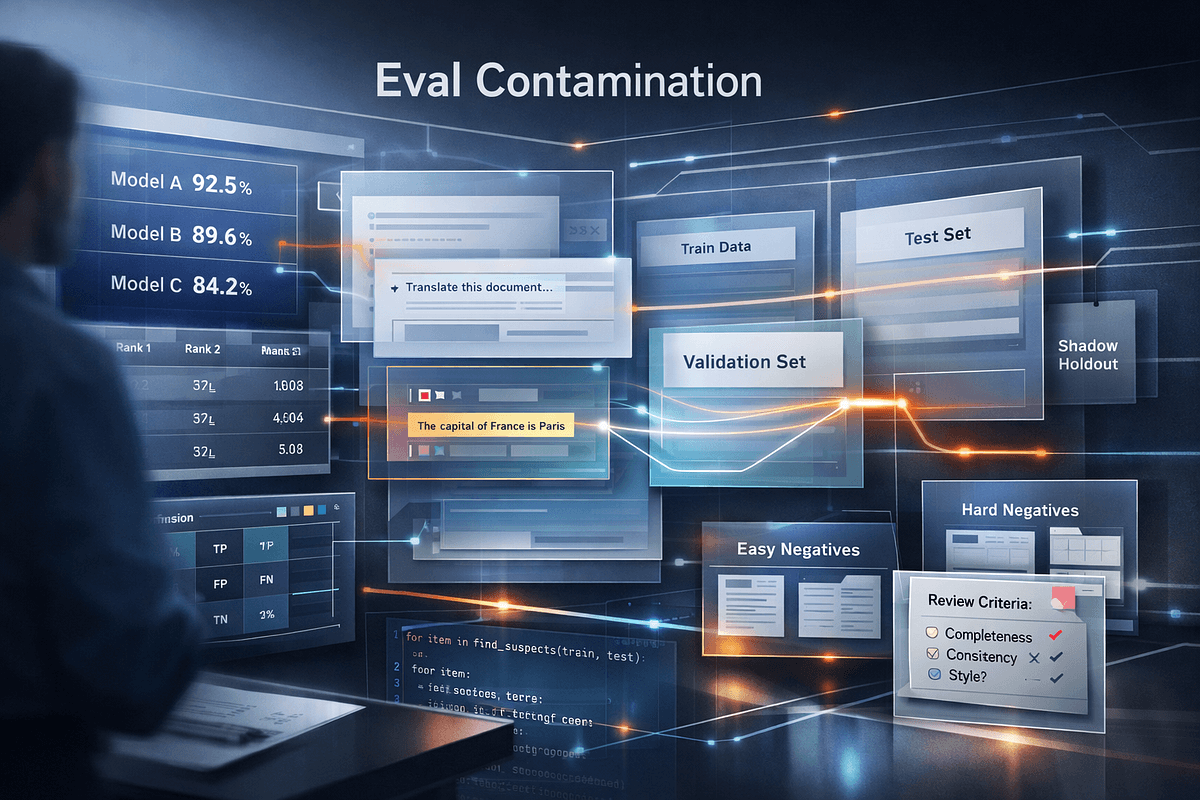
- The article warns that subtle data contamination in evaluation pipelines—from benchmark leakage to temporal overlap—can create misleading performance metrics.
- Identifying these eight leakage sources is essential for trustworthy AI validation.
What Happened: The Hidden Crisis in AI Evaluation

A new technical article on Medium sounds a critical alarm for AI practitioners: evaluation contamination. The piece, titled "Nobody warns you about eval contamination: 8 leakage sources," argues that subtle, often overlooked forms of data leakage can completely invalidate the benchmarks used to measure AI model performance. The core premise is that if information from the test set inadvertently influences the training process, the resulting performance metrics become meaningless—creating a dangerous illusion of capability.
The author outlines eight specific sources of this contamination, which range from obvious pitfalls to insidious leaks that can go undetected for months. This is not a theoretical concern; as organizations race to benchmark models against competitors and internal baselines, contaminated evaluations can lead to misguided deployment decisions, wasted R&D resources, and ultimately, production failures.
Technical Details: The Eight Leakage Sources

While the full article details each point, the eight contamination sources can be broadly categorized:
- Benchmark Leakage: This is the classic case where test data from popular public benchmarks (like GLUE, SQuAD, or ImageNet) is found within the training corpus. Large-scale web-scraped datasets are prime culprits.
- Temporal Leakage: For time-series or real-world data, training on information from a future "test" period. A model predicting Q4 sales shouldn't be trained on data leaked from January of the next year.
- Data Augmentation Leakage: Applying augmentation techniques (like image flipping or text paraphrasing) after the train-test split, which can create synthetic samples that are unrealistically similar to test instances.
- Preprocessing Leakage: Calculating global statistics (mean, standard deviation, vocabulary) using the entire dataset (train + test) before splitting, thereby letting test data influence the training setup.
- Label Leakage: Inadvertently including information in the input features that directly reveals the label. For example, a "customer churn" model might have a feature like "days since last service call," which for churned customers would be artificially high.
- Multi-Modal Leakage: When training a model on one modality (e.g., text) using data that is paired with another modality (e.g., an image) that appears in the test set for a different task.
- Human-in-the-Loop Leakage: When human raters or annotators who helped create the test set are also involved in refining the model, potentially biasing it toward their annotation style.
- Pipeline/Code Leakage: Bugs in evaluation code that accidentally expose test labels during training, or caching mechanisms that cause data from a previous test run to influence a new training cycle.
The article emphasizes that contamination is often not malicious but a byproduct of complex, iterative development pipelines where data hygiene can be an afterthought.
Retail & Luxury Implications: Trustworthy AI is a Business Imperative
For retail and luxury AI leaders, this technical deep dive has profound implications. The sector's AI initiatives—from personalized recommendation engines and visual search to demand forecasting and customer sentiment analysis—live and die by the validity of their evaluation metrics.
Why This Matters:
- Product & Campaign Performance: A recommendation model with contaminated evaluations might show stellar offline accuracy but fail to drive conversions in a live A/B test, leading to missed revenue targets and wasted marketing spend.
- Forecasting & Inventory: A demand forecasting model suffering from temporal leakage could appear perfectly accurate during validation but catastrophically mispredict future trends, resulting in overstock or stockouts.
- Computer Vision Applications: For visual search or automated product tagging, benchmark leakage (e.g., test images appearing in pre-training datasets) creates a false sense of model robustness, risking poor customer experience upon launch.
- Competitive Benchmarking: As brands increasingly tout their AI capabilities, ensuring internal evaluations are clean is crucial for honest competitive analysis and strategic planning. A contaminated "win" against a benchmark is a pyrrhic victory.
The Path Forward: The article serves as a checklist for AI/ML teams. Before declaring a model ready for production, technical leaders must audit their data pipelines for these eight sources. This involves implementing rigorous MLOps practices: immutable, versioned datasets; strict separation of preprocessing logic; and automated checks for data overlap. The cost of prevention is far lower than the cost of a failed AI initiative built on a faulty foundation.