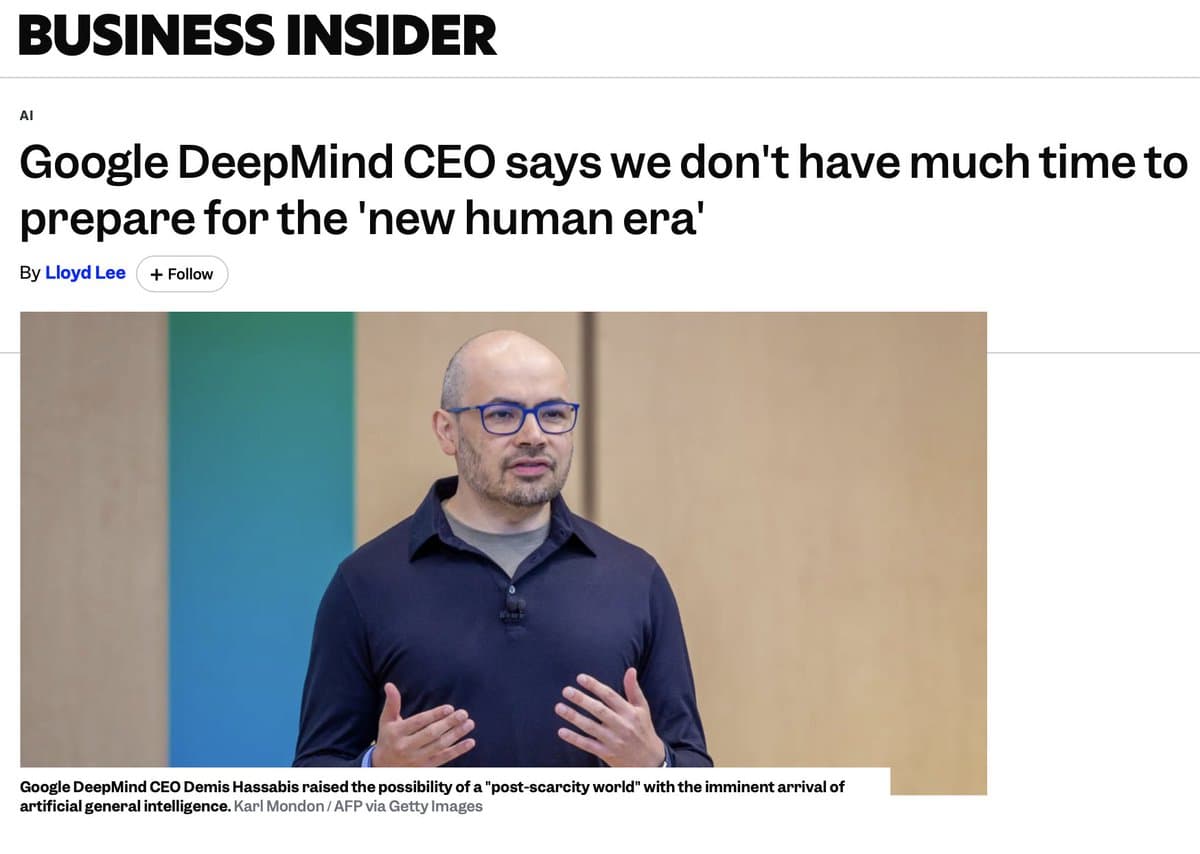
Demis Hassabis, CEO of Google DeepMind, warned that artificial general intelligence (AGI) arriving around 2030 will be a singularity-level event with no turning back. He said society has "little time to prepare" for what he called the most profound revolution since the Industrial Revolution, but ten times faster and more powerful.
Key facts
- Hassabis equated AGI around 2030 to 'the singularity'.
- He said society 'doesn't have long to prepare'.
- Called current era 'foothills of the singularity'.
- Described it as Industrial Revolution 'ten times faster'.
- Source is a post by @kimmonismus on X.
In a stark public statement, DeepMind CEO Demis Hassabis broke from his typically measured scientific posture to issue what he described as a necessary societal warning about AGI timelines. Speaking at Google I/O and in subsequent commentary, Hassabis equated the arrival of AGI around 2030 to "the singularity — a point in time when there's no turning back from a breakthrough technological development" According to @kimmonismus.
"Society needs to hear that because we don't have long to prepare for what that means," Hassabis said, framing the warning as a public service rather than product promotion. The statement carries particular weight given Hassabis's reputation as arguably the most serious scientist in the AI field — someone who has historically avoided the hype-driven commentary common among AI startup founders.
Hassabis further declared: "When we look back at this time, I think we will realize that we were standing in the foothills of the singularity." He characterized the current moment as being on "the threshold of the most profound revolution," comparable to the Industrial Revolution but "ten times faster and ten times more powerful."
Why This Warning Matters More Than Typical AGI Predictions
Hassabis's warning is structurally different from the AGI timeline claims made by OpenAI CEO Sam Altman or Anthropic CEO Dario Amodei. Both Altman and Amodei have financial incentives tied to AGI narratives — Altman has publicly discussed AGI as a fundraising and product narrative, while Amodei has predicted AGI as early as 2026. Hassabis, by contrast, leads a research lab embedded inside Google, with less direct fundraising pressure. His credibility derives from a track record of scientific breakthroughs (AlphaGo, AlphaFold, AlphaFold2) rather than product launches.
This is also notable given DeepMind's long-standing policy of avoiding public AGI timeline predictions. Hassabis's decision to break that silence suggests either internal conviction that the field has crossed a threshold, or a strategic attempt to shape public policy conversations before the technology outpaces regulation.
What Hassabis Left Unsaid
The source material does not specify what concrete evidence underpins the 2030 prediction — no benchmark results, training compute projections, or capability milestones were cited. Hassabis did not clarify whether DeepMind's own systems (Gemini, AlphaGo-class architectures) are on a path to AGI, nor did he differentiate between narrow superhuman AI and general intelligence. The warning remains qualitative rather than quantitative, which limits its falsifiability but amplifies its rhetorical force.
Historical Precedent: The Singularity as a Moving Target
The term "singularity," popularized by Ray Kurzweil in his 2005 book The Singularity Is Near, has historically been a moving target. Kurzweil initially predicted the singularity would arrive by 2045. Hassabis's 2030 timeline is significantly more aggressive, and places him closer to predictions made by less scientifically cautious figures. If Hassabis is correct, the window for societal preparation is roughly four years — shorter than a typical US presidential term.
Comparisons to the Industrial Revolution are instructive but potentially misleading. The Industrial Revolution unfolded over decades, allowing labor markets, social institutions, and political systems to adapt incrementally. A tenfold acceleration would compress that adaptation into years, raising questions about unemployment, wealth concentration, and governance that Hassabis's warning does not address.
What to Watch
Watch for DeepMind's next major technical publication or product release — specifically whether Gemini 2 or AlphaFold3-level systems demonstrate cross-domain reasoning capabilities that would validate Hassabis's timeline. Also monitor the UK government's AI Safety Summit follow-through: Hassabis's warning may accelerate regulatory action from the UK's Frontier AI Taskforce. If DeepMind begins publicly sharing AGI readiness metrics (e.g., benchmark coverage across 100+ domains), that would signal internal confidence behind the 2030 claim.
Key Takeaways
- Demis Hassabis warned AGI around 2030 will be a singularity-level event.
- He says society has little time to prepare for a revolution ten times faster than the Industrial Revolution.