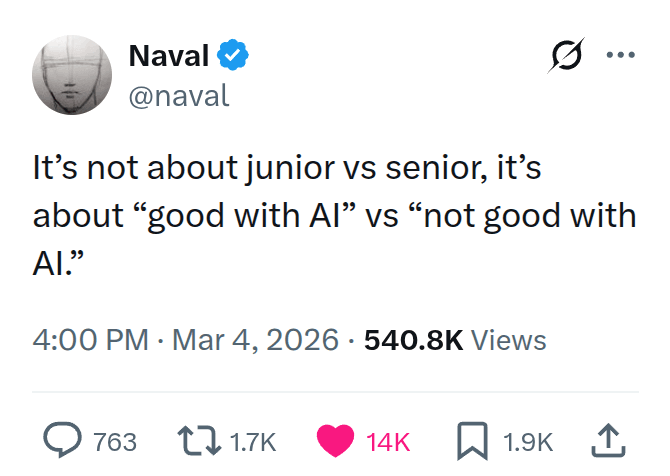
In a provocative tweet that has sparked widespread discussion, AI researcher Rohan Paul declared: "Competence is now a function of how effectively you offload cognition to silicon." This concise statement captures a fundamental transformation occurring across professional landscapes worldwide. As artificial intelligence systems become increasingly sophisticated, the very definition of professional competence is undergoing a radical redefinition.
The Cognitive Offloading Revolution
Traditionally, professional competence has been measured by an individual's accumulated knowledge, analytical capabilities, and problem-solving skills developed through years of education and experience. This paradigm is rapidly shifting as AI tools become capable of performing cognitive tasks that were once exclusively human domains.
Cognitive offloading refers to the process of delegating mental tasks to external systems—in this case, AI-powered silicon-based systems. This includes everything from data analysis and pattern recognition to creative ideation and strategic planning. The most competent professionals are no longer necessarily those with the greatest innate intelligence or most extensive knowledge base, but rather those who most effectively integrate AI tools into their workflow.
The Collapsing Hierarchy
Paul's observation about the "seniority hierarchy collapsing" points to a profound organizational transformation. Traditional corporate structures have typically rewarded tenure and accumulated experience, creating predictable career ladders based on years of service. AI is disrupting this model by enabling junior professionals to perform tasks that previously required years of experience.
A recent McKinsey report found that AI tools can accelerate certain professional tasks by 40-60%, effectively compressing the experience curve. Junior analysts can now produce insights that once required senior-level expertise, while entry-level programmers can build sophisticated applications using AI-assisted coding tools. This democratization of capability is flattening organizational structures and creating new pathways for advancement based on technological fluency rather than tenure.
The Commoditization of Intelligence
Perhaps the most significant implication of Paul's statement is the "commoditization of intelligence." For centuries, human intelligence has been a scarce resource, distributed unevenly across populations and commanding premium value in knowledge economies. AI is changing this equation by making sophisticated cognitive capabilities widely accessible at minimal cost.
Basic research, data analysis, content creation, and even strategic thinking can now be augmented or performed by AI systems. This doesn't render human intelligence obsolete but rather changes its economic value. The premium is shifting from raw cognitive power to skills in problem framing, ethical judgment, creative synthesis, and human-AI collaboration.
The Brutal Market Reality
Paul's warning about "the market is brutal for those who ignore it" reflects an emerging economic reality. Professionals and organizations that fail to adapt to this cognitive offloading paradigm risk rapid obsolescence. Several factors contribute to this brutal market dynamic:
Productivity Disparities: Early adopters of AI tools are achieving productivity gains that create competitive advantages difficult to overcome through traditional means.
Cost Structures: Organizations leveraging AI effectively can deliver similar or superior outcomes with reduced labor costs, putting pressure on traditional business models.
Innovation Velocity: AI-augmented teams can iterate and innovate at speeds that outpace purely human teams, accelerating competitive cycles.
The New Competence Framework
In this transformed landscape, professional competence encompasses several new dimensions:
AI Integration Skills: The ability to identify which cognitive tasks to offload, select appropriate tools, and integrate them seamlessly into workflows.
Prompt Engineering: Crafting effective instructions and queries that yield optimal results from AI systems—a skill becoming as fundamental as search query formulation was in the internet age.
Human-AI Collaboration: Developing workflows that leverage the complementary strengths of human and artificial intelligence, recognizing that each has distinct advantages.
Judgment and Validation: While AI can generate outputs, human professionals must exercise judgment in evaluating, contextualizing, and applying these outputs appropriately.
Continuous Learning: As AI capabilities evolve rapidly, the most valuable competence is the ability to continuously learn and adapt to new tools and methodologies.
Industry Implications
This shift toward cognitive offloading affects different industries in distinct ways:
Creative Fields: Writers, designers, and artists are finding that competence now includes the ability to use AI as a creative collaborator while maintaining distinctive human perspective and emotional resonance.
Professional Services: Lawyers, consultants, and accountants are offloading research, document analysis, and compliance checking to AI, freeing time for higher-value strategic advising and client relationship management.
Technical Fields: Engineers and developers are using AI for code generation, debugging, and system design, shifting their focus to architecture, integration, and innovation.
Management: Leaders are leveraging AI for data-driven decision support, scenario planning, and organizational analysis, requiring new competencies in interpreting AI-generated insights.
Ethical and Societal Considerations
This transformation raises important questions about equity, access, and the future of work. The democratizing potential of AI tools could reduce barriers to entry in many fields, but only if access to these tools is widespread. There's also the risk of creating new divides between those with AI fluency and those without.
Additionally, over-reliance on cognitive offloading could potentially erode fundamental human skills, much as calculators affected mental arithmetic capabilities. The most successful approaches will likely balance AI augmentation with deliberate maintenance of core human competencies.
Preparing for the Silicon-Enhanced Future
For individuals and organizations navigating this transition, several strategies emerge:
Develop Hybrid Intelligence: Cultivate workflows that combine human and artificial intelligence in complementary ways.
Focus on Uniquely Human Skills: Emphasize capabilities that remain difficult to automate, such as complex ethical reasoning, emotional intelligence, and creative breakthrough thinking.
Create Learning Cultures: Establish environments where continuous skill development, particularly around emerging technologies, is encouraged and supported.
Redefine Metrics: Develop new ways to measure competence and productivity that account for AI augmentation rather than penalizing it.
Conclusion
Rohan Paul's observation about competence becoming a function of cognitive offloading to silicon captures a fundamental shift in how we work, learn, and create value. This isn't about humans being replaced by machines, but about redefining human potential through partnership with increasingly capable AI systems.
The most successful professionals and organizations in the coming years will be those who master this partnership—who understand not just how to use AI tools, but how to think with and through them. Competence in the age of AI is less about what you know than about how effectively you can extend your cognition through silicon, while maintaining the essential human qualities that give meaning and direction to our technological capabilities.
As this transformation accelerates, the question isn't whether to engage with AI, but how to do so in ways that enhance rather than diminish our humanity. The future belongs not to those with the most intelligence, but to those who most intelligently integrate artificial intelligence into their cognitive toolkit.
Source: Rohan Paul (@rohanpaul_ai) on X/Twitter