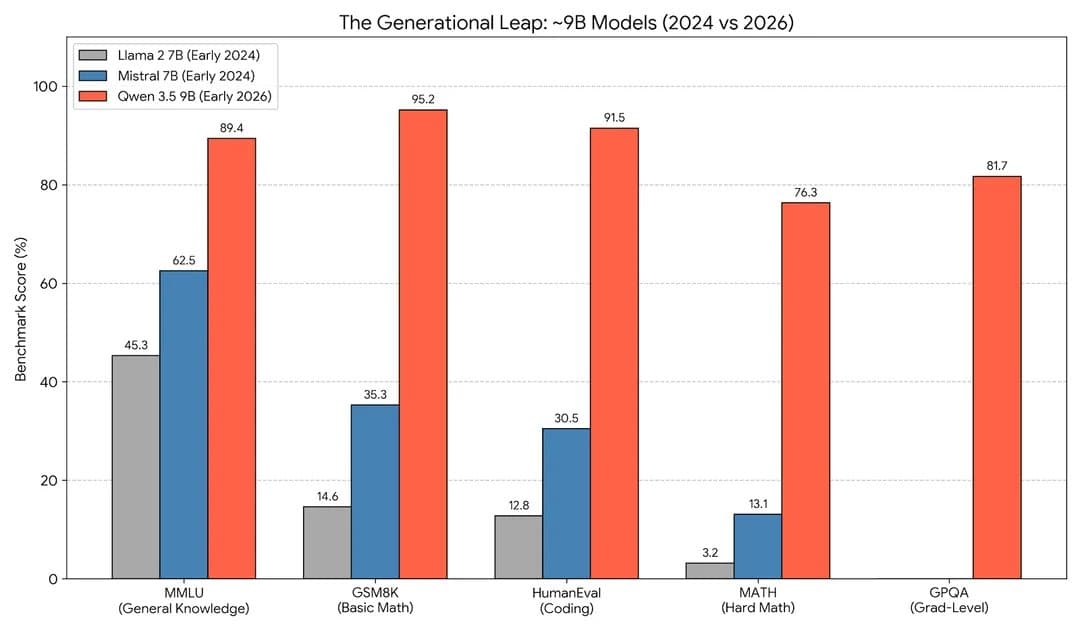
A striking visual comparison circulating on social media has captured the AI community's attention, revealing what appears to be a dramatic leap in model efficiency within a remarkably short timeframe. The side-by-side comparison shows two AI-generated images with identical model size specifications, separated by just two years of development. The difference in quality, coherence, and detail is immediately apparent—and according to observers, "absolutely insane."
The Viral Comparison
The original post by @kimmonismus on X (formerly Twitter) presents a simple but powerful visual: two AI-generated images labeled with the same model size parameters, one from 2022 and one from 2024. While the source doesn't specify the exact models compared, the implication is clear—today's models are achieving significantly better results with the same computational footprint as their predecessors from just two years ago.
This phenomenon represents more than just incremental improvement. The visual evidence suggests that the AI field is experiencing efficiency gains that may be outpacing even the most optimistic projections. Where hardware improvements traditionally followed Moore's Law (doubling transistor density approximately every two years), AI efficiency appears to be improving at an even faster rate through algorithmic and architectural innovations.
Context: The Efficiency Revolution
This development didn't occur in isolation. Over the past two years, the AI research community has made significant strides in several key areas:
Architectural improvements have enabled models to make better use of available parameters. Techniques like mixture-of-experts architectures, better attention mechanisms, and more efficient training methodologies have allowed models to achieve better performance without increasing parameter counts.
Training methodology advances have played a crucial role. Innovations in data curation, training objectives, and optimization algorithms have enabled models to learn more effectively from the same amount of data and computation.
Inference optimization has seen remarkable progress. Techniques like quantization, pruning, and distillation allow models to maintain performance while reducing computational requirements during deployment.
Implications for the AI Ecosystem
This acceleration in efficiency has profound implications across multiple dimensions of the AI landscape:
Democratization of AI: As models become more efficient, the computational barriers to entry decrease. Smaller organizations and even individual researchers can now work with capable models that previously required massive computational resources.
Environmental impact: More efficient models require less energy for both training and inference, potentially reducing the carbon footprint of AI development and deployment.
Deployment costs: The operational costs of running AI models scale with computational requirements. Efficiency improvements directly translate to lower costs for businesses implementing AI solutions.
Edge computing: Improved efficiency enables more capable AI models to run on edge devices with limited computational resources, opening new possibilities for applications in mobile devices, IoT, and embedded systems.
The Research Behind the Leap
Several key research directions have contributed to this rapid efficiency improvement:
Scaling laws refinement: Researchers have developed a better understanding of how model performance scales with parameters, data, and compute. This understanding has led to more optimal allocation of resources during model development.
Data quality over quantity: The field has increasingly recognized that carefully curated, high-quality training data can be more valuable than simply increasing dataset size. This shift has enabled more efficient learning.
Architectural innovations: New model architectures like transformers with linear attention, state-space models, and hybrid approaches have demonstrated better efficiency characteristics than previous designs.
Training efficiency: Techniques like curriculum learning, progressive training, and better initialization strategies have reduced the computational cost of reaching a given performance level.
Challenges and Limitations
While the efficiency improvements are impressive, several challenges remain:
Measurement complexity: Comparing models across different architectures and training methodologies is notoriously difficult. The "same model size" comparison may overlook important differences in how those parameters are utilized.
Specialization trade-offs: Some efficiency gains come from specializing models for particular tasks, which may reduce their general capabilities.
Reproducibility issues: Many efficiency improvements depend on proprietary techniques or undisclosed implementation details, making independent verification difficult.
Diminishing returns: As models approach certain theoretical limits, further efficiency improvements may become increasingly difficult to achieve.
Future Trajectory
The observed two-year leap suggests several possible future developments:
Continued algorithmic progress: If current trends continue, we may see further efficiency improvements that enable capabilities currently requiring much larger models.
Hardware-software co-design: As efficiency becomes a primary concern, we're likely to see closer integration between model architectures and specialized hardware.
New evaluation metrics: Traditional benchmarks may need to evolve to better capture efficiency alongside raw performance.
Regulatory considerations: As efficient models become more accessible, regulatory frameworks may need to adapt to address potential misuse scenarios.
Conclusion
The viral comparison highlighting two years of AI efficiency gains represents more than just a technical curiosity—it signals a fundamental shift in how AI capabilities are advancing. While the field previously focused heavily on scaling model size, we're now seeing that algorithmic and architectural innovations can deliver dramatic improvements even with fixed computational resources.
This development has significant implications for how AI research is conducted, how models are deployed, and who can participate in the AI ecosystem. As efficiency continues to improve, we may be approaching a future where advanced AI capabilities become increasingly accessible while requiring decreasing computational resources—a development with profound implications for technology, society, and the global economy.
The "absolutely insane" progress captured in this simple comparison serves as a powerful reminder that in AI, sometimes the most important advances aren't measured in parameters or FLOPs, but in how intelligently we use the resources we already have.