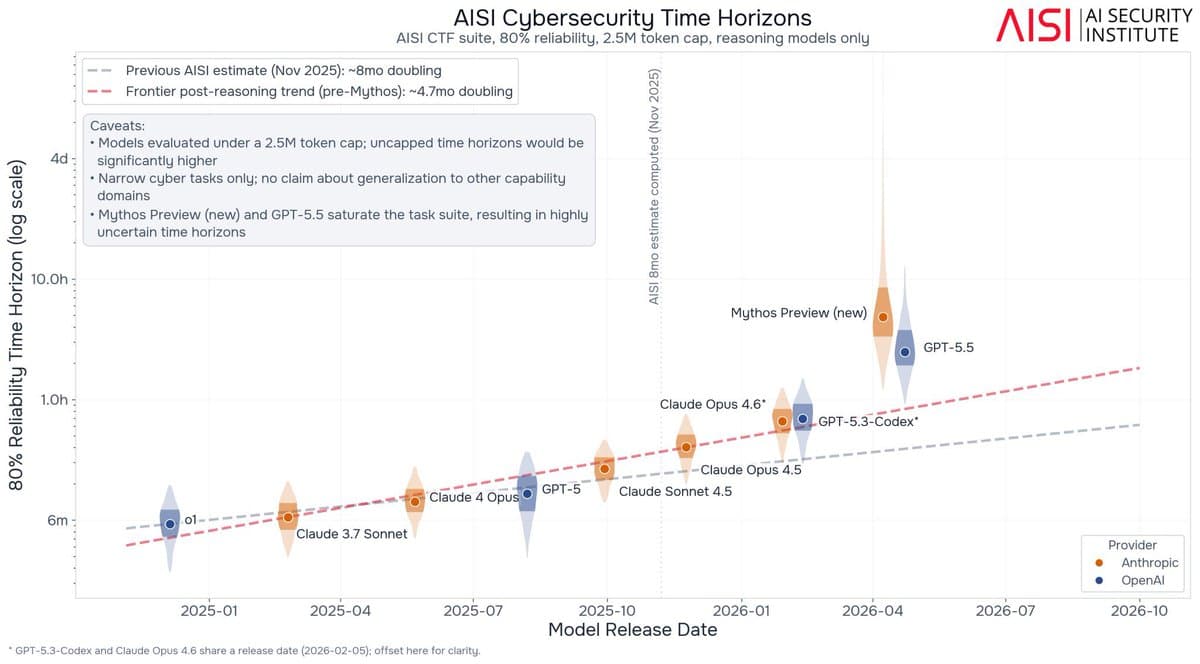
UK AI Security Institute (AISI) reports AI cyber capabilities double every 4.5 months. Mythos and GPT-5.5 show token-limited ability, not inherent capability constraints.
Key facts
- AI cyber capability doubling time: 4.5 months.
- Mythos and GPT-5.5 show token-limited ability.
- No upper bound established for cyber attack effectiveness.
- Findings from UK state AI Security Institute.
- Reported via researcher Ethan Mollick on X.
The UK's state AI Security Institute (AISI) published findings on the rapid acceleration of AI-driven cyber capabilities. The report, shared via researcher Ethan Mollick [According to @emollick], highlights two key models: Mythos and GPT-5.5.
Both models demonstrate significant gains in cyber capabilities, but the critical finding is that establishing an upper bound on their performance is difficult. The models appear limited by the number of tokens they can process during inference, rather than by their underlying reasoning or strategy ability. This suggests that with more compute—specifically more token budget—their cyber attack effectiveness could rise further without architectural changes.
The 4.5-Month Doubling Clock
AISI's headline metric is the capability doubling time of 4.5 months for AI cyber skills. This is faster than the widely cited 18-month Moore's Law doubling for general-purpose compute, but aligns with other AI scaling trendlines such as the 3-4 month doubling of training compute seen in frontier models since 2022 [per public training compute estimates]. The finding implies that defensive cyber measures must improve at a comparable or faster rate to maintain parity.
The unique take here is that token-limited capability undermines the common argument that AI models have a "glass ceiling" on complex reasoning tasks like cybersecurity. If the only bottleneck is inference token budget, then as context windows grow and inference costs fall, these models will scale in effectiveness without requiring new training runs or architectural breakthroughs.
AISI did not disclose the specific benchmarks or test environments used to measure cyber capability, nor did it detail the evaluation protocols. The findings are preliminary and based on a limited set of models, but the trendline is stark. The doubling time extrapolates from current model performance trends, and the report implies that current defensive AI may not be keeping pace.
What to watch
Watch for AISI to release the full evaluation methodology and benchmark details. Also monitor whether OpenAI and Anthropic publish their own cyber capability evaluations for GPT-5.5 and Claude variants, which would either corroborate or challenge the 4.5-month doubling finding.
[Updated 14 May via the_decoder]
The Decoder reports that AISI has twice revised its cyber capability doubling estimate—first from eight months down to 4.7, and now Anthropic's Claude Mythos Preview and OpenAI's GPT-5.5 have surpassed even that accelerated timeline. Mythos is the first model to clear all of AISI's attack simulations. Anthropic's head of red teaming, Logan Graham, warns, 'Within a year, Mythos will probably look quite dumb' [per The Decoder].