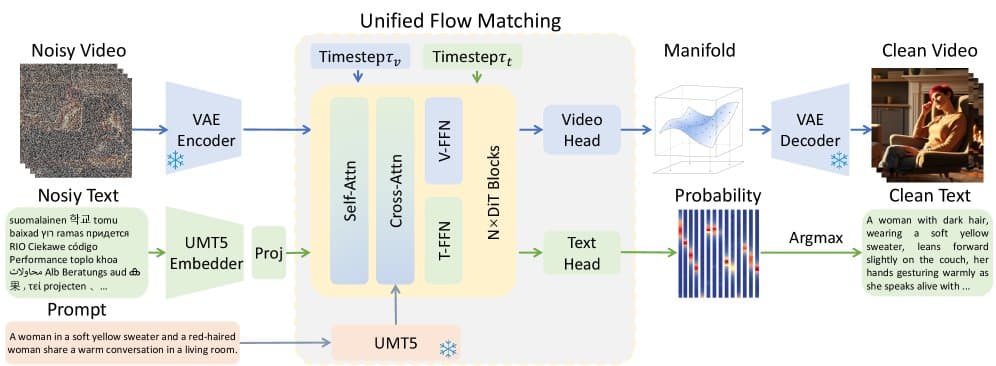
A new research paper proposes Uni-ViGU, a unified framework that tackles both video generation and video understanding within a single diffusion model. The work inverts the conventional paradigm, which typically uses separate architectures for generation (creating videos from text) and understanding (describing or analyzing videos). Instead, Uni-ViGU extends a video generator to handle understanding tasks by jointly modeling video and text via unified flow matching.
Key Takeaways
- A new paper introduces Uni-ViGU, a unified model that performs video generation and understanding within a single diffusion process via flow matching.
- This inverts the standard approach of separate models for each task.
What the Researchers Built
The core innovation is architectural and conceptual. The team designed a model that treats video generation and video understanding (e.g., captioning, question answering) not as separate tasks for separate models, but as two facets of a single, unified generative process. The model is based on a diffusion framework where both video pixels and text tokens are denoised within the same continuous flow.
Conventionally, video understanding models are discriminative—they analyze and label existing video. Video generators are purely generative—they create video from noise and a text prompt. Uni-ViGU reframes understanding as a conditional generative task: generating a text description conditioned on a (noisy) video input, within the same model that can also generate video conditioned on text.
How It Works: Unified Flow Matching
The technical heart of the method is unified flow matching within a diffusion process. In standard video diffusion models, a network learns to denoise random noise into a coherent video, guided by a text condition. Uni-ViGU expands this.
- Joint Space: The model operates in a joint space of video and text. During training, it learns the conditional relationships
p(video | text)for generation andp(text | video)for understanding simultaneously. - Single Process: Whether the task is to generate a video from text or to caption a given video, the same diffusion denoising process is used. For understanding, the input video is treated as the partially denoised state, and the model completes the denoising process for the text component.
- Flow Matching: The authors employ flow matching techniques, an alternative to standard diffusion training objectives that can offer more stable training and efficient sampling, to model the continuous transformation between noise and the joint (video, text) data distribution.
This unified approach means the model develops a single, coherent internal representation that bridges the visual dynamics of video and semantic meaning of language.
Potential Implications & Why It Matters
If successful and scalable, this paradigm shift could have significant practical and theoretical implications:
- Model Efficiency: A single model that performs both generation and understanding eliminates the need to train, maintain, and deploy two separate specialized systems. This reduces computational overhead and complexity.
- Improved Representations: By forcing the model to excel at both creating and describing video, it may learn richer, more grounded representations of visual concepts and their relationships to language. The generative objective can act as a powerful regularizer for the understanding task, and vice-versa.
- New Capabilities: A truly unified model might enable novel interactive or iterative tasks, like refining a generated video through a conversational interface or editing a video based on a critique of its initial caption.
However, the paper, shared via a HuggingFace tweet, is a preview. The community awaits the full manuscript to evaluate benchmark results, model scale, and direct comparisons to state-of-the-art separate models (e.g., Sora or Lumiere for generation, VideoLLaMA or Gemini 1.5 for understanding) on standardized tasks.
gentic.news Analysis
Uni-ViGU enters a competitive landscape where unification is a clear trend but remains challenging. This follows Google DeepMind's historical push with models like Gato (a "generalist" agent) and more recently, the industry-wide convergence toward multimodal foundation models like GPT-4V and Gemini, which combine understanding across text, image, and video. However, most of these are primarily understanding-focused, with generation often handled by separate, specialized models (e.g., DALL-E, Imagen, Veo).
The Uni-ViGU approach—using a single generative diffusion process for both—is a more radical technical integration. It aligns thematically with other recent research pushing the boundaries of diffusion models, such as Stable Diffusion 3's improved text rendering and Pika Labs' work on consistent character generation, but tackles a broader problem scope. Its success will hinge on whether a single diffusion transformer (DiT) backbone can match or exceed the performance of two models optimized for their respective tasks, which are already highly sophisticated. The computational trade-offs—training one giant model versus two large ones—will be a key point of scrutiny for practitioners.
This work also subtly challenges the prevailing scaling law narrative that has dominated AI, which often assumes separate pre-training for modality-specific encoders. If Uni-ViGU shows strong results, it could reignite interest in truly joint, from-scratch multimodal training paradigms, a path that has been less traveled due to its immense data and compute requirements.
Frequently Asked Questions
What is Uni-ViGU?
Uni-ViGU is a proposed AI model architecture that unifies video generation and video understanding (like captioning) into a single diffusion model. It uses a technique called unified flow matching to handle both creating videos from text and describing videos with text within one continuous process.
How is Uni-ViGU different from models like Sora or Gemini?
Models like OpenAI's Sora are primarily video generators, while models like Google's Gemini 1.5 are multimodal understanders. They are typically designed and optimized for one primary direction (text-to-video or video-to-text). Uni-ViGU attempts to be a single model that performs both directions equally well using the same core mechanism.
What is flow matching in AI?
Flow matching is a machine learning framework for training continuous normalizing flows. In the context of diffusion models, it's an alternative training objective to the standard denoising score matching. It can lead to more stable training and faster sampling by learning a deterministic path from noise to data, rather than learning to reverse a stochastic noising process step-by-step.
When will the full Uni-ViGU paper and results be available?
The model was announced via a social media post from HuggingFace Papers. As of now, the full academic paper with detailed methodology, benchmarks, and model weights is not yet publicly available. The research community is awaiting its release on a preprint server like arXiv for full evaluation.