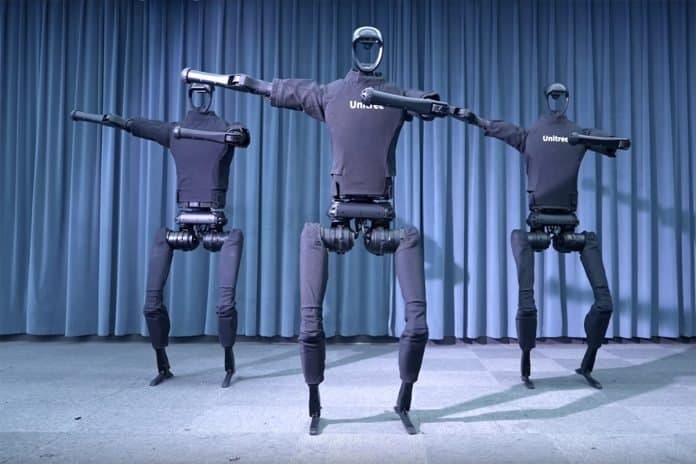
Unitree Robotics, a leading Chinese robotics company, has reportedly achieved a significant milestone in dynamic locomotion with its H1 humanoid robot. According to a social media post from AI researcher Rohan Paul, the H1 has reached a running speed of 10 meters per second (m/s).
Key Takeaways
- Unitree's H1 humanoid robot has reportedly reached a running speed of 10 meters per second.
- This performance brings it close to the peak speed of elite sprinters like Usain Bolt.
What Happened

The report, shared via a retweet, states simply: "Unitree’s H1 humanoid reached 10 m/s." The post provides immediate context by comparing this speed to human athletic performance, noting that world-champion sprinter Usain Bolt's peak speed was approximately 12.42 m/s during his 100-meter world record run. This places the H1's performance firmly in the territory of elite human athletes, a symbolic and technical benchmark for legged robotics.
Context
Unitree is best known for its highly agile quadruped robots like the Go1 and B2, which have become staples in research and commercial applications. The development of the H1 represents the company's ambitious push into the crowded and technically challenging humanoid robotics space. Achieving stable, high-speed bipedal running is a far more complex problem than quadrupedal galloping, requiring advanced control algorithms, powerful actuators, and real-time balance management.
While the source does not provide details on the testing conditions, duration, or whether the speed was sustained, a verified 10 m/s run would represent one of the fastest publicly reported speeds for a full-sized, electric humanoid robot.
The Competitive Landscape

The race for capable humanoid robots has intensified over the last two years. Key players include:
- Tesla Optimus: Focused on low-cost, manufacturable design for factory tasks. Its public demonstrations have shown walking and object manipulation, but not high-speed running.
- Boston Dynamics Atlas: The long-time leader in dynamic humanoid movement, famous for parkour and backflips. It is hydraulically powered and represents a different engineering approach than the all-electric H1.
- Figure AI: Partnered with BMW and OpenAI, focusing on end-to-end AI for practical manipulation and walking.
- Agility Robotics Digit: Deployed in pilot programs at warehouses, prioritizing efficiency and payload capacity over raw speed.
Unitree's claim of 10 m/s, if validated under standard testing protocols, would position the H1 as a leader in the specific domain of high-speed bipedal locomotion.
gentic.news Analysis
This reported speed milestone from Unitree is a direct shot across the bow of the established humanoid frontrunners, particularly Tesla and Boston Dynamics. While Tesla's Optimus has emphasized a pragmatic, factory-floor-ready design philosophy, and Boston Dynamics' Atlas has showcased unparalleled dynamic agility through complex parkour, Unitree is competing on a pure performance metric: straight-line speed. This aligns with the company's heritage from the quadruped space, where its robots are often benchmarked as the fastest in their class.
The pursuit of speed isn't just for show. For humanoids to be truly useful in dynamic human environments—think emergency response, security, or large-scale logistics—they will need to move with purpose and urgency. A running speed that matches a fast human jog or sprint opens up application scenarios that are closed to slower, shuffling robots. However, the critical next questions are about efficiency, robustness, and cost. Can the H1 run at this speed for more than a few seconds? What is its power consumption? Can it do this reliably outside a lab? Unitree's challenge will be to transition from a stunning demo to a repeatable, practical capability.
This development also highlights a key strategic divergence in the humanoid race. Some companies are betting that "good enough" mobility paired with advanced AI for manipulation will win the market. Unitree, along with Boston Dynamics, appears to be betting that superior physical capability—be it speed, agility, or strength—will be a fundamental long-term differentiator. The next phase will be seeing which approach finds commercial traction first.
Frequently Asked Questions
How fast is 10 meters per second?
10 meters per second is equivalent to 36 kilometers per hour (km/h) or 22.4 miles per hour (mph). This is faster than the average human sprint speed and is comparable to the pace of a competitive college-level sprinter.
Is the Unitree H1 faster than Boston Dynamics' Atlas?
Based on publicly available videos, Boston Dynamics' Atlas has demonstrated complex dynamic movements like flips and vaults, but not sustained straight-line running at a published top speed. Unitree's reported 10 m/s for the H1, if confirmed, would likely make it faster in a pure sprint. However, Atlas may still hold an advantage in overall agility and the ability to perform acrobatic maneuvers.
What are the main technical challenges for a humanoid robot to run this fast?
Achieving high-speed bipedal running requires solving several extreme challenges simultaneously: generating sufficient torque from leg actuators to propel the body forward, maintaining balance with a high center of mass, achieving rapid stride cycles, and managing ground impact forces—all while processing sensor data in real-time to adjust to terrain. It pushes the limits of actuator design, control theory, and power system density.
Has this speed been officially verified by Unitree?
As of this reporting, the speed claim originates from a social media post by an AI researcher sharing the information. Unitree Robotics has not yet released an official statement or verification video specifically detailing a 10 m/s run. The robotics community typically awaits official data sheets or peer-reviewed conference presentations for full validation of such performance metrics.