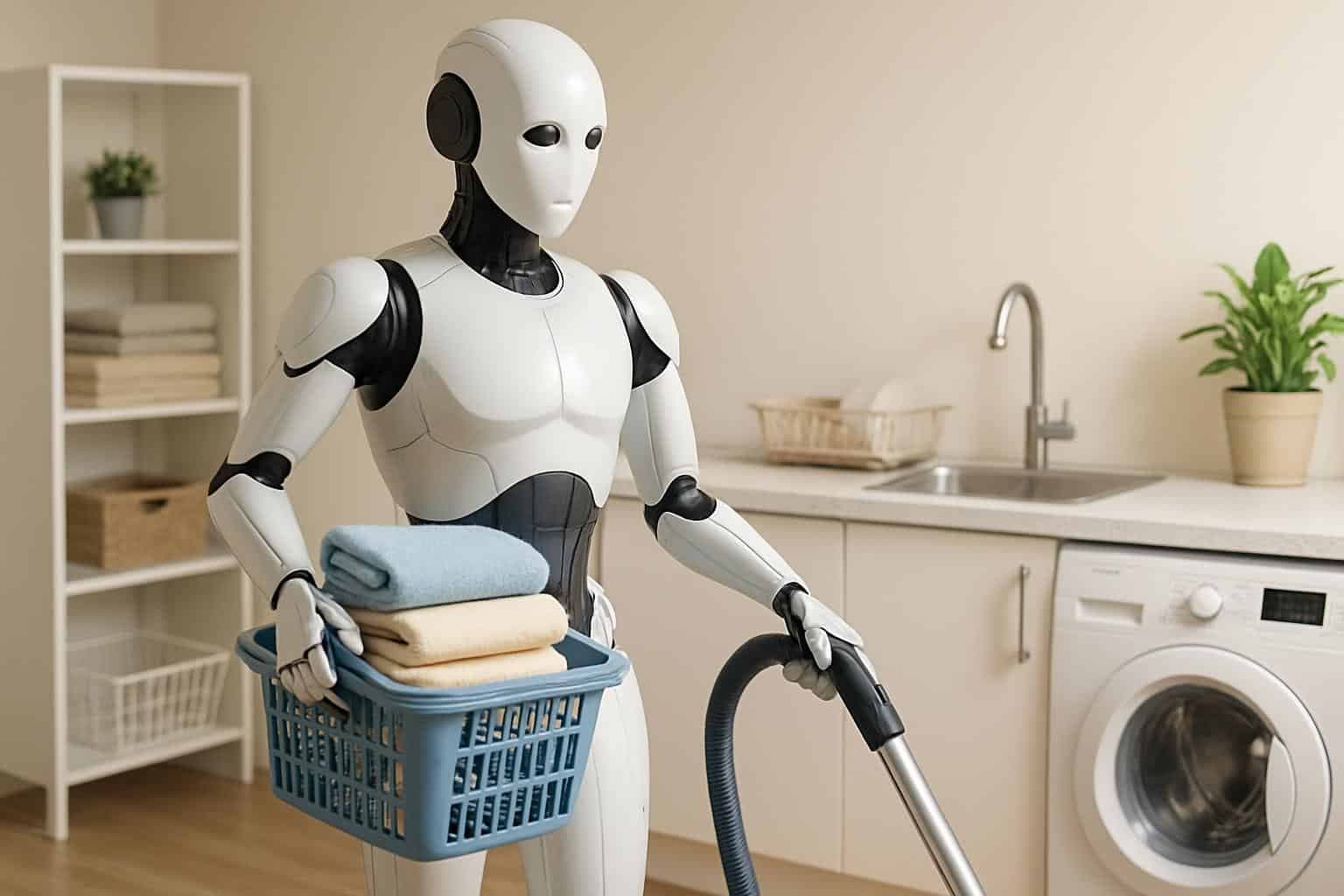
A home robot developed by the Chinese AI company UniXAI is reportedly performing daily household chores, including laundry, in real homes in Suzhou, China. The development, highlighted in a social media post, suggests a move from laboratory demonstrations to early, practical deployments of domestic robotics.
What Happened
According to a post on X (formerly Twitter) by AI observer Rohan Pandey (@rohanpaul_ai), UniXAI's home robot is "taking on daily chores" in Suzhou. The specific task mentioned is laundry, indicating the robot is interacting with complex, deformable objects and multi-step processes in unstructured home environments. The post frames this as robots "moving households fast, for real," contrasting it with staged promotional videos.
Context
Developing robots capable of reliably performing a wide array of chores in diverse, cluttered human homes is one of the grand challenges in AI and robotics. It requires integrating advanced computer vision for object recognition and scene understanding, dexterous manipulation to handle varied items, and long-horizon task planning to break down activities like "do the laundry" into a sequence of actions (sorting, loading detergent, operating machine, transferring clothes).
Most public progress in this domain has come from research labs like Google's DeepMind (with its RT-2 and other models) or Boston Dynamics, often shown in controlled settings. A claim of robots operating in actual households represents a significant, if early, validation step.
Limited Technical Details
The source material is a brief social media post, not a technical paper or corporate announcement. Therefore, critical details about the UniXAI robot are not provided. Unknowns include:
- Robot Form Factor: Is it a humanoid, a mobile manipulator on a wheeled base, or a specialized stationary arm?
- Autonomy Level: Is it fully autonomous, or does it operate with human supervision or high-level guidance?
- AI Stack: What perception, planning, and control models drive it? Is it vision-language-action model based (e.g., similar to Google's RT-1/RT-2)?
- Scope of Tasks: Beyond laundry, what other "daily chores" can it perform?
- Deployment Scale: Is this a single pilot home, a small trial, or a broader rollout?
Without this information, the development should be viewed as a notable data point in the trend toward practical home robotics, rather than a detailed technical breakthrough.
gentic.news Analysis
This report of a UniXAI home robot operating in Suzhou fits directly into the intensifying global race to develop general-purpose robots for consumer and industrial settings. While the technical specifics are absent, the location and company are significant. China has identified robotics as a critical strategic industry, and domestic companies are pushing aggressively on both the hardware and AI software fronts. This follows a pattern of rapid prototyping and real-world testing seen in other Chinese tech sectors.
This development aligns with the broader industry trend we've been tracking, where large foundation models for robotics are transitioning from research to application. For instance, our previous coverage of Google's RT-2 highlighted how vision-language-action models could translate internet-scale knowledge into robotic control. A company like UniXAI deploying a robot for chores suggests they may be implementing similar architectural principles, focusing on the immense challenge of reliability and safety in unstructured environments.
The mention of laundry is particularly telling. It's a chore often cited as a target for home automation but fraught with difficulty due to the need to perceive and manipulate soft, tangled fabrics, operate appliances, and handle liquids. Success here, even if partial, implies non-trivial advances in multimodal perception and manipulation policies. The key question for practitioners is not just if it can do a task in a demo, but its mean time between failures (MTBF) in a real home—a metric that will determine economic viability.
Frequently Asked Questions
What is UniXAI?
UniXAI is a Chinese artificial intelligence company. Based on this report, a core focus of their research and development appears to be applied robotics, specifically for domestic and service-oriented tasks. Detailed public information about the company's founding, funding, or full product portfolio is limited.
What can the UniXAI home robot do?
Based on the single source report, the robot is performing daily household chores. The only specific task mentioned is laundry. The phrase "daily chores" suggests it may be capable of a suite of related activities, such as tidying, light cleaning, or fetching items, but these are not confirmed.
Is this robot fully autonomous?
The source material does not specify the level of autonomy. It could range from full autonomy, where the robot perceives, plans, and acts without intervention, to a high-level instruction following model (e.g., "do the laundry") with human oversight for error recovery, or even more direct teleoperation or guidance. True, reliable full autonomy for a long-horizon task like laundry in any home environment remains an unsolved problem.
How does this compare to robots from Boston Dynamics or Tesla?
The comparison is difficult without technical details. Boston Dynamics' Atlas has demonstrated incredible dynamic mobility and dexterity in research videos but is not a consumer product. Tesla's Optimus is a humanoid robot in development, with public updates showing progress on tasks like sorting battery cells or folding shirts in a lab. The UniXAI report is distinct in claiming operation in actual households, which is a different validation milestone than a corporate lab demo. However, without performance metrics or video evidence, the relative capabilities cannot be assessed.