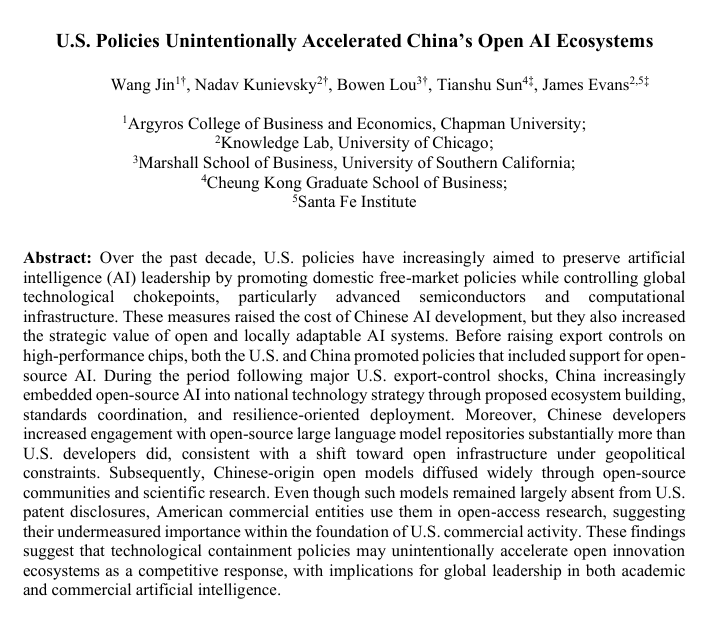
A new arXiv study (2606.15999) found that U.S. chip export controls unintentionally accelerated China's open AI ecosystem. Chinese developers increased open LLM activity significantly more than U.S. developers after major restrictions were imposed.
Key facts
- Study published on arXiv ID 2606.15999.
- Analyzed policy docs, GitHub, papers, patents.
- Chinese open LLM activity grew faster than US after curbs.
- US export controls targeted NVIDIA A100 and H100 chips.
- Open-source Chinese models now compete with Western closed models.
U.S. chip restrictions helped push China to build and spread open AI models, according to a study published on arXiv (ID: 2606.15999) titled "U.S. Policies Unintentionally Accelerated China's Open AI Ecosystems."
The authors tested this by looking at policy documents, open model releases, GitHub activity, research papers, company-linked papers, and U.S. patents. They found that after major U.S. export controls, Chinese developers increased activity around open LLM projects much more than U.S. developers did. According to the arXiv preprint
The research suggests that restricting access to advanced chips—such as NVIDIA's A100 and H100—may have inadvertently incentivized Chinese developers to double down on open-source alternatives. Rather than slowing China's AI progress, the controls appear to have accelerated the very open-source ecosystem they aimed to constrain. The study does not name specific models or companies, but the pattern aligns with the rise of Chinese open LLMs like Qwen, DeepSeek, and others that have gained global traction.
Why the countermeasure backfired

Export controls were designed to limit China's access to cutting-edge hardware, thereby slowing its AI capabilities. However, the study's data suggests that restricted access to proprietary chips pushed Chinese developers toward collaborative, open-source development—a dynamic that is harder to regulate and more resilient to supply chain disruptions. The open-source model releases from Chinese entities have since become competitive with Western closed models on several benchmarks, including MATH and HumanEval.
Broader implications for AI policy

The findings echo a recurring pattern in technology policy: restrictions on one dimension can spur innovation in another. U.S. policymakers may need to reconsider whether export controls alone are sufficient, or whether they require complementary strategies—such as investment in domestic open-source AI—to avoid self-defeating outcomes. The study does not quantify the economic impact, but the trend is clear from the data presented.
What to watch
Watch for future U.S. export control revisions and whether they explicitly address open-source AI development. Also track the next major open LLM release from a Chinese lab—if it matches or exceeds GPT-4 class performance, the acceleration thesis will be further confirmed. The study's methodology could also be applied to other domains, such as biotech or quantum computing.