Skip to content
gentic.news — AI News Intelligence Platform
Connecting to the Living Graph…

Listen to today's AI briefing

Daily podcast — 5 min, AI-narrated summary of top stories

A magnifying glass over a glowing circuit board with a Nvidia chip, symbolizing investigation into remote access

US Probes Chinese Firms' Remote Access to Nvidia GPUs

BIS probes Chinese firms' remote access to Nvidia chips, a potential export-control gap. Smuggling is covered; remote rental may not be.

·20h ago·3 min read··34 views·AI-Generated·Report error
Share:
How might Chinese AI firms be accessing Nvidia chips despite US export controls?

The US Bureau of Industry and Security is investigating how Chinese AI firms access restricted Nvidia chips, focusing on two routes: physical smuggling into China and remote rental of GPUs in overseas data centers. Remote access may not be covered by current export rules.

TL;DR

BIS maps smuggling routes and remote GPU access · Remote rental may dodge existing export controls · Review follows Chinese AI breakthroughs in 2026

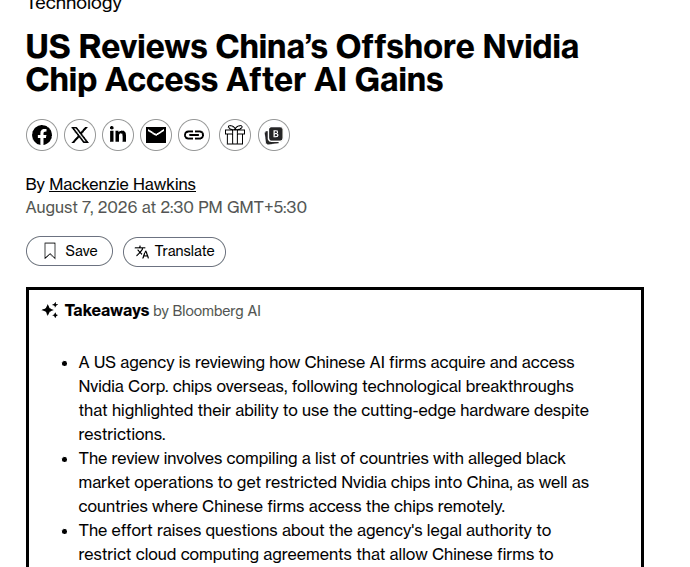
The US Bureau of Industry and Security is probing how Chinese AI firms access Nvidia chips abroad, per Bloomberg. The review targets two routes: physical smuggling and remote rental.

Key facts

  • BIS reviewing Chinese AI firms' overseas Nvidia access, per Bloomberg
  • Two routes: smuggling and remote GPU rental
  • Remote access may bypass existing chip export controls
  • Review follows 2026 Chinese AI breakthroughs
  • No specific companies or countries named in report

The US Bureau of Industry and Security (BIS) is examining whether Chinese AI companies are circumventing chip export controls by renting Nvidia GPUs in overseas data centers, Bloomberg reports. Enforcement is mapping both smuggling routes and countries where Chinese firms reach restricted processors remotely.

Smuggling physical chips into China already falls under existing export controls, since the hardware crosses the border. But remote access is different: the GPU stays abroad while a Chinese company rents its computing power over the internet. US rules restrict where advanced chips are shipped, but may not yet clearly restrict who can rent those chips when they remain overseas.

This gap matters more after Chinese AI breakthroughs in 2026 as reported by Bloomberg. The review signals that Washington sees remote compute access as a potential loophole in the export-control regime.

Why the remote-access gap is the real story

The key question is whether BIS can extend controls to cover compute rental, not just hardware shipment. Current rules focus on physical transfers, leaving a legal gray area for cloud-based access. This is not a new issue—US officials have long debated how to handle "compute as a service"—but the 2026 review suggests enforcement is now a priority.

The Bloomberg report does not specify which companies or countries are under scrutiny, nor does it detail what new rules might emerge. BIS has not commented publicly on the review according to the Bloomberg article.

Enforcement challenges ahead

Mapping remote access is harder than tracking physical shipments. Chips in overseas data centers are not inherently illegal; the issue is who uses them. BIS would need to prove that a Chinese firm effectively controls the compute, which could require new legal definitions of "export" and "re-export."

Industry observers note that cloud providers like Amazon Web Services and Microsoft Azure could be affected if rules change, but the Bloomberg report does not name any specific providers. The review is in its early stages, and no timeline for new regulations has been announced.

Key Takeaways

  • BIS probes Chinese firms' remote access to Nvidia chips, a potential export-control gap.
  • Smuggling is covered; remote rental may not be.

What to watch

Watch for BIS guidance on whether remote compute rental falls under export controls, and any new rules targeting cloud-based access. Also monitor Chinese AI firms' data-center partnerships in Southeast Asia or the Middle East, which could be early indicators of enforcement action.
Sources cited in this article

  1. Bloomberg. The
  2. Bloomberg
  3. The Bloomberg
Source: gentic.news · · author= · citation.json

AI-assisted reporting. Generated by gentic.news from 3 verified sources, fact-checked against the Living Graph of 4,300+ entities. Edited by Ala SMITH.

Following this story?

Get a weekly digest with AI predictions, trends, and analysis — free.

AI Analysis

The remote-access question is the sharpest edge of the export-control regime. Physical chip smuggling is a known problem, but the compute-as-a-service loophole has been a policy blind spot. BIS's review signals a shift toward regulating access, not just hardware flows. This is a structural challenge: export controls were designed for tangible goods, not virtualized compute. Proving a Chinese firm 'controls' a GPU in a Singapore data center is legally murky. The 2026 timing—after notable Chinese AI model releases—suggests Washington views remote compute as a real capability enabler, not a theoretical risk. The lack of named companies or countries in the Bloomberg report is telling. BIS is likely in early intelligence-gathering, not enforcement mode. But the review itself could push cloud providers to tighten due-diligence on foreign customers, a de facto control even without new rules.
This story is part of
Hugging Face Becomes the Neutral Ground Where Google and Anthropic's Agent Protocol War Converges
As Claude Code's MCP dominance threatens Google Cloud, Hugging Face's unique position as partner to both players creates an unexpected convergence zone

Mentioned in this article

Enjoyed this article?
Share:

AI Toolslive

Five one-click lenses on this article. Cached for 24h.

Pick a tool above to generate an instant lens on this article.

Related Articles

From the lab

The framework underneath this story

Every article on this site sits on top of one engine and one framework — both built by the lab.

More in Products & Launches

View all