Amazon Web Services declared AWS DevOps Agent generally available on March 31, 2026, pairing the launch with a production-ready integration with the Datadog MCP Server that the two companies had previewed at re:Invent 2025. The combination targets the most expensive phase of software operations: the minutes between an alert firing and an engineer understanding what broke.
What the Architecture Actually Does
It is worth being precise about what is connected to what, because marketing copy from both vendors blurs this.
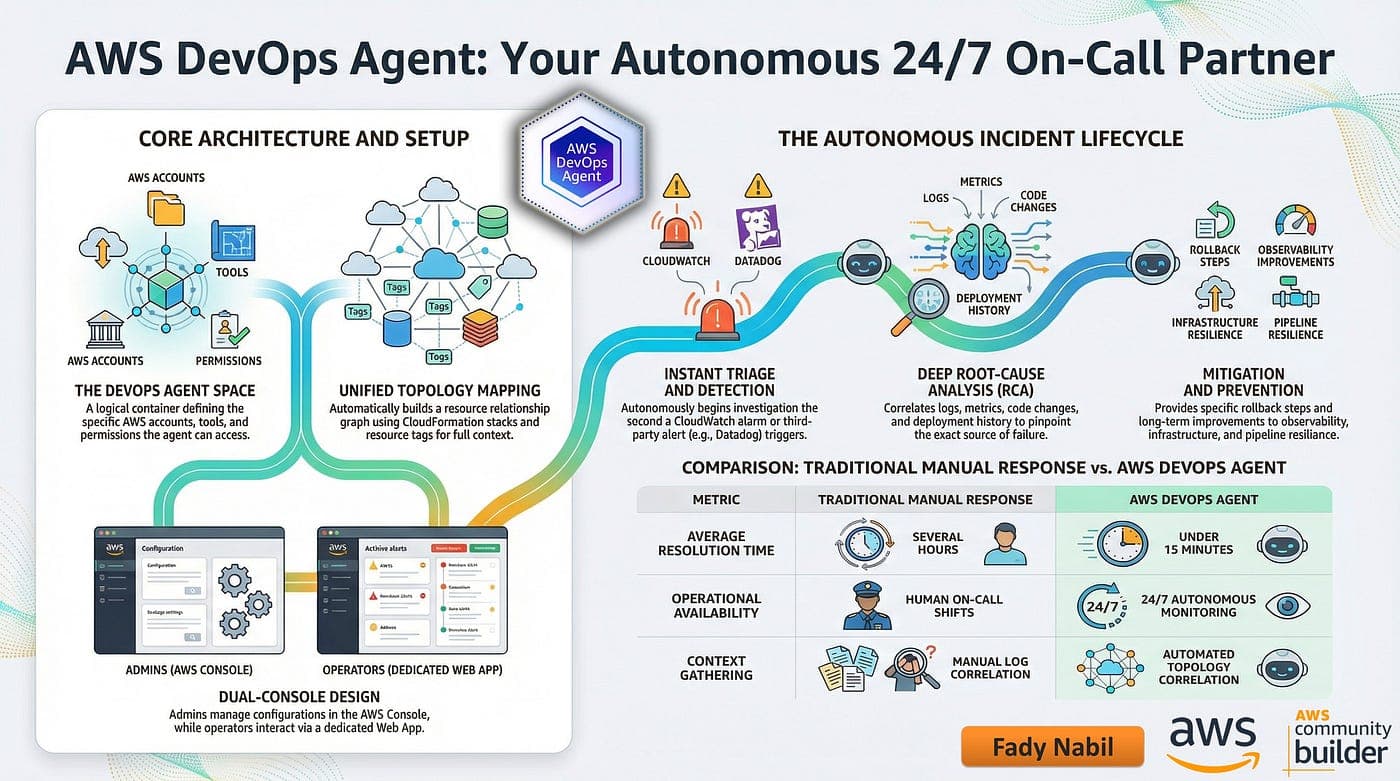
AWS DevOps Agent is Amazon's own autonomous AI agent, hosted in your AWS account as an "Agent Space." It is not Claude Code, and it does not run inside your IDE. It is a cloud-native service that wakes on an alert, investigates autonomously, and surfaces findings through a central dashboard where engineers can review and intervene.
Datadog MCP Server (launched March 10, 2026) is a remote Model Context Protocol server that exposes Datadog's logs, metrics, APM traces, and monitor states to any MCP-compatible agent over OAuth 2.0. AWS DevOps Agent can be configured to call it as a telemetry source during an investigation.
The closed-loop workflow runs as follows:
- A Datadog monitor fires and sends a webhook to an AWS DevOps Agent endpoint.
- AWS DevOps Agent pulls structured context from the Datadog MCP Server — error logs, span-level latency, recent deployment events — without requiring a human to open a browser.
- The agent correlates that Datadog telemetry with Amazon CloudWatch logs, CloudTrail events, and CI/CD deployment history to build a unified picture of the incident.
- It proposes — or, depending on configuration, executes — a mitigation: rolling back a deployment, scaling an Auto Scaling group, adjusting a parameter.
- Engineers can monitor the investigation on a dashboard and engage the agent via chat at any point.
Datadog connects via OAuth 2.0 and supports multi-region deployments to satisfy data sovereignty requirements. Upon configuration, AWS issues a one-time webhook URL and auth token that must be saved immediately.
Verified Numbers
AWS has published several customer figures from the preview period:
- Up to 75% lower MTTR — reported across preview customers broadly.
- 3–5x faster incident resolution — AWS's headline claim for the agent.
- Hours to minutes — Western Governors University (WGU) reported this shift specifically for their environment.
- 40% MTTR reduction — Clariant, using DevOps Agent with Dynatrace (a competing observability vendor), reported cutting manual investigation time by more than half.
- 100+ AWS integrations, 1,000+ built-in integrations — Datadog's catalog breadth, providing context for why the MCP bridge matters.
These are vendor-reported figures from a commercial launch, not independent benchmarks. They should be read as directional, not deterministic.
Key Facts
- GA date: March 31, 2026
- Datadog MCP Server GA: March 10, 2026
- Regions: Six at launch, including us-east-1, eu-west-1, eu-central-1
- Other GA integrations: Azure, Azure DevOps, PagerDuty, Grafana, Dynatrace, New Relic, Splunk, GitHub, GitLab, ServiceNow, Slack
- Pricing: Credits against AWS Support spend — 100% for Unified Operations, 75% for Enterprise Support, 30% for Business Support+. Two-month free trial for new customers.
- Notable preview customers: United Airlines, T-Mobile, Western Governors University
Why This Moment Matters
The Datadog integration matters because observability data has historically been the hardest context gap to close for AI agents working on production incidents. An agent that can read your code but cannot read your logs is blind to the most important signal. Datadog's MCP Server is the first production-grade bridge between a major observability platform and the emerging class of autonomous operations agents — and AWS being the first hyperscaler to build a native connector at GA gives the pattern institutional weight.
The broader pattern is also significant: AWS is simultaneously launching Security Agent alongside DevOps Agent, and both support extensibility through custom skills. This suggests Amazon is building toward a platform of autonomous operational agents rather than one-off tooling.
For teams already invested in Datadog and AWS, the marginal cost of connecting the two is low — the Datadog MCP Server uses existing API keys and OAuth, and AWS Support credits may absorb the DevOps Agent cost entirely at Enterprise tier.
What to Watch
The immediate questions are whether autonomous execution (not just investigation) reaches production trust in real-world on-call settings, and whether independent benchmarks replicate AWS's 75% MTTR claim. Watch for Dynatrace, New Relic, and Grafana to respond with comparable MCP integrations — Datadog's MCP Server launch has now set a baseline the rest of the observability market will be measured against.
Source: gn_mcp_protocol