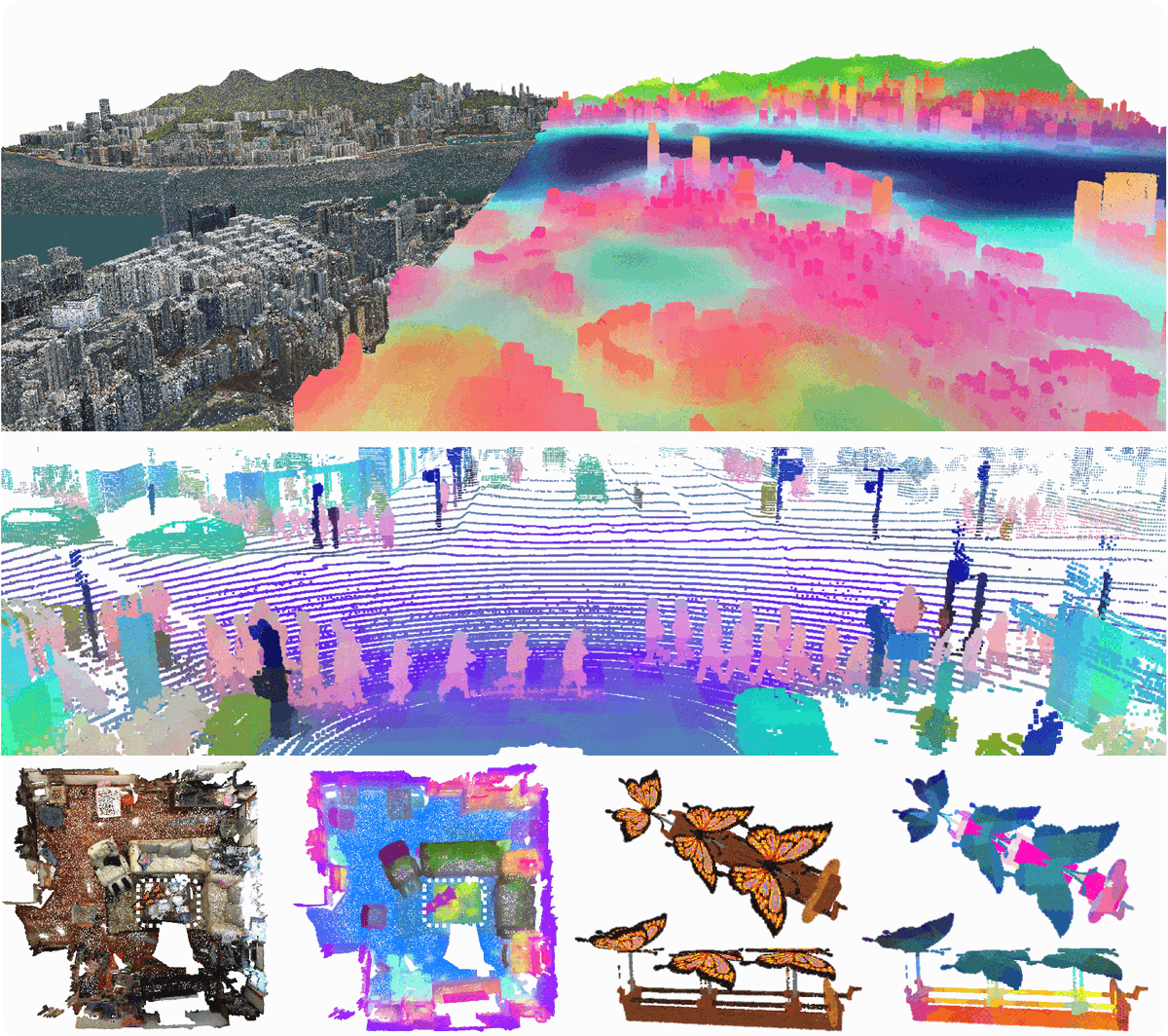
Researchers have achieved a significant milestone in 3D artificial intelligence with the development of Utonia, a single self-supervised transformer model capable of learning unified representations across all types of point cloud data. This breakthrough addresses one of the most persistent challenges in 3D computer vision: the fragmentation of models and representations across different data domains.
The Fragmented World of 3D Data
Until now, 3D AI systems have typically required specialized models for different types of point cloud data. LiDAR data from autonomous vehicles, CAD models from manufacturing, indoor scans from architectural applications, and video-lifted 3D reconstructions each demanded their own specialized architectures and training approaches. This fragmentation created significant barriers to knowledge transfer between domains and limited the scalability of 3D AI applications.
Point clouds—collections of data points in three-dimensional space—have become increasingly important across numerous industries. Autonomous vehicles rely on LiDAR point clouds for navigation, manufacturing uses CAD point clouds for design and quality control, and augmented reality applications depend on reconstructed point clouds from video data. The lack of a unified approach to processing these diverse data types has been a major bottleneck in the field.
How Utonia Works: Technical Innovation
Utonia employs a self-supervised learning approach that allows it to learn from unlabeled point cloud data across multiple domains simultaneously. The transformer architecture, which has revolutionized natural language processing and 2D computer vision, has been adapted to handle the unique challenges of 3D point cloud data.
The key innovation lies in Utonia's ability to extract domain-invariant features while still capturing the specific characteristics of different point cloud types. The model learns to recognize fundamental 3D structures and patterns that transcend specific data sources, creating a shared representation space where knowledge from one domain can benefit applications in another.
Unlike previous approaches that required separate encoders for different point cloud types or extensive fine-tuning for domain adaptation, Utonia uses a single encoder architecture that processes all point cloud data through the same neural network pathways. This unified approach dramatically reduces computational overhead and simplifies deployment across diverse applications.
Cross-Domain Transfer and Emergent Behaviors
One of the most remarkable aspects of Utonia is its ability to facilitate cross-domain transfer—applying knowledge learned from one type of point cloud data to completely different domains. For example, patterns learned from indoor architectural scans could potentially improve object recognition in autonomous vehicle LiDAR data, or techniques developed for CAD model analysis could enhance video-based 3D reconstruction.
Researchers have observed emergent behaviors in the model that weren't explicitly programmed or trained. These include improved generalization to unseen point cloud types, better handling of noisy or incomplete data, and the ability to perform zero-shot learning on new point cloud categories. Such emergent capabilities suggest that Utonia is learning fundamental principles of 3D structure rather than simply memorizing patterns from specific datasets.
Practical Applications and Industry Impact
The implications of this research extend across multiple industries:
Autonomous Systems: Self-driving vehicles could benefit from more robust perception systems that integrate knowledge from diverse 3D data sources, potentially improving safety and reliability in varied environmental conditions.
Manufacturing and Design: CAD model analysis could be enhanced by incorporating insights from real-world scanned data, enabling better simulation, quality control, and design optimization.
Robotics: Robots operating in unstructured environments could leverage unified 3D representations to better understand their surroundings and manipulate objects more effectively.
Geospatial Analysis: Remote sensing and LiDAR data analysis could be improved through cross-pollination with other point cloud domains, potentially enhancing applications in urban planning, environmental monitoring, and disaster response.
Augmented and Virtual Reality: More accurate and efficient 3D reconstruction from video data could lead to improved AR/VR experiences and content creation tools.
Challenges and Future Directions
While Utonia represents a significant advance, challenges remain. The model's performance across extremely diverse point cloud types requires further validation in real-world applications. Additionally, the computational requirements for training such a comprehensive model, while reduced compared to maintaining multiple specialized models, are still substantial.
Future research directions likely include:
- Extending the approach to include temporal point cloud data (4D)
- Integrating Utonia with other modalities like images and text
- Developing more efficient training methods for the unified model
- Exploring applications in scientific domains like molecular modeling and astrophysics
The Broader Context in AI Research
Utonia's development reflects broader trends in artificial intelligence research toward unified models that can handle multiple data types and tasks. Just as large language models have demonstrated remarkable capabilities across diverse language tasks, Utonia suggests that similar unification may be possible in the 3D domain.
This research also highlights the growing importance of self-supervised learning in computer vision and beyond. By learning from unlabeled data across multiple domains, Utonia demonstrates how AI systems can develop more general and robust representations without requiring massive amounts of manually annotated data for each specific application.
The work on Utonia, shared via HuggingFace's research dissemination channels, represents another example of how open research sharing accelerates innovation in artificial intelligence. As 3D data becomes increasingly important across industries, unified approaches like Utonia will likely play a crucial role in making 3D AI more accessible, efficient, and powerful.
Source: Research shared via HuggingFace Papers (@HuggingPapers) highlighting Utonia's unified approach to point cloud representation learning.