What Happened
A technical practitioner has published a detailed account of their experience implementing Facebook AI Similarity Search (FAISS) as a vector database for a recommendation system. The article, hosted on Medium, is framed as a set of "key insights" gained from hands-on work, focusing on the practical realities of vector indexing and search. While the full text is behind a paywall, the summary indicates the content delves into the operational nuances of using this foundational technology for a canonical AI application: recommendations.
Technical Details: FAISS and Vector Search
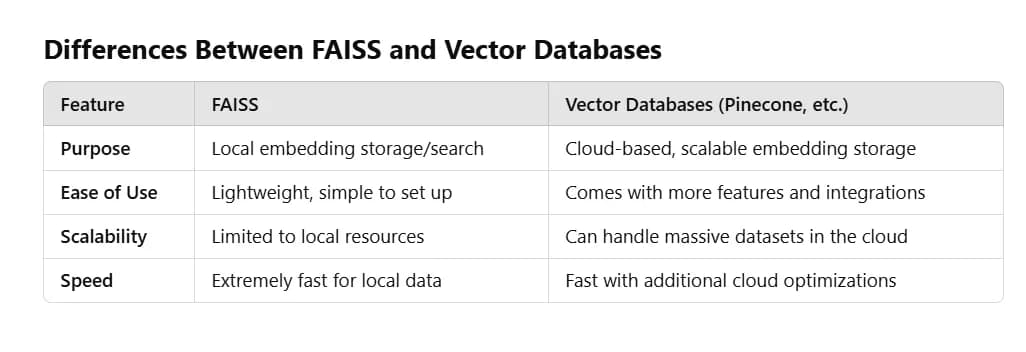
FAISS is an open-source library developed by Facebook AI Research for efficient similarity search and clustering of dense vectors. It is not a full-fledged database in the traditional sense but a specialized library that enables fast nearest-neighbor search, which is the computational heart of many modern AI systems.
In the context of recommendation systems, the core workflow involves:
- Embedding Generation: Items (products, articles, videos) and users are converted into numerical representations called embeddings using models (e.g., collaborative filtering models, transformer-based models). These embeddings capture semantic or behavioral similarities in a high-dimensional space.
- Indexing with FAISS: These millions of embeddings (vectors) are ingested into FAISS, which builds an index. FAISS provides multiple indexing methods (e.g., IVF, HNSW, Product Quantization) that trade off between search speed, accuracy, and memory usage.
- Querying: When a user interacts with the platform, their current state or profile is also converted into an embedding (a query vector). FAISS performs a nearest-neighbor search to find the most similar item vectors from its index, which are then returned as recommendations.
The practitioner's insights likely cover critical implementation choices, such as:
- Selecting the appropriate FAISS index type for a given scale and latency requirement.
- Balancing recall (finding all relevant items) against query speed.
- Managing the computational cost and memory footprint of the index.
- Handling the continuous update of the index with new items or user interactions.
Retail & Luxury Implications
While the source article is a general technical write-up, the application to retail and luxury is direct and profound. Vector search powered by libraries like FAISS is the engine behind the next generation of personalized customer experiences.
1. Hyper-Personalized Discovery: Moving beyond simple "customers who bought this also bought" rules, vector-based systems can understand nuanced style preferences. A customer who browses minimalist leather handbags and architectural watches can be shown a curated selection of modern furniture or avant-garde jewelry that shares a similar aesthetic embedding, creating a cohesive brand universe.
2. Visual and Multi-Modal Search: Luxury is intensely visual. FAISS can index vectors generated from product images by vision models (like CLIP). This enables "search by image" or "find similar style" features where a customer can upload a photo of a desired silhouette or texture and find matching items from the catalog, dramatically improving discovery.
3. Scalable Real-Time Recommendations: For global e-commerce platforms with catalogs of millions of SKUs, the efficiency of FAISS is non-negotiable. It allows for real-time, personalized recommendations on product pages, in search results, and in marketing emails without degrading user experience with slow load times.
4. Unified Customer Profiles: By creating embeddings from diverse data streams—purchase history, browsing behavior, CRM data, and even customer service interactions—a brand can build a holistic vector representation of a customer. FAISS can then find clusters of similar customers for targeted campaigns or identify high-value customers who exhibit signals of interest in a new collection.
The gap between the technical implementation described in the source and a production retail system lies in the surrounding data infrastructure: the robustness of the embedding models, the pipeline for updating vectors in real-time, and the integration with existing product catalogs and CRM systems. The FAISS component is a critical, high-performance cog in a much larger machine.