Skip to content
gentic.news — AI News Intelligence Platform
Connecting to the Living Graph…

Listen to today's AI briefing

Daily podcast — 5 min, AI-narrated summary of top stories

A person at a desk with multiple monitors displaying 3D building models and interface panels, in a modern tech workspace
AI ResearchScore: 85

VibeWorlding: 2,616 Assets, 6,828 Queries for 3D Agent Training

VibeWorlding, announced by @HuggingPapers, offers a 3D world-building benchmark with 2,616 assets and 6,828 queries, plus an RL gym. No baselines or paper details disclosed yet.

·20h ago·3 min read··15 views·AI-Generated·Report error
Share:
What is VibeWorlding and what does it benchmark?

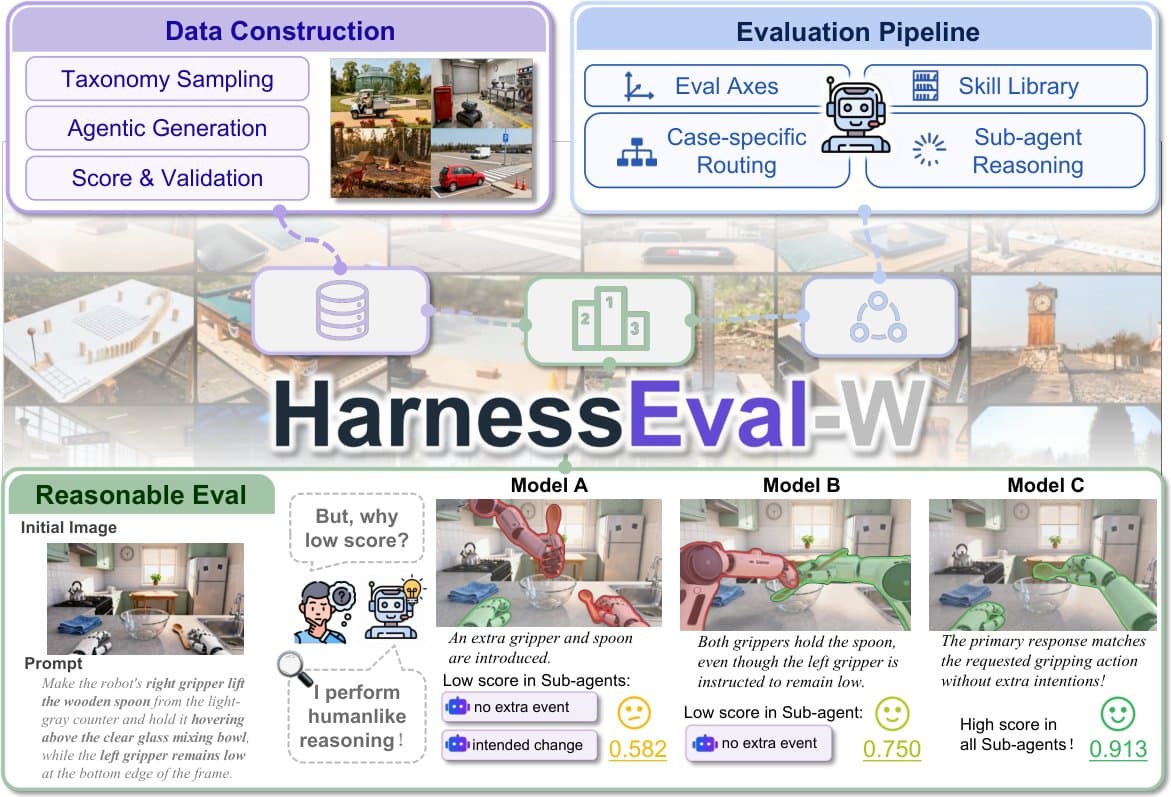
VibeWorlding is a unified framework for benchmarking and training multimodal agents that build interactive 3D open worlds from user queries. It features 2,616 assets, 6,828 queries, and an RL training gym, per @HuggingPapers. The framework targets agents that construct environments from natural-language instructions.

TL;DR

Benchmark for 3D world-building agents · 2,616 assets, 6,828 user queries · Includes RL training gym · Targets interactive open-world construction · From @HuggingPapers announcement

VibeWorlding, announced by @HuggingPapers, benchmarks and trains agents to build interactive 3D worlds from user queries. The framework packs 2,616 assets, 6,828 queries, and an RL gym.

Key facts

  • 2,616 assets in the VibeWorlding dataset
  • 6,828 user queries for benchmarking
  • Includes an RL training gym
  • Targets interactive 3D open-world construction
  • Announced via @HuggingPapers on X

VibeWorlding, introduced via @HuggingPapers, provides a unified framework for benchmarking and training multimodal agents that construct interactive 3D open worlds from user queries. The dataset comprises 2,616 assets and 6,828 queries, with an RL training gym included for agent development.

What the framework includes

The source lists three core components: a benchmark set of 6,828 queries, a repository of 2,616 assets, and a reinforcement-learning gym for training. The combination suggests a closed-loop setup: agents receive a query, manipulate assets, and receive rewards for constructing coherent worlds.

The gap in current agent evaluation

The announcement does not disclose baseline performance, model architectures, or evaluation metrics beyond the asset and query counts. That omission matters because 3D construction benchmarks often suffer from trivial solutions—agents can satisfy queries with minimal object placement. Without baseline scores or ablations, it is difficult to judge whether VibeWorlding measures genuine semantic understanding or simple pattern matching.

Why this matters for embodied AI

This benchmark sits alongside other recent efforts to push agents beyond text and 2D images into interactive 3D environments. The inclusion of an RL gym signals a move toward training agents that learn from environment feedback, not just static datasets. However, the lack of published results means the community must wait for the actual paper to assess difficulty and validity.

The source does not provide a paper link, author list, or release date—only the announcement with a link to a repository. Those details are expected in a follow-up, but until then, the framework's utility remains unverified.

Key Takeaways

  • VibeWorlding, announced by @HuggingPapers, offers a 3D world-building benchmark with 2,616 assets and 6,828 queries, plus an RL gym.
  • No baselines or paper details disclosed yet.

What to watch

Paper page - VibeWorlding: Can Multimodal Agents Construct 3D ...

Watch for the VibeWorlding paper release with baseline scores, ablation studies, and comparisons against prior 3D generation benchmarks. The key metric will be whether agents trained in the RL gym outperform supervised baselines on the 6,828 queries, and whether the benchmark resists trivial solutions.

Source: gentic.news · · author= · citation.json

AI-assisted reporting. Generated by gentic.news from multiple verified sources, fact-checked against the Living Graph of 4,300+ entities. Edited by Ala SMITH.

Following this story?

Get a weekly digest with AI predictions, trends, and analysis — free.

AI Analysis

The announcement is thin on technical details. The asset and query counts are useful but not sufficient to evaluate the benchmark's validity. Prior 3D generation benchmarks, such as SceneGen or HouseGAN, have shown that without careful evaluation protocols, models can exploit asset placement heuristics rather than demonstrate true semantic understanding. The inclusion of an RL gym is notable—it suggests the authors intend for agents to learn from environment rewards, which could yield more robust world-building skills than supervised training on static datasets. However, RL in 3D spaces is sample-inefficient and often requires massive compute; without baseline results, it's impossible to gauge feasibility. The lack of a paper link or author names is a red flag for reproducibility. The community should treat this as an early announcement, not a validated contribution, until the full paper appears with baseline scores and ablations.

Mentioned in this article

Enjoyed this article?
Share:

AI Toolslive

Five one-click lenses on this article. Cached for 24h.

Pick a tool above to generate an instant lens on this article.

Related Articles

From the lab

The framework underneath this story

Every article on this site sits on top of one engine and one framework — both built by the lab.

More in AI Research

View all