A common roadblock for developers diving into AI agent frameworks is moving from understanding the tools to launching a real project. A new open-source repository, highlighted by the VMLOps community, directly tackles this by curating over 500 specific project ideas paired with starter code.
What's in the Repository
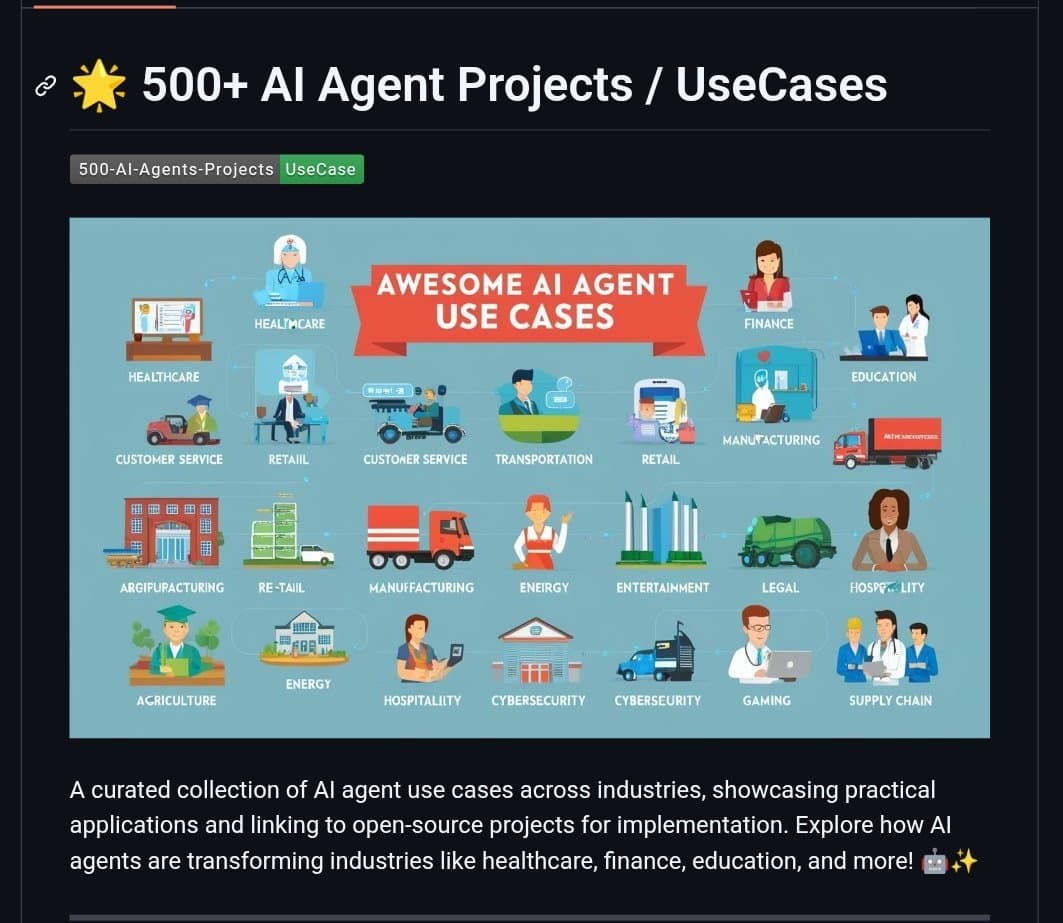
The repository is structured as a practical guide to overcoming the "blank canvas" problem in AI agent development. It organizes project ideas by industry verticals, including healthcare, finance, legal, gaming, and supply chain. For each idea, the repository provides associated code examples that utilize popular agent frameworks such as CrewAI, AutoGen, LangGraph, and Agno.
The core value proposition is acceleration: instead of spending days brainstorming and setting up a basic structure, a developer can browse the list, select a project relevant to their interests or domain, and immediately start with a functional codebase. This shifts the focus from "what to build" to "how to build it better."
The Developer Experience Gap
The tweet from @_vmlops pinpoints a specific and widespread pain point in the current AI engineering landscape. As frameworks for building multi-agent systems have matured—with tools like LangChain's LangGraph and CrewAI's orchestration layer becoming more accessible—the barrier to entry has shifted from technical implementation to practical ideation. Developers can learn the APIs and concepts but often stall when trying to conceive a project that is sufficiently complex to be instructive yet manageable for a learning exercise or portfolio piece.
This repository serves as a bridge, offering a menu of vetted starting points that are inherently multi-step or multi-agent in nature, which is precisely where these frameworks shine.
gentic.news Analysis
This development is a natural evolution in the maturing AI agent toolchain. For much of 2024 and 2025, the focus was on the core infrastructure: making frameworks like CrewAI and AutoGen stable, scalable, and interoperable. As we covered in our 2025 year-in-review, the "Year of the Agent," the community successfully moved from proof-of-concept agents to robust systems capable of handling real business logic.
Now, in 2026, the challenge is widespread adoption and practical application. This repository aligns with a clear trend we're tracking: the shift from framework development to developer enablement. It's a community-driven response to fill the gap left by framework documentation, which typically explains "how" but not "what." By providing concrete ideas with code, it lowers the activation energy for engineers to experiment with and ultimately productionize agentic workflows. This is crucial for the next phase of agent adoption, where use-case diversity will drive framework innovation.
Looking at the competitive landscape, this also indirectly pressures commercial platforms. While companies like Google (with its Vertex AI Agent Builder) and AWS (with Amazon Q Agent) offer guided, cloud-hosted agent creation, they often lock developers into specific ecosystems. An open-source, framework-agnostic idea repository empowers developers to build on their own terms, potentially fostering more innovation in the open-source agent space, which has been fiercely competitive with offerings from Meta, Microsoft, and various startups.
Frequently Asked Questions
What AI agent frameworks are supported in this repository?
The repository explicitly mentions and includes code examples for several leading open-source frameworks: CrewAI for role-based agent orchestration, AutoGen for conversational multi-agent systems, LangGraph for building stateful, cyclic workflows, and Agno, a newer framework for building robust AI-native applications. This multi-framework approach ensures developers aren't locked into a single toolset.
Is this suitable for beginners in AI agent development?
Yes, but with a caveat. The repository is an excellent resource for beginners who have completed introductory tutorials on a framework like CrewAI or LangGraph and are asking "what next?" It provides the crucial project context. However, users will still need a foundational understanding of the chosen framework's concepts (like agents, tasks, tools, and state graphs) to effectively modify and extend the provided starter code.
How are the project ideas categorized and selected?
The ideas are categorized by major industry verticals such as healthcare, finance, legal, gaming, and supply chain. This structure helps developers immediately narrow down to domains they have expertise or interest in. The selection likely prioritizes projects that are non-trivial, demonstrate clear multi-agent or multi-step logic, and have tangible real-world analogs, making them compelling for learning and portfolio development.
Can I contribute my own AI agent project idea to this repository?
Most open-source repositories of this nature welcome contributions. While the source material doesn't specify, it's highly probable that the maintainers accept pull requests for new project ideas, especially those that include clean, well-documented example code using the supported frameworks. This would be in line with the community-driven spirit of the VMLOps and broader AI engineering ecosystem.