Two days ago, Anthropic announced Agentic Workflows, a new managed service designed to run persistent, stateful AI agents on behalf of developers and enterprises. The announcement generated significant buzz, amassing 2 million views within two hours. However, a swift developer analysis on Hacker News highlighted that the headline-grabbing starting price of $0.08 per hour is a best-case scenario, with real-world costs being substantially more complex and often higher.
This move marks Anthropic's formal entry into the burgeoning AI agent orchestration market, competing directly with platforms like LangGraph, CrewAI, and OpenAI's recently announced Assistants API v2. Unlike simple API calls, Agentic Workflows are designed for long-running, multi-step tasks that require maintaining context, using tools, and making decisions over extended periods.
Key Takeaways
- Anthropic launched Agentic Workflows, a managed service for running persistent AI agents.
- While marketed from $0.08/hr, real-world costs are higher due to compute, memory, and network fees.
What's New: Managed, Persistent AI Agents
Agentic Workflows is a cloud-based service that abstracts away the infrastructure needed to run Claude-powered agents. Key features include:
- Stateful Execution: Agents maintain memory and context across long-running sessions, which can last for hours or days.
- Managed Infrastructure: Anthropic handles the provisioning, scaling, and reliability of the underlying compute.
- Integrated Tool Use: Agents can be equipped with pre-defined tools (e.g., web search, code execution, API calls) that they can invoke autonomously.
- Workflow Definition: Developers define agent behaviors and decision trees, which the service then executes.
The core promise is operational simplicity: developers define the what, and Anthropic manages the how of running complex AI agents.
The Real Cost: Beyond the $0.08/hr Headline
The initial marketing highlighted a starting price of $0.08 per hour for a basic agent instance. However, as dissected by the developer community, this is merely the base compute cost for a minimal instance. The total cost is a composite of several variables:
- Compute Cost: The $0.08/hr baseline. Scales with the assigned vCPUs and memory.
- Memory Cost: Persistent state storage is billed separately, akin to a managed database.
- Network Egress: Data transfer out of Anthropic's cloud incurs additional fees.
- Claude API Calls: Each inference call the agent makes to the Claude model is billed per-token, following standard Claude API pricing.
A realistic agent performing a non-trivial task—like conducting multi-source research, writing and testing code, or managing a customer support dialogue—would likely require more than minimal compute, significant memory for context, and numerous Claude calls. Early estimates suggest a moderately complex agent could easily cost $2-5 per hour or more, making total cost of ownership (TCO) a critical calculation for developers.
Compute Instance Base vCPU/Memory for agent runtime From ~$0.08/hour Persistent Memory Storage for agent state and context Per GB-hour Claude Inference Tokens processed for agent reasoning Per input/output token (API rates) Network Egress Data transferred out of Anthropic cloud Per GBHow It Compares: The Agent Platform Landscape
Anthropic is entering a competitive space. The launch positions Agentic Workflows as a direct competitor to:
- OpenAI's Assistants API: Offers persistence and tool use but is less focused on complex, long-horizon workflows.
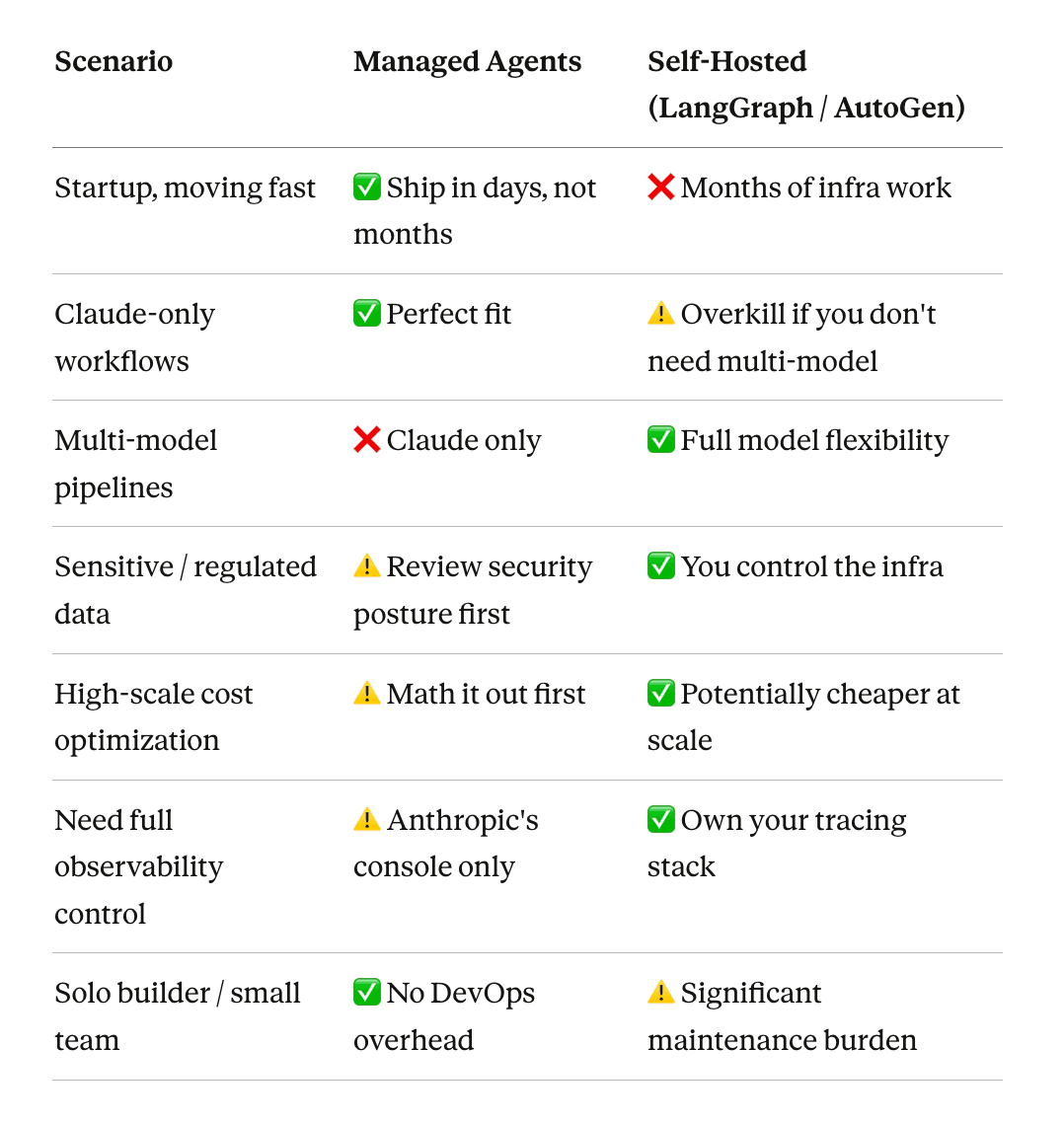
- Self-hosted Frameworks (LangGraph, CrewAI): Provide maximum flexibility but require developers to manage their own infrastructure, monitoring, and scaling.
- Cloud AI Services (AWS Bedrock Agents, Google Vertex AI): Offer similar managed agent capabilities but are tied to broader cloud ecosystems.
Anthropic's differentiator is the tight integration with the Claude model family, known for its strong reasoning and constitutional AI safety features. The service is likely optimized for Claude's specific strengths in long-context, chain-of-thought reasoning.
What to Watch: Limitations and Strategic Implications
The launch is significant, but several questions remain:
- Vendor Lock-in: Workflows are deeply tied to Claude. Porting an agent to another model (like GPT-4o or Gemini) would likely require a full rewrite.
- Performance Transparency: As a managed service, developers have less visibility into latency bottlenecks or fine-grained control over optimization.
- Market Fit: The pricing model makes it most viable for enterprise use-cases with clear ROI, potentially putting it out of reach for hobbyists or early-stage startups.
Strategically, this is Anthropic's answer to the agent-as-a-service trend. It moves the company beyond being just a model provider (selling API calls) to becoming a full-stack AI application platform. This aligns with a broader industry shift where model providers are capturing more of the value chain by offering higher-level, sticky services.
gentic.news Analysis
Anthropic's launch of Agentic Workflows is a direct and expected escalation in the platform wars between frontier AI labs. This follows OpenAI's major update to its Assistants API in late 2025, which added more robust state management and cheaper, faster models. The pattern is clear: leading model providers are no longer content to be mere inference engines; they are building vertically integrated platforms to host the next generation of AI-native applications.
This move also reflects a strategic pivot for Anthropic. Historically focused on research and model safety, the company is now demonstrating increased commercial agility. As we noted in our coverage of Claude 3.5 Sonnet's release, Anthropic has been steadily improving its developer platform and time-to-market. The Agentic Workflows launch confirms this trend towards productization.
The complex, multi-component pricing model is a double-edged sword. For enterprise clients, it offers granularity and potentially aligns cost with value. For the broader developer community, however, it introduces significant cost uncertainty. This creates an opening for open-source agent frameworks and middleware companies that can offer predictable, simplified pricing. The success of Agentic Workflows will hinge not just on its technical capabilities, but on whether developers find its value proposition—managed complexity—worth the premium and lock-in over self-hosted alternatives.
Frequently Asked Questions
How much does an Anthropic Agentic Workflow actually cost?
The total cost is highly variable and consists of four main components: compute instance time (from ~$0.08/hr), persistent memory storage, Claude API token usage, and network egress fees. A simple, idle agent might cost close to the baseline, but an agent performing meaningful work (research, coding, analysis) will incur significant Claude API costs and likely require more compute, leading to an estimated realistic range of $2 to $5 or more per hour.
How is this different from the OpenAI Assistants API?
While both offer persistent, tool-using agents, Anthropic's Agentic Workflows are architected for more complex, long-running, and stateful workflows that can last for hours or days. The OpenAI Assistants API is generally geared towards shorter, conversational interactions. Anthropic's service also uses a different pricing model, separating compute, memory, and inference costs, whereas OpenAI's pricing is primarily token-based.
Can I run my AI agent on Anthropic's service using a model other than Claude?
No. Agentic Workflows is a tightly integrated service designed specifically for the Claude model family. The workflows, tool calling, and state management are optimized for Claude's architecture and capabilities. Migrating an agent built on this platform to use a different foundational model would require significant re-engineering.
Is this service suitable for hobbyists or small projects?
Given the complex and potentially high costs, Agentic Workflows appears primarily targeted at enterprise and commercial applications where the cost can be justified by business value or ROI. For hobbyists, prototyping, or small-scale projects, using the standard Claude API with a self-hosted agent framework (like LangGraph) or using OpenAI's Assistants API likely offers more predictable and lower costs.