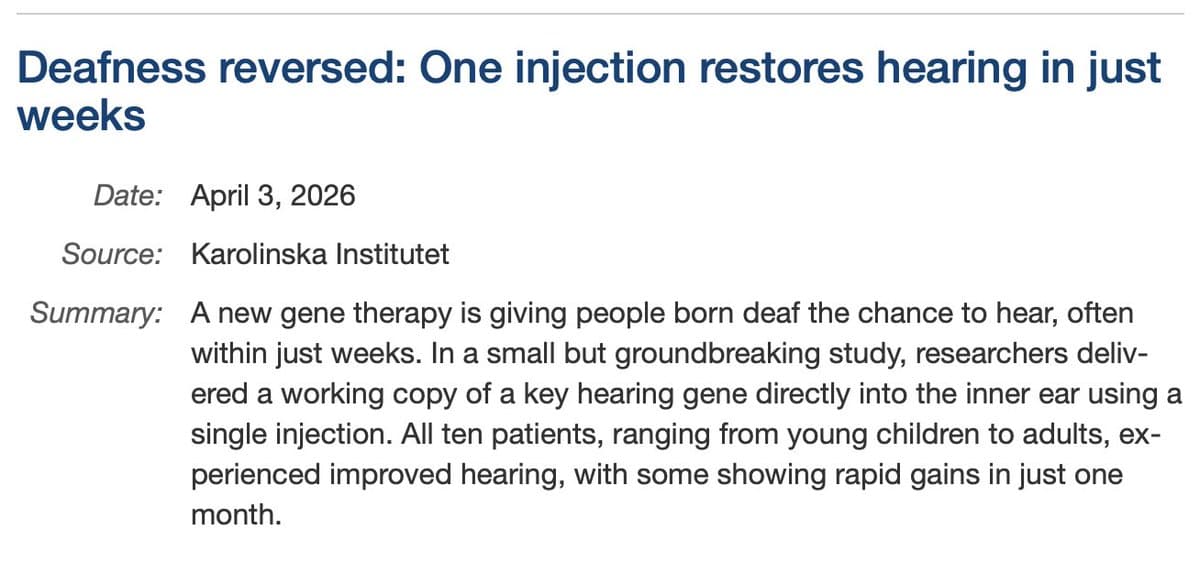
A clinical trial has reported a landmark result: a single injection of gene therapy directly into the inner ear successfully reversed deafness in all ten patients treated. According to a social media thread from a science communicator, some patients began hearing again within weeks of the treatment. The results suggest gene therapy has crossed a significant threshold for treating genetic forms of hearing loss, achieving an outcome many believed was still years away.
What Happened
The source, a thread from science communicator @kimmonismus, highlights results from an apparent clinical trial. The core claim is that a single administration of gene therapy, delivered via injection into the inner ear (likely the cochlea), led to a reversal of deafness in every one of the ten patients treated. The timeline for improvement was rapid for some, with hearing restoration observed within weeks. While the thread does not specify the exact genetic mutation targeted, the mechanism implies the therapy is designed to correct a specific inherited defect causing hearing loss.
Context
Hearing loss from genetic causes, such as mutations affecting the hair cells in the inner ear, has long been a target for gene therapy. Previous research in animal models has shown promise, but translating this to humans with robust, consistent results has been a major hurdle. Successful human trials have been limited and incremental. A result where 100% of patients (n=10) showed reversal of deafness represents an exceptionally high efficacy rate for any first-in-human gene therapy trial, particularly for a sensory disorder.
The Technical Approach
While the source thread promises to "dig into this breakthrough and how it works," the detailed mechanism is not provided in the initial post. Based on established research in the field, the likely approach involves using a viral vector (such as an adeno-associated virus or AAV) to deliver a functional copy of a defective gene into the cells of the inner ear. The injection is a delicate surgical procedure, requiring precise delivery to the cochlea to transduce hair cells or supporting cells. The rapid onset of effect (weeks) aligns with the timeline for gene expression and cellular repair following AAV-mediated delivery.
Why It Matters
If these preliminary results are validated and published in a peer-reviewed journal, they would represent one of the most successful demonstrations of gene therapy for a sensory disorder to date. Deafness affects millions worldwide, and a significant portion is genetic in origin. A safe, effective, one-time treatment could transform the standard of care, moving beyond hearing aids and cochlear implants to potentially restore natural hearing. The 100% response rate in a small cohort is a strong signal, though larger trials will be necessary to confirm safety and efficacy across a broader population.
gentic.news Analysis
This reported breakthrough sits at the convergence of two high-impact technological trends we track closely: advanced biomedical engineering and the increasing clinical validation of gene therapy platforms. While not a direct AI/ML development, the design of the viral vectors and the understanding of genetic pathways that make such therapy possible are increasingly informed by computational biology and AI-driven protein design tools. For instance, companies like DeepMind (via Isomorphic Labs) and Recursion Pharmaceuticals are applying AI to understand disease biology and drug discovery, creating a pipeline that could generate more targeted genetic medicines like this one.
Historically, progress in gene therapy for hearing loss has been steady but measured. This result, if confirmed, represents a dramatic acceleration. It follows a pattern of gene therapies achieving historic "firsts" in recent years, such as treatments for spinal muscular atrophy and inherited retinal disease. The field is moving from proving concept to delivering durable cures. For the AI and tech community, this is a critical reminder that the most profound applications of computational advancement may not be in generative chatbots, but in designing the tools that repair human biology at its most fundamental level. The companies and research institutes that master the integration of AI with wet-lab biology and clinical development will define the next decade of medicine.
Frequently Asked Questions
What type of deafness did this gene therapy treat?
The source does not specify the exact genetic condition, but the mechanism implies it targeted a specific form of inherited sensorineural hearing loss. Most likely, it addressed a monogenic disorder (caused by a mutation in a single gene) crucial for the function of hair cells in the inner ear, such as those involving the TMC1 or OTOF genes.
How is the gene therapy injected into the inner ear?
The procedure, known as an intracochlear injection, is a delicate microsurgical technique. It typically involves accessing the cochlea through the round window membrane and injecting a liquid containing the viral vector carrying the therapeutic gene. This allows the vector to directly transduce the cells inside the cochlea.
Is this gene therapy a cure for all types of deafness?
No. This approach is designed to correct specific genetic errors. It would not be effective for hearing loss caused by noise exposure, aging (presbycusis), infections, or non-genetic factors. Its application is for individuals whose deafness is directly caused by the particular gene defect the therapy is designed to fix.
What are the next steps after this trial?
The reported results are likely from an early-phase (Phase I/II) clinical trial focused on safety and initial efficacy. The next steps would involve a larger Phase III trial with more patients to conclusively prove the treatment's effectiveness and monitor long-term safety. Following successful Phase III trials, the therapy would seek regulatory approval (e.g., from the FDA or EMA) to become a commercially available treatment.