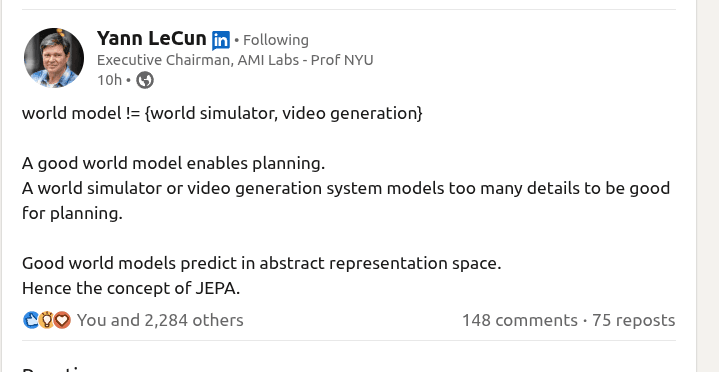
Meta's Chief AI Scientist Yann LeCun recently made a critical clarification on social media that has resonated throughout the AI research community. In response to a post by AI researcher Rohan Paul, LeCun stated: "world model != {world simulator, video generation}" - a concise but profound statement that challenges common assumptions about how artificial intelligence should understand and interact with reality.
This seemingly simple equation carries significant weight coming from one of the pioneers of deep learning and a leading voice in AI research. LeCun's distinction addresses a fundamental confusion in how researchers and developers conceptualize the building blocks of artificial intelligence, particularly as the field moves toward more sophisticated systems.
What LeCun Actually Said
The original statement appeared on X (formerly Twitter) in response to Rohan Paul's post. LeCun used mathematical notation to emphasize that world models are not equivalent to the set containing world simulators and video generation systems. This distinction is crucial because it separates the concept of internal representation from the capability to generate outputs.
World models, in LeCun's framework, refer to an AI system's internal representation of how the world works - the causal relationships, physical laws, and regularities that govern reality. This is distinct from world simulators, which are systems that can generate possible future states of the world, and video generation systems, which create visual sequences without necessarily understanding the underlying mechanics.
The Context: LeCun's Broader Vision for AI
This clarification aligns with LeCun's long-standing advocacy for what he calls "objective-driven AI" - systems that can learn world models through observation and use them for planning and reasoning. In numerous talks and papers, LeCun has argued that current AI systems, while impressive in narrow domains, lack the common sense and reasoning abilities that would come from having robust world models.
LeCun's approach contrasts with the predominant paradigm in AI research, which often focuses on pattern recognition and statistical correlation rather than causal understanding. His distinction suggests that simply being able to simulate or generate plausible outputs doesn't equate to having a genuine understanding of how the world operates.
Technical Implications for AI Development
The distinction has practical implications for how researchers approach AI architecture. A world simulator might be able to generate possible future states given current conditions, but without an underlying world model, it cannot reason about why those states occur or how they might be influenced by interventions.
Similarly, modern video generation systems like Sora from OpenAI can create remarkably realistic videos from text prompts, but as LeCun has pointed out elsewhere, these systems don't necessarily understand the physics or causality behind what they're generating. They're excellent at producing statistically plausible sequences but may fail at tasks requiring genuine understanding of object permanence, gravity, or cause-and-effect relationships.
This distinction matters for developing AI systems that can operate safely and effectively in the real world. An autonomous vehicle needs more than just a simulator of traffic patterns - it needs a world model that understands how other vehicles might behave, how pedestrians might move, and how physical objects interact.
The Philosophical Dimension
LeCun's statement touches on deeper philosophical questions about intelligence and understanding. The distinction between simulation and modeling parallels debates in cognitive science about the nature of human intelligence. Do we understand the world because we can simulate it mentally, or do we simulate it because we have an underlying model?
This connects to what philosophers and cognitive scientists call "folk physics" - the intuitive understanding of how objects behave that humans develop from infancy. Current AI systems often lack this basic understanding, which limits their ability to reason about novel situations or transfer knowledge between domains.
Industry Impact and Research Directions
The clarification comes at a time when major AI labs are investing heavily in world models and simulation technologies. Companies like DeepMind, OpenAI, and Meta itself are exploring how to build AI systems that can learn from fewer examples by developing better representations of how the world works.
LeCun's distinction suggests that researchers should focus on developing systems that can learn world models through observation and interaction, rather than simply scaling up existing approaches to simulation and generation. This could lead to more data-efficient AI systems that require less training data and compute resources.
Challenges in Implementing World Models
Building genuine world models presents significant technical challenges. Unlike video generation systems that can be trained on massive datasets of existing videos, world models need to capture underlying principles that may not be immediately apparent from surface observations.
Researchers are exploring various approaches, including self-supervised learning, where systems learn by predicting missing parts of their input, and contrastive learning, where they learn to distinguish between plausible and implausible states of the world. LeCun himself has proposed architectures like the Joint Embedding Predictive Architecture (JEPA) as a pathway toward learning world models.
The Road Ahead for AI Research
LeCun's clarification serves as both a correction to common misconceptions and a roadmap for future research. By distinguishing world models from mere simulation or generation capabilities, he highlights what may be the next major frontier in AI: developing systems that don't just recognize patterns but understand the principles behind them.
This approach could lead to AI systems with greater robustness, better generalization capabilities, and more sophisticated reasoning abilities. It represents a shift from treating AI as primarily a pattern-matching tool to viewing it as a system for building and using knowledge about how the world works.
As AI continues to advance, LeCun's distinction reminds us that technical capabilities like video generation, while impressive, don't necessarily equate to intelligence. True understanding requires more than just the ability to produce plausible outputs - it requires internal models that capture the causal structure of reality.
Source: Yann LeCun via X (formerly Twitter) in response to Rohan Paul's post