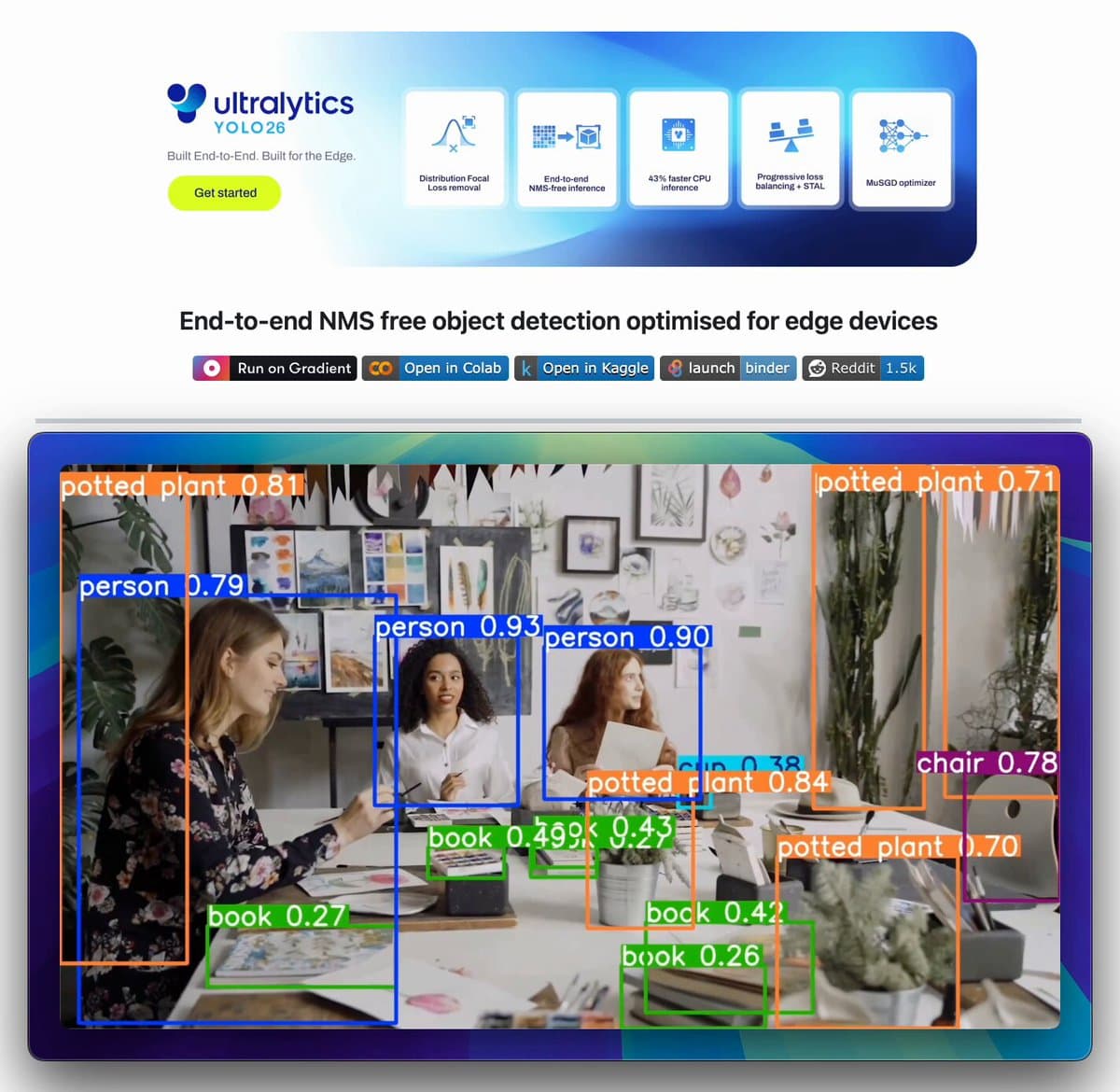
In a significant breakthrough for computer vision, YOLO26 has emerged as a revolutionary approach to real-time object detection by completely eliminating the need for Non-Maximum Suppression (NMS), a traditional bottleneck in detection pipelines. This development, highlighted by AI researcher Akshay Pachaar, represents what could be a fundamental shift in how detection systems are designed and deployed across industries.
The NMS Problem: A Historical Bottleneck
For years, object detection systems have relied on NMS as a crucial post-processing step. Traditional YOLO (You Only Look Once) architectures, while revolutionary in their single-pass approach, still required NMS to filter out duplicate bounding box predictions. This process involves comparing overlapping detections and suppressing all but the most confident ones, creating several inherent problems:
- Speed Limitations: NMS adds computational overhead that slows down inference, particularly problematic for real-time applications
- Inconsistency Issues: The heuristic nature of NMS can lead to unpredictable results, with detection quality varying based on threshold parameters
- Complexity: Implementing efficient NMS requires additional code and optimization efforts
As Pachaar notes, "Traditional YOLO needs NMS to remove duplicate boxes; it's slow and inconsistent." This limitation has persisted through multiple YOLO iterations, despite significant improvements in backbone networks and detection heads.
YOLO26's Architectural Breakthrough
YOLO26 addresses this fundamental limitation through what appears to be a reimagined detection architecture. While specific architectural details beyond the public announcement remain limited, the key innovation lies in enabling single-pass predictions that inherently avoid duplicate detections without post-processing.
The model reportedly achieves:
- True single-pass inference without NMS overhead
- Faster processing speeds compared to NMS-dependent architectures
- Support for up to 300 detections per image while maintaining accuracy
- Improved consistency in detection outputs
Technical Implications and Performance
The elimination of NMS suggests YOLO26 may employ one of several emerging techniques:
Anchor-Free Designs
Recent research in anchor-free detection methods has shown promise in reducing duplicate predictions. These approaches predict objects directly without predefined anchor boxes, potentially minimizing the overlap issues that necessitate NMS.
End-to-End Optimization
YOLO26 might implement a fully differentiable architecture where the training process itself learns to avoid duplicate predictions, possibly through novel loss functions or attention mechanisms that enforce spatial uniqueness.
Density-Aware Architectures
Advanced feature extraction methods that better understand object density and spatial relationships could enable the network to naturally avoid redundant detections.
Early indications suggest significant performance improvements, particularly in scenarios requiring real-time processing like autonomous vehicles, surveillance systems, and interactive applications where milliseconds matter.
Practical Applications and Industry Impact
The implications of NMS-free object detection extend across multiple domains:
Autonomous Systems
Self-driving cars and drones require instantaneous object detection with minimal latency. Removing NMS overhead could improve reaction times and system reliability in safety-critical applications.
Edge Computing
Resource-constrained devices benefit dramatically from reduced computational requirements. YOLO26's efficiency makes advanced object detection more accessible on mobile devices, IoT sensors, and embedded systems.
Video Analytics
Real-time video processing for security, retail analytics, and content moderation becomes more scalable without NMS bottlenecks, enabling higher frame rates and resolution support.
Robotics and Manufacturing
Industrial automation systems requiring precise, rapid object detection for sorting, quality control, and manipulation tasks stand to gain from both speed and consistency improvements.
Availability and Implementation
According to the announcement, the YOLO26 model is available for download, suggesting immediate practical applicability. The research community and industry developers can now experiment with and benchmark this new approach against established detection frameworks.
Early adopters will need to consider:
- Integration with existing pipelines designed around NMS-dependent outputs
- Potential retraining or fine-tuning requirements for domain-specific applications
- Comparative validation against current state-of-the-art models
The Future of Object Detection Architectures
YOLO26 represents more than just another incremental improvement—it challenges a fundamental assumption in object detection design. If successful, it could inspire:
- New architectural paradigms that question other "necessary" components in computer vision pipelines
- Hardware optimization specifically for NMS-free detection, potentially unlocking further efficiency gains
- Cross-pollination of ideas to other detection tasks like instance segmentation and pose estimation
- Simplified deployment with fewer hyperparameters to tune and more predictable behavior
Challenges and Considerations
While promising, YOLO26 will face scrutiny regarding:
- Generalization performance across diverse datasets and challenging conditions
- Comparison metrics against established benchmarks and real-world applications
- Training stability without NMS during the learning process
- Adoption barriers in systems heavily optimized for traditional architectures
The computer vision community will need to rigorously evaluate whether the NMS-free approach maintains detection quality in edge cases like heavily occluded objects, small object detection, and crowded scenes where NMS has historically played a crucial role.
Conclusion
YOLO26's elimination of Non-Maximum Suppression marks a potential turning point in object detection technology. By addressing a long-standing bottleneck, it opens new possibilities for real-time applications where speed, consistency, and efficiency are paramount. As the model becomes available for testing and implementation, the coming months will reveal whether this architectural shift represents a fundamental improvement or a specialized solution with specific trade-offs.
For developers and researchers, YOLO26 offers an opportunity to rethink object detection pipelines and explore new optimization strategies. For industry applications, it promises faster, more reliable vision systems that could accelerate the adoption of AI-powered automation across sectors.
Source: Akshay Pachaar via X/Twitter