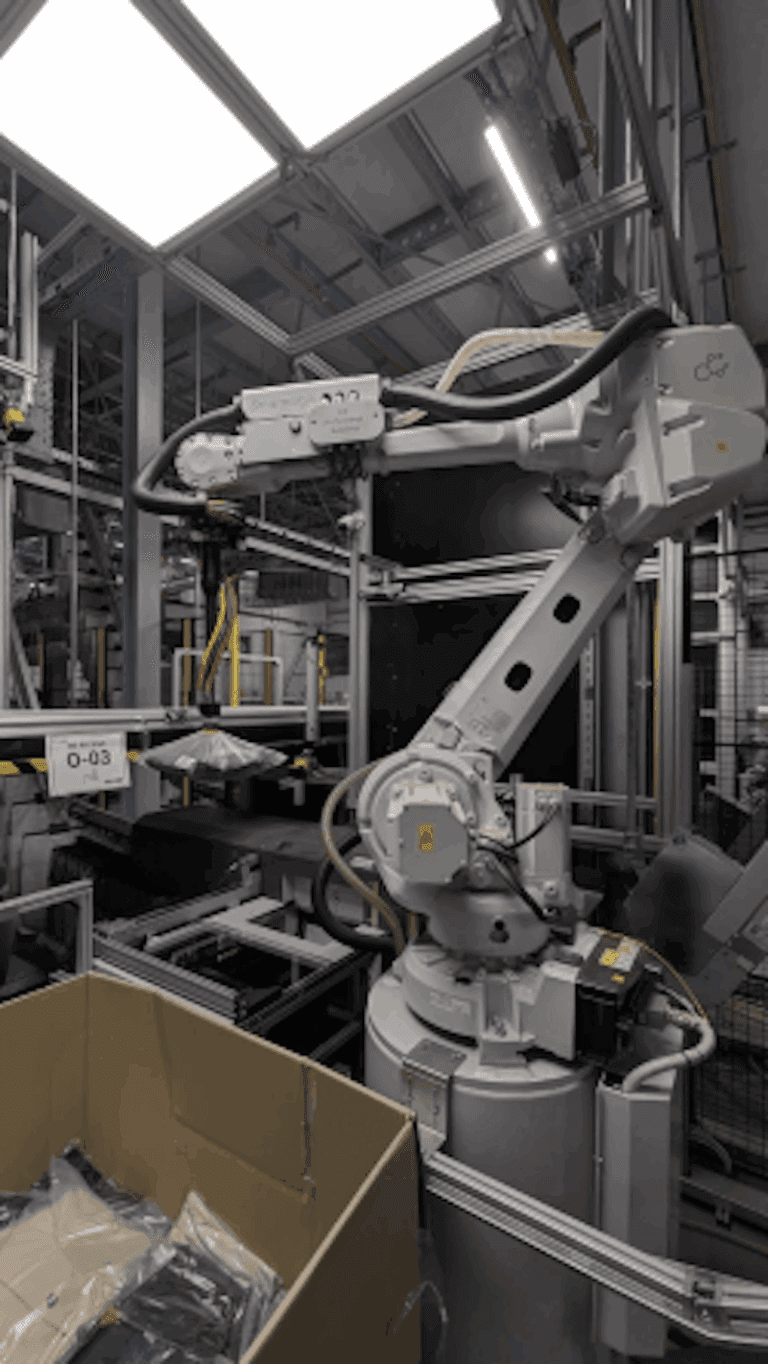
The Innovation — What the source reports
Zalando, the Berlin-based European fashion and lifestyle platform, is ramping up its investment in and deployment of AI-powered warehouse robots. While the source article is brief, the headline confirms a clear strategic direction: scaling up. This indicates a transition from pilot programs or limited deployments to broader, more integrated use of robotics within their logistics network.
For a company of Zalando's scale—serving millions of customers across 25+ European markets with a vast, ever-changing inventory of apparel, shoes, and accessories—warehouse efficiency is a critical competitive lever. The "AI-powered" descriptor is key; these are not simple automated guided vehicles (AGVs) following magnetic tape. They are likely systems utilizing computer vision, machine learning for path optimization, and potentially real-time data integration to handle the unique challenges of fashion logistics: variable-sized items, fragile packaging, high return rates, and extreme seasonal volume fluctuations.
Why This Matters for Retail & Luxury
While Zalando operates in the fast-fashion and broad lifestyle segment, its technological investments are a bellwether for the entire sector, including luxury. The core challenges of fulfillment—accuracy, speed, cost, and handling complexity—are universal.
Concrete Scenarios and Departments:
- High-Value Item Handling: AI robots equipped with precise vision systems can safely retrieve and transport luxury handbags, watches, or garments, reducing the risk of damage from manual handling.
- Returns Processing (Reverse Logistics): The bane of e-commerce, especially in apparel where fit is uncertain. AI robots can efficiently intake, sort, and triage returned items, assessing them for immediate restocking, cleaning/repair, or outlet channel routing. This is critical for protecting margin.
- Seasonal and Collection Launches: Luxury houses face massive surges during collection launches and holiday seasons. Scalable robotic systems can flex capacity without the lead time and training required for human seasonal workers.
- Inventory Accuracy & Omnichannel Fulfillment: AI systems can conduct continuous, real-time cycle counts, ensuring stock accuracy for both e-commerce and in-store clienteling (e.g., "find in store," "ship from store"). This bridges the physical and digital inventory divide.
Business Impact
The business case for warehouse automation in retail is well-documented, though specific metrics for Zalando's new deployment are not provided in the source. Generally, successful implementations target:
- Throughput Increase: 2-3x more units picked per hour.
- Accuracy Rates: Reducing mis-picks to 99.99%+ accuracy, crucial for luxury where sending the wrong item erodes trust.
- Labor Optimization: Redirecting human workers from repetitive walking and picking tasks to higher-value roles in quality control, problem-solving, and customer service.
- Space Utilization: Robotic systems like goods-to-person or high-density mobile storage can increase storage capacity within the same footprint—a major factor for expensive urban or European logistics real estate.
- Reduced Time-to-Customer: Accelerating the last-mile promise, a key differentiator in premium service.
Implementation Approach
Scaling up implies moving beyond the proof-of-concept phase. For luxury brands considering a similar path, the technical and operational requirements are significant:
Technical Requirements:
- Robotics Hardware: Selection of mobile manipulators, autonomous mobile robots (AMRs), or robotic arms suitable for soft goods.
- AI/ML Stack: Computer vision models trained on vast datasets of product imagery (likely leveraging Zalando's own catalog), reinforcement learning for dynamic pathfinding in crowded warehouses, and digital twin simulation for testing.
- Integration Layer: A middleware platform to connect the robotic fleet's management system (FMS) to the core Order Management System (OMS), Warehouse Management System (WMS), and Enterprise Resource Planning (ERP).
- Infrastructure: Warehouse redesign or retrofitting for optimal robot flow, robust Wi-Fi/5G coverage, and charging stations.
Complexity & Effort: This is a multi-year, multi-million-euro transformation, not a plug-and-play solution. It requires deep collaboration between internal logistics teams, IT, and robotics vendors. Phased rollouts, starting with a single fulfillment center or a specific process (e.g., returns sorting), are the standard approach to de-risk the project.
Governance & Risk Assessment
Privacy: Less of a concern in warehouse operations compared to customer-facing AI, but worker monitoring and data collection must comply with GDPR and local labor regulations.
Bias: Potential bias in computer vision systems if training data is not representative of the full product range (e.g., failing to correctly identify items from new or niche designers).
Maturity Level: AI-powered warehouse robotics is a rapidly maturing field. The decision to "scale up" suggests Zalando has passed the initial hurdle of technological reliability. However, the total cost of ownership (maintenance, software updates, hardware refreshes) and long-term adaptability to new packaging or product types remain key maturity questions. The ROI must be calculated over a 5-7 year horizon.
gentic.news Analysis
Zalando's move is part of a broader, accelerating trend of AI integration into physical retail operations, a space seeing intense activity from major tech players. Google, a dominant entity in our knowledge graph with 179 prior mentions, is aggressively building the infrastructure and protocols that could underpin future autonomous systems like these. While not directly mentioned in this Zalando story, Google's recent launch of the Universal Commerce Protocol (UCP)—an open-source standard for securing agentic commerce—hints at a future where AI agents (which could coordinate robotic fleets) securely transact and share data. Furthermore, Google's work on TurboQuant for efficient LLM compression and its Agentic Sizing Protocol for retail show a clear focus on making AI more efficient and applicable to core retail problems, from back-end logistics to front-end customer experience.
This also connects to the broader robotics trend (6 prior mentions, 4 this week). Zalando's scale-up validates robotics as a tangible ROI area, beyond the hype of humanoids. It creates competitive pressure. For luxury conglomerates like LVMH or Kering, the question shifts from "if" to "how and when." The complexity of luxury packaging, authentication, and high-touch service may require more customized solutions than Zalando's, but the underlying drivers of speed, accuracy, and cost are inescapable.
Finally, this operational AI push complements the industry's focus on generative AI for design and marketing. The true leaders will be those who excel at both: creating desire and flawlessly fulfilling it. Zalando's investment is a bet on mastering the latter at scale.