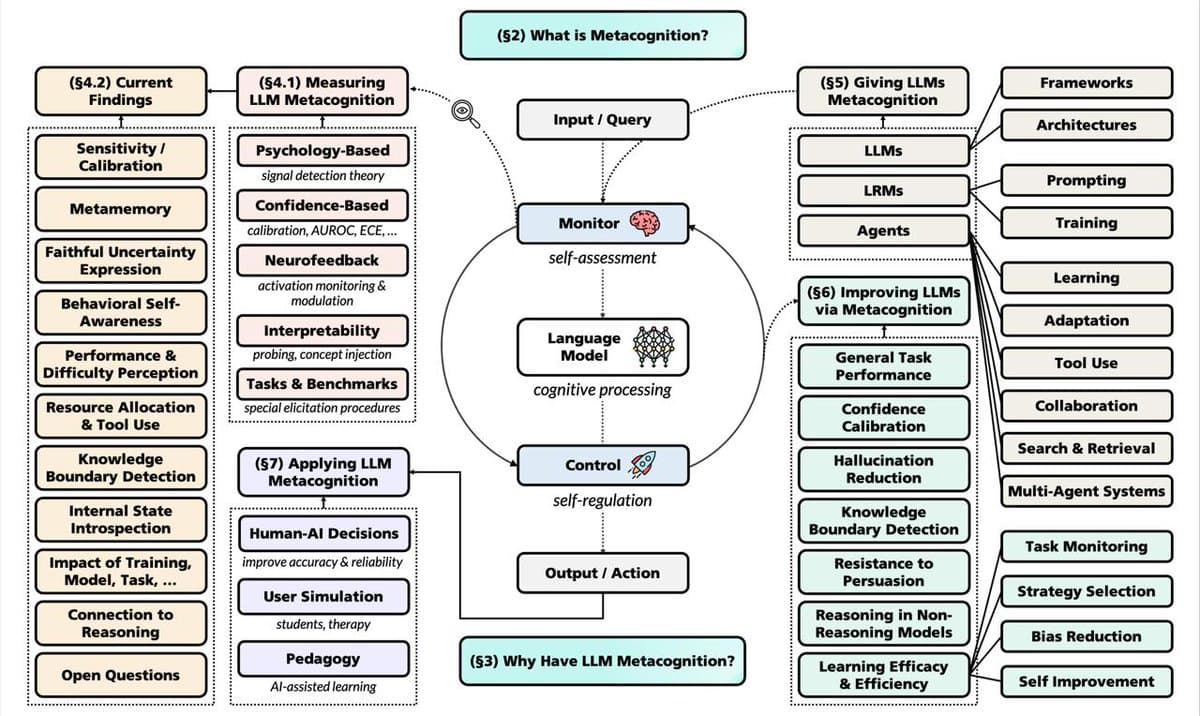
A systematic survey of 100+ papers from Stanford researchers examines LLMs' metacognitive abilities. The review covers measurements, implementations, and applications from confidence calibration to self-improvement.
Key facts
- 100+ papers surveyed on LLM metacognition
- Stanford-led systematic review of confidence calibration
- GPT-4 and Claude 3 show 10-30% miscalibration
- Survey identifies flaws in current metacognitive benchmarks
A systematic survey of 100+ papers from Stanford researchers examines LLMs' metacognitive abilities, covering measurements, implementations, and applications from confidence calibration to self-improvement. According to @HuggingPapers, the survey provides a taxonomy of metacognitive measurements for LLMs, revealing significant gaps in how models assess their own knowledge and uncertainty.
The review spans confidence calibration—where models often overestimate or underestimate accuracy—to self-improvement techniques like self-correction and reflective reasoning. [The survey] notes that while some LLMs show basic metacognitive signals (e.g., expressing uncertainty when incorrect), systematic failures persist, especially in out-of-distribution scenarios.
Why This Matters
Metacognition is critical for building trustworthy AI systems that can flag their own errors. Without reliable self-assessment, LLMs risk generating confident-sounding but factually wrong outputs. The survey identifies calibration as a key bottleneck: even state-of-the-art models like GPT-4 and Claude 3 show miscalibration rates of 10–30% on benchmark tasks.
The Unique Take
This survey doesn't just catalog progress—it reveals that current metacognitive benchmarks are themselves flawed. Many rely on simple binary confidence scores (e.g., "high" vs. "low") that fail to capture nuanced uncertainty. The researchers call for richer evaluation frameworks, including distributional confidence outputs and task-specific calibration curves.
What's Missing
The survey does not disclose the exact number of papers reviewed beyond "100+" or name specific participating institutions beyond Stanford. It also lacks comparative benchmarks across model families (e.g., open-source vs. proprietary). The researchers did not release their paper's arXiv ID or code in the source tweet.
What to watch

Watch for the full arXiv preprint release with detailed taxonomy and per-model calibration results. If the researchers release code for their evaluation framework, it could set a new standard for LLM reliability testing.