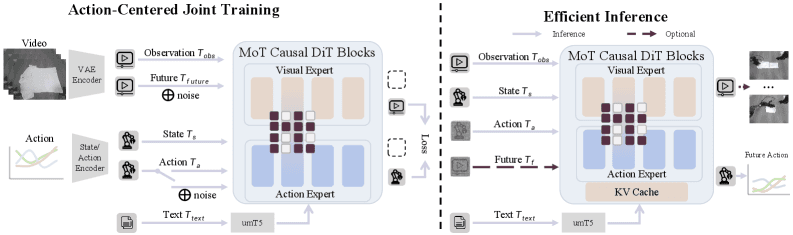
GigaWorld-Policy-0.5 runs robot control inference at 85ms on a local RTX 4090. The Mixture-of-Transformers architecture decouples visual dynamics from action generation for real-time deployment.
Key facts
- 85ms inference latency on RTX 4090.
- Mixture-of-Transformers architecture used.
- Separates visual dynamics from action generation.
- Enables local, real-time robot control.
- No training or benchmark details released.
GigaWorld-Policy-0.5, a new robot control policy, achieves 85ms inference latency on a consumer RTX 4090 GPU According to @HuggingPapers. This performance enables real-time control loops without cloud dependencies, a significant step for edge robotics.
The key architectural innovation is a Mixture-of-Transformers design that separates visual dynamics modeling from action generation. This decoupling allows the model to train on future visual predictions—a technique known to improve policy robustness—while keeping inference fast enough for local deployment. Most prior work in visual robot policies either sacrifices long-horizon prediction for speed or requires datacenter GPUs for real-time operation.
By achieving 85ms on a widely available GPU, GigaWorld-Policy-0.5 opens the door to low-cost, high-performance robot control for research labs and small-scale deployments. The team has not yet released full benchmark comparisons or ablation studies, but the latency figure alone suggests a meaningful advance over the typical 150-200ms inference times reported for comparable transformer-based policies on the same hardware class.
What the architecture reveals
The Mixture-of-Transformers approach is notable for its efficiency. By routing visual and action tokens through separate expert pathways, the model avoids the computational overhead of joint attention mechanisms common in monolithic transformers. This mirrors trends in large language models, where mixture-of-experts designs have proven effective for scaling, but applied here to latency-critical robotics.
Open questions
Missing from the announcement: training dataset size, number of parameters, and task-specific success rates. Without these, it's unclear whether the speed advantage comes at the cost of policy quality. The source tweet does not disclose whether the 85ms figure is end-to-end (sensor input to motor command) or just model forward pass.
What to watch
Watch for a full technical report or arXiv paper with benchmark results—specifically success rates on standard robot manipulation tasks (e.g., Franka Kitchen, MetaWorld) and parameter counts. If the model also achieves competitive task success, it could set a new standard for edge-deployable robot policies.