What Happened
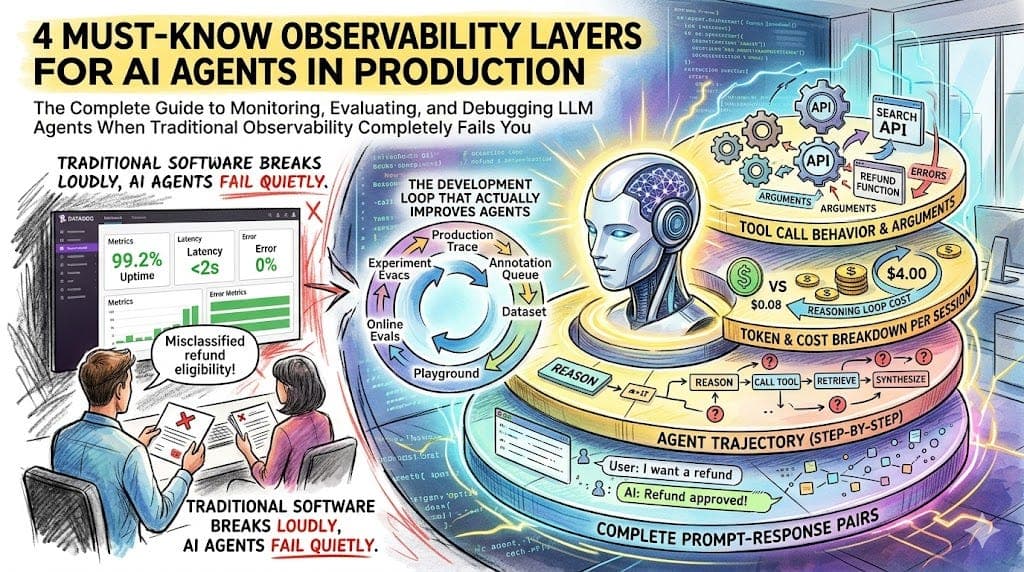
A comprehensive technical guide, published on the Towards AI platform on Medium, argues that traditional software observability tools are insufficient for production-grade AI agents. The article posits that developers need a new, structured framework built around four distinct layers to effectively monitor, evaluate, and debug these complex, autonomous systems. This follows a recent trend of technical guides from Towards AI, including a March 29th publication on the modern RAG stack for 2026.
The core premise is that AI agents—autonomous systems built on large language models (LLMs) that can plan, execute actions, and interact with environments—introduce novel failure modes. Their non-deterministic, multi-step nature breaks conventional logging and monitoring paradigms.
Technical Details: The Four Layers
While the full guide is behind Medium's paywall, the summary and title indicate a structured approach. Based on industry standards and the stated goal of addressing where "traditional observability completely fails," the four layers likely encompass:
- Infrastructure & Execution Observability: Monitoring the underlying compute, memory, network calls, and tool execution latency. This is the base layer, tracking whether the agent's actions are being carried out technically.
- LLM Input/Output (I/O) Observability: Logging and tracing the precise prompts, context windows, and model responses. This includes tracking token usage, costs, and response latencies across different LLM providers.
- Agentic Reasoning & Planning Observability: The most complex layer. This involves tracing the agent's internal decision-making process: its planned steps, replanning events, tool selections, and the rationale behind its actions. This is critical for debugging "agent hallucinations" or illogical action sequences.
- Business Logic & Evaluation Observability: Measuring the agent's performance against business-defined success criteria. This goes beyond technical metrics to include custom evaluators, guardrails, and outcome-based scoring (e.g., did the shopping assistant successfully find and recommend a suitable product?).
The guide is positioned as a "complete" solution, suggesting it covers instrumentation, tooling recommendations, and debugging workflows specific to this stack.
Retail & Luxury Implications
For retail and luxury brands experimenting with or planning to deploy AI agents, this framework is not a nice-to-have—it is a prerequisite for operational stability and brand safety.
Concrete Applications & Risks:
- High-Touch Customer Service Agents: An agent handling a complex return, exchange, and re-purchase sequence across inventory systems and CRM platforms needs all four layers. Layer 3 observability is essential to understand why it might have offered an incorrect promotion, while Layer 4 ensures customer satisfaction (CSAT) is being positively impacted.
- Personal Shopping & Styling Agents: Debugging a poor outfit recommendation requires tracing the agent's journey through product catalogs (Layer 1), its interpretation of the user's style prompt (Layer 2), its reasoning for selecting specific items (Layer 3), and ultimately measuring click-through or conversion rates (Layer 4).
- Supply Chain & Inventory Agents: An autonomous agent managing replenishment must have its planning logic (Layer 3) fully observable to audit its decisions and prevent costly overstock or stockouts. Its API calls to warehouse systems (Layer 1) must be reliably tracked.
Without this granular observability, brands risk deploying "black box" agents that are impossible to troubleshoot, potentially leading to brand-damaging customer interactions, financial loss, and the all-too-common fate of pilot projects that never graduate to production. This directly connects to the Knowledge Graph intelligence showing that 86% of AI agent pilots fail to reach production, a systemic gap that robust observability aims to close.
Implementation Approach
Adopting this framework requires a shift in MLOps strategy:
- Tooling Assessment: Existing APM tools (Datadog, New Relic) cover Layer 1 well. Specialized LLM observability platforms (Arize, WhyLabs, LangSmith) are emerging to handle Layers 2 and parts of 3. Layer 4 often requires custom integration with business intelligence systems.
- Instrumentation Overhead: Engineering teams must bake in logging and tracing from the initial agent architecture design. Retrofitting is painful and incomplete.
- Skill Development: Data scientists and ML engineers need to collaborate with platform and DevOps teams to implement and maintain this observability stack.
The complexity is non-trivial but is the tax for moving beyond demos and prototypes.
Governance & Risk Assessment
- Privacy: Observability logs containing full prompt/response cycles and user data must be treated with extreme care, requiring strict access controls, anonymization, and compliance with data residency laws (GDPR, CCPA).
- Bias & Fairness: Layer 4 evaluators must be designed to detect discriminatory patterns in agent behavior across customer segments.
- Maturity Level: The tooling for agentic reasoning observability (Layer 3) is still nascent. Early adopters will face integration challenges and may need to build custom components.
- Cost: Comprehensive logging of LLM I/O and intermediate steps can generate significant data storage and processing costs, which must be factored into ROI calculations.
gentic.news Analysis
This guide arrives at a critical inflection point for AI agents in enterprise. The Knowledge Graph shows AI Agents are a trending topic, appearing in 21 articles this week, underscoring the intense industry focus. However, this excitement is tempered by a harsh reality: recent reports reveal 86-88% of AI agent pilots fail to reach production, a phenomenon often termed "agent washing." This observability framework directly attacks the root cause of that failure rate—the inability to reliably monitor, debug, and trust autonomous systems in complex environments like retail.
The guide's publication on Medium, a platform we've referenced 20 times, aligns with its role as a primary channel for disseminating practical, technical know-how to developers. The entity relationships are telling: AI Agents are shown to use technologies like Agentic Commerce and are leveraged by companies like Shopify, confirming their direct relevance to the retail tech stack. This contextualizes the guide not as theoretical research, but as a response to real-world implementation pain points.
For luxury retail, where brand integrity is paramount, the stakes are even higher. An unobservable customer service agent that makes a tone-deaf recommendation is a direct reputational threat. This framework provides the necessary blueprint for the rigorous governance luxury houses require. It complements our recent coverage, such as "[The Single-Agent Sweet Spot: A Pragmatic Guide to AI Architecture Decisions](slug: the-single-agent-sweet-spot-a)" and "[Guest Column Asks: Is Travel Retail Ready for Agentic AI?](slug: guest-column-asks-is-travel-retail)", by addressing the operational sustainment phase that follows architectural design. In essence, this is the manual for moving from a promising pilot to a hardened, production-ready asset.