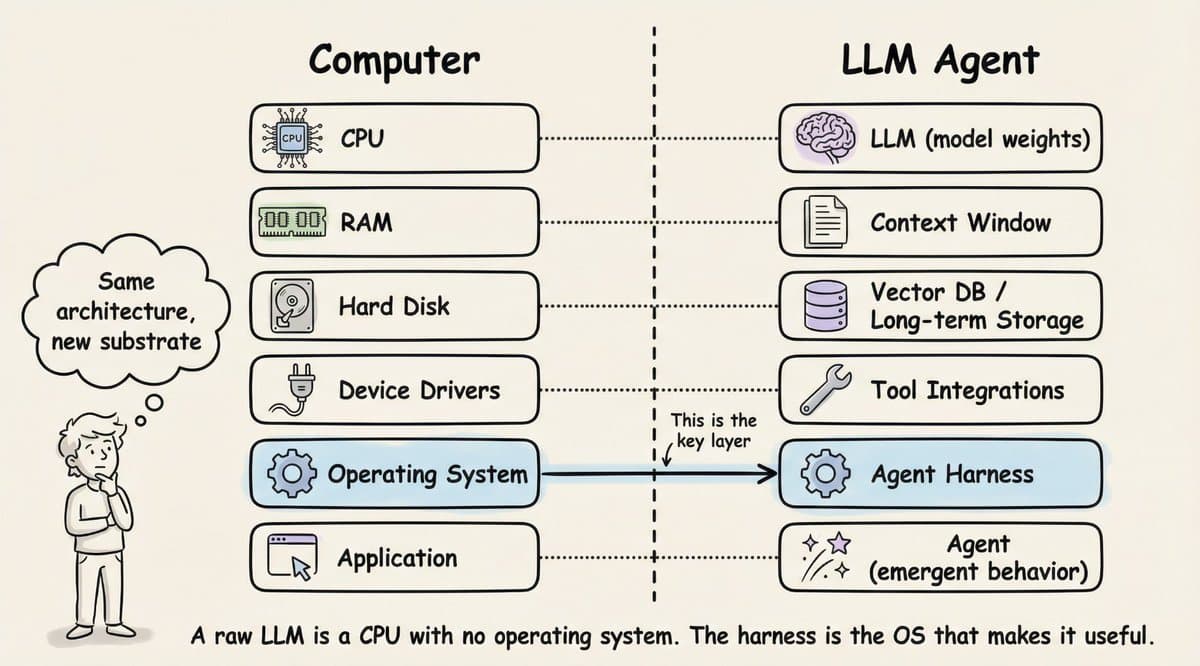
A raw large language model is a powerful but fundamentally useless piece of technology. That's the provocative starting point of a clear analogy gaining traction among AI engineers: an LLM without an agent harness is like a CPU without an operating system.
This framework, popularized by AI engineer Akshay Pachaar, provides a mental model for understanding why two products using the exact same underlying model can deliver wildly different performance. The critical differentiator isn't the model weights—it's the infrastructure, or "harness," built around them.
The Computer Analogy for LLM Systems
The analogy maps traditional computer components directly to elements of an LLM agent system:
CPU LLM (Model Weights) Raw compute engine. Powerful but useless alone. RAM Context Window Fast, always-available working memory. Limited capacity. Hard Disk Vector DB / Long-term Storage Large-capacity, slow-access storage for retrieval. Device Drivers Tool Integrations Interfaces for external interaction (code exec, web search, file I/O). Operating System Agent Harness The critical layer. Manages tools, memory, retrieval, error recovery, and termination. Application The Agent Emergent behavior from a well-functioning "OS." Not installed software.This breakdown clarifies why simply having a state-of-the-art model like GPT-4 or Claude 3 is insufficient for building a reliable agent. The harness—the orchestration logic that decides when to call a tool, what to keep in context, and how to handle failures—is the true product.
Proof in Performance: The LangChain Benchmark Leap
The most concrete evidence supporting this analogy comes from a real-world benchmark result. According to Pachaar, LangChain changed only their agent harness infrastructure while keeping the underlying model and its weights identical. This change alone propelled their agent's performance from outside the top 30 to rank #5 on TerminalBench 2.0.
TerminalBench is a comprehensive evaluation suite for coding agents that tests capabilities like code generation, debugging, and repository navigation. A jump of over 25 positions without touching the model underscores a pivotal industry realization: agent performance is now bottlenecked by engineering, not pure model capability.
What an Agent Harness Actually Does
So, what does this "operating system" layer actually engineer? It manages the complete orchestration loop that transforms a stateless, next-token predictor into a stateful, goal-directed actor:
- Tool Selection & Execution: Decides which external tool (calculator, browser, API) to use, formats the correct input, and parses the output.
- Context & Memory Management: Dynamically manages the limited context window. It decides what to keep in immediate "RAM," what to offload to long-term "disk" (vector databases), and what to retrieve when needed.
- State & Planning: Maintains a representation of the task state, breaks down high-level goals into executable steps, and can adjust plans based on intermediate results.
- Error Handling & Recovery: Implements fallback strategies when a tool call fails or the model generates an invalid action.
- Stopping Criteria: Determines when the task is complete or when to halt unproductive loops.
This is the unglamorous, complex engineering that separates a demo from a product. It's why companies like Cognition Labs (developer of Devin) and Magic invest heavily in proprietary agentic infrastructure beyond just model access.
gentic.news Analysis
This analogy crystallizes a major shift in the AI stack's center of gravity. For years, the race was purely about model scale and architecture (Transformer, MoE, etc.). The landmark release of GPT-4 in 2023 was the peak of this paradigm. However, as Pachaar's thread and LangChain's benchmark result show, the frontier of capability has moved from the model layer to the systems layer.
This aligns with the trend we've tracked since late 2024: the rise of "thin models, thick infrastructure." Startups and enterprises are achieving state-of-the-art application performance not by training 100B+ parameter models from scratch, but by building superior orchestration systems on top of foundation models from OpenAI, Anthropic, or Meta. The recent funding round for LlamaIndex, which focuses on data frameworks for LLMs, further validates investment flowing into this middleware layer.
The analogy also exposes a key vulnerability for application builders: vendor lock-in moves up the stack. Previously, lock-in was at the model API (e.g., GPT-4). Now, it can exist at the harness layer. If an agent's capabilities are deeply tied to a proprietary orchestration engine (like LangChain's or a bespoke system), swapping the underlying LLM becomes easier, but swapping the entire agent framework becomes far harder and more costly. This creates a new strategic battleground.
Frequently Asked Questions
What is an agent harness in simple terms?
An agent harness is the software "wrapper" or orchestration system that manages a large language model. It handles memory, decides when to use tools like a calculator or web browser, recovers from errors, and determines when a task is finished. Think of it as the operating system that makes the raw "brain" (the LLM) practically useful.
Can I build my own agent harness, or should I use a framework?
You can build your own, but it's a major engineering undertaking. Frameworks like LangChain, LlamaIndex, and AutoGen provide foundational components. The choice depends on your need for control versus development speed. For most production applications, extending a robust framework is the pragmatic starting point.
Does a better agent harness work with any LLM?
In theory, yes. A well-designed harness should be model-agnostic, interfacing via a standard API. This is the promise of the "thin model, thick infrastructure" approach. In practice, some optimizations or prompts may be tuned for specific model families (e.g., Claude vs. GPT), but the core architecture is transferable.
What's the difference between an agent and an agent harness?
The agent is the emergent, goal-directed behavior produced by the system. The agent harness is the software infrastructure that enables that behavior. Using the computer analogy: the harness is the Windows/macOS/Linux operating system; the agent is the word processor or web browser you use to get work done.