What Happened
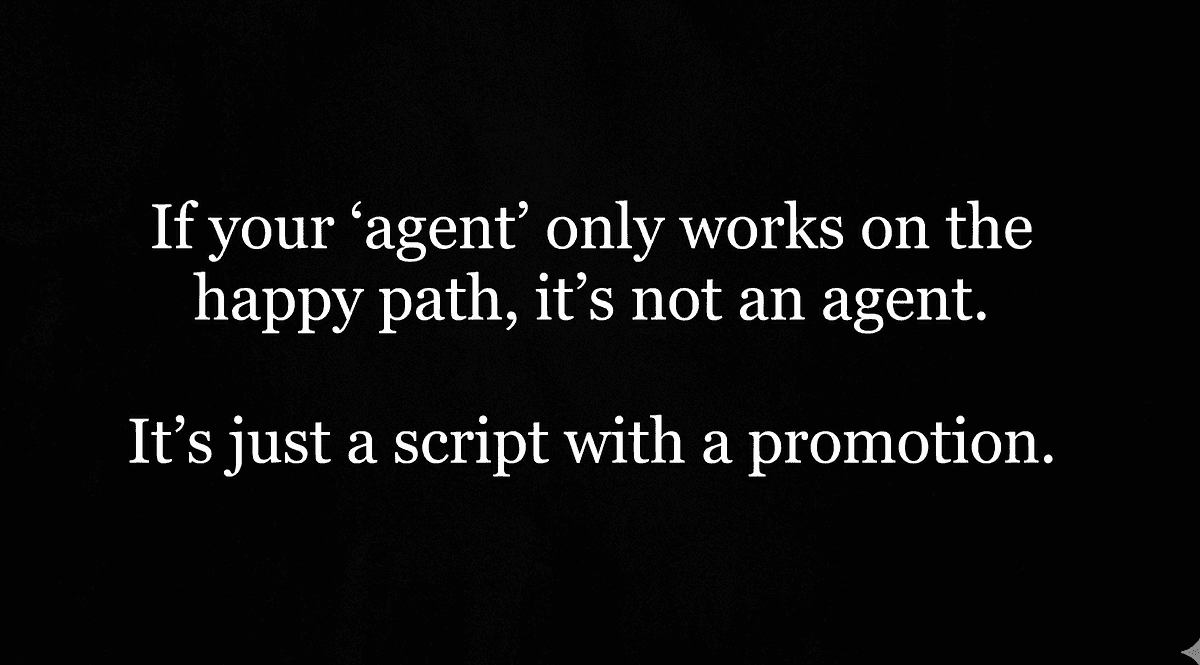
A production engineer specializing in multi-agent systems for SDLC automation has published a definitive guide to cutting through the hype surrounding "AI agents." The article, published on Medium, confronts the industry-wide problem of agent washing—the practice of rebranding chatbots, RPA tools, and hardcoded automation scripts as "agentic AI" to capitalize on market excitement.
The core statistic is stark: 88% of AI agents never make it to production. According to the author, this failure isn't due to technological limitations but because most marketed "agents" aren't agents at all. Out of thousands of vendors, only about 130 are building genuinely agentic systems. The rest are "expensive chatbots with a new label."
This follows a broader industry trend we've been tracking: AI Agents have been mentioned in 178 prior articles on our platform, with a significant spike of 24 articles this week alone, indicating intense market focus and, consequently, heightened hype.
The 5-Point "Is This Actually an Agent?" Checklist
The author's framework is built from hands-on experience evaluating tools and building agents that ship. Here are the five criteria that separate real agents from washed ones:
1. Does It Reason About What to Do Next?
A real agent receives a goal and decides its own sequence of steps. It doesn't follow a fixed Directed Acyclic Graph (DAG) or hardcoded workflow. The test: give the system a novel task. Does it figure out a path, or does it crash?
2. Does It Recover When a Step Fails?
This is the most common failure point for imposters. A real agent handles failure as part of its workflow—retrying with a different approach, falling back to an alternative tool, or gracefully degrading. An agent-washed product crashes, returns garbage, or silently ignores the failure. The test: deliberately break a dependency. Does it adapt or die?
3. Does It Complete Tasks End-to-End Without Hand-Holding?
Real agents take a goal and deliver a result. They don't stop at every checkpoint for human instruction. While human-in-the-loop (HITL) is valid for high-stakes decisions, there's a difference between an agent that does 95% of the work and surfaces a decision point, versus a system that needs human input at every step but labels each step "an agent action." The test: give it a multi-step task and walk away. Is it done, blocked, or did it silently fail?
4. Does It Use Tools Dynamically?
A real agent selects and uses tools based on situational needs, not a hardcoded sequence. The key signal: can the agent use a tool it wasn’t explicitly told to use for this specific task? If it can reason about its tool inventory and pick the right one, that's real agency. The test: give it a task requiring a novel tool combination. Does it compose the right set?
5. Does It Handle Novel Inputs?
The demo always works. An agent-washed product falls apart outside its training distribution. A real agent applies reasoning to novel situations—maybe not perfectly, but it doesn't catastrophically break. The test: feed it structurally different input. Real agents degrade gracefully. Fake ones crash or hallucinate.
What Production-Ready Agents Actually Look Like
Passing the checklist gets you to "real agent," but there's another gap to "production-ready agent." The author details critical operational characteristics:
They're Observable: Every decision is logged and traceable—not just inputs/outputs, but intermediate reasoning steps, tool selections, and retry decisions. If you can't trace a decision, you can't debug it.
They're Cost-Controlled: An unconstrained agent solving a single software engineering task can cost $5–8 in API fees. Production agents use model routing—expensive frontier models for complex reasoning, cheaper models for simpler tasks—and implement strict usage budgets and kill switches.
They Have Guardrails: Production agents operate within predefined boundaries. They don't make unlimited API calls, modify production data without checks, or escalate tickets without validation. Guardrails are enforced programmatically, not just documented.
They're Built for Change: Tools break, APIs version, requirements shift. Production agents are built with abstraction layers that allow tool swapping without rewriting core agent logic. Their architecture assumes the environment will change.
Retail & Luxury Implications
For retail and luxury AI leaders, this guide is a crucial reality check. The sector is ripe for agentic AI applications: personalized shopping concierges, dynamic inventory orchestration, automated visual merchandising analysis, and intelligent customer service resolution. However, the risk of falling for "agent washing" is particularly high given the pressure to deliver cutting-edge, personalized customer experiences.
Concrete Evaluation Scenarios:
- Vendor Pitch: A startup demonstrates a "personal styling agent" that takes a customer's mood board and suggests items. Does it dynamically search the catalog, check real-time inventory, consider returns history, and compose a complete look? Or is it a chatbot that fetches pre-defined "editor's picks" based on a keyword?
- Internal Build: Your team prototypes an "agent" to optimize markdown pricing. Does it analyze sales velocity, competitor pricing, seasonal trends, and warehouse capacity to decide a pricing strategy? Or is it a script that applies a fixed discount curve after a set number of days?
- Customer Service: A proposed "resolution agent" handles returns. Does it assess the reason, check the customer's value, review policy exceptions, and decide to approve, offer a discount, or escalate? Or does it just populate a form and route it to a human?
The Stakes: Implementing a washed "agent" leads to sunk costs, lost time (the author notes teams waste months building on non-agentic foundations), and ultimately, a broken customer experience when the system fails at the first edge case. In luxury, where brand perception is everything, a brittle AI that fails publicly is a significant risk.
Implementation Approach
For teams evaluating or building:
- Audit with the Checklist: Apply the 5-point test rigorously to any vendor demo or internal proof-of-concept. Demand to see the failure recovery and novel input tests.
- Start with Observability: Before scaling any agent, ensure you have tracing for its reasoning chain. This is non-negotiable for debugging and trust.
- Control the Budget: Model routing and strict cost controls must be part of the initial architecture, not an afterthought.
- Define the Goal, Not the Path: Frame tasks for agents as objectives ("increase basket size for this customer segment") rather than prescribed workflows. The agent's value is in finding the optimal path.
gentic.news Analysis
This article provides crucial, ground-level validation of a trend we've been monitoring. The author's claim that 88% of AI agents never reach production directly aligns with and provides a concrete cause for the March 2026 analysis we previously covered, which revealed the same statistic due to widespread 'agent washing'. This isn't just an academic problem; it's a massive efficiency drain affecting enterprise pilots.
The guide's emphasis on multi-agent systems and production readiness connects directly to several developments in our knowledge graph. The push for Agentic RAG (mentioned in 10 prior articles) and agentic AI systems are part of the same evolution toward actionable, autonomous AI. However, as this article warns, the gap between research demos and production systems remains vast.
Notably, the entities Shopify, Northeast Grocery, and Blue Yonder are already recorded in our KG as using AI Agents or Agentic AI. These early adopters in commerce and logistics are likely facing the exact evaluation challenges described. Their experiences would be a valuable follow-up: are they deploying real agents per this checklist, or are they also navigating washed solutions?
The author's focus on cost control and observability echoes the themes in our recent coverage of tools like Base44's Superagent Skills and the Dead Letter Oracle for governing AI decisions. The industry is maturing from fascination with capability to a focus on governance, cost, and reliability—the true hallmarks of a production-grade technology.
For retail and luxury, the message is clear: the potential of agentic AI is real, but the market is flooded with imposters. Success depends on rigorous technical evaluation, a focus on production fundamentals, and a healthy skepticism toward hype. The 130 genuine agent builders the author mentions are the ones worth finding.