The Innovation — What AgentOps Proposes
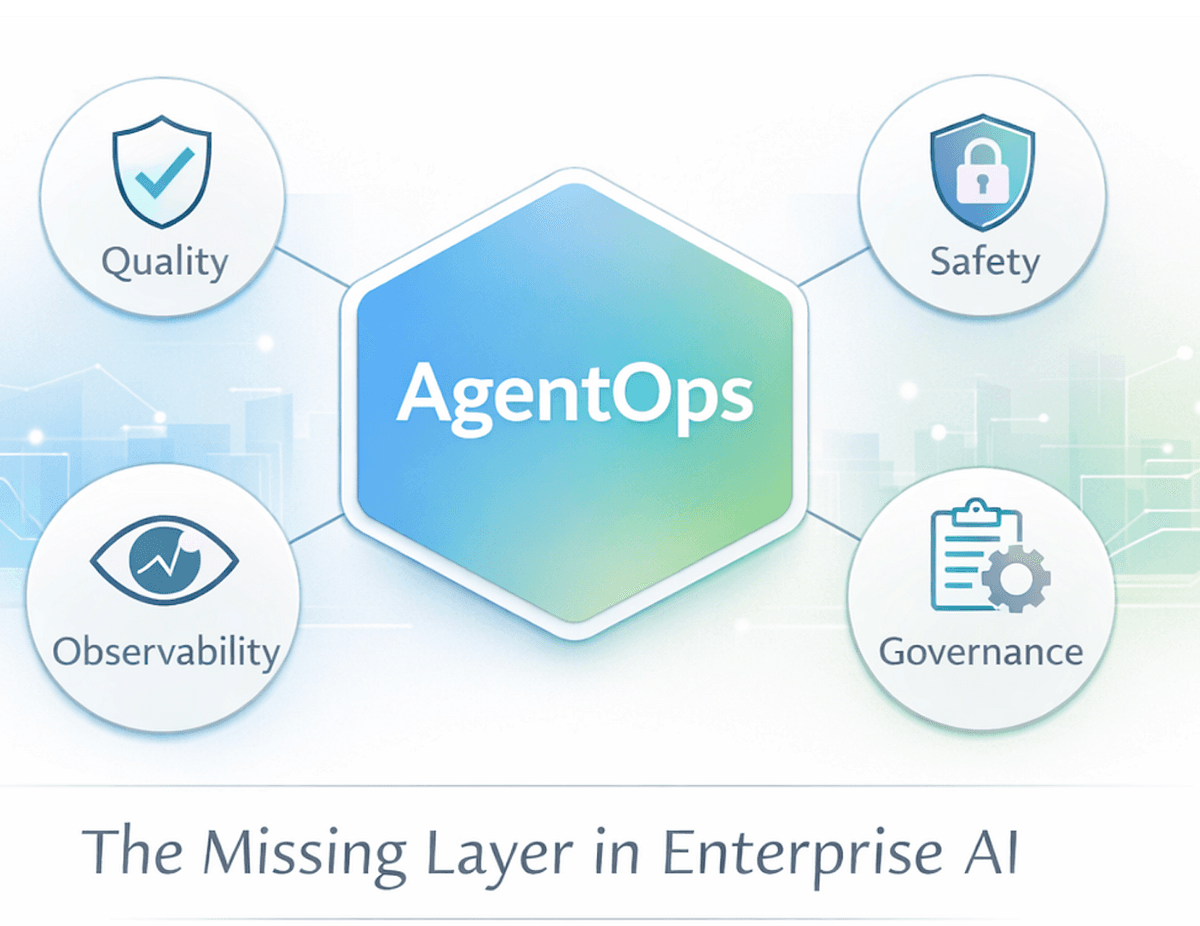
The Medium article by H.P. Kaur introduces AgentOps as a critical missing layer in the enterprise AI stack. It's not another tool for building agents, but a framework for operating them safely, reliably, and at scale. The core premise is that while creating AI agents has become easier with LLMs, deploying them into real business workflows where they interact with data, APIs, and users introduces profound risks around safety, compliance, and reliability.
The proposed AgentOps architecture is presented as a practical framework derived from real-world deployments. It aims to sit between the agent runtime and the business environment, providing the necessary observability, guardrails, and governance that enterprises require but current tooling lacks.
Why This Matters for Retail & Luxury
For retail and luxury brands, the implications are immediate and significant. The industry is actively exploring AI agents for:
- Personal Shopping & Styling Assistants: Autonomous agents that browse catalogs, understand customer preferences from past interactions, and suggest complete outfits or products.
- Inventory & Supply Chain Orchestration: Agents that monitor stock levels, predict demand shifts, and autonomously trigger re-orders or production adjustments.
- Customer Service Resolution: Agents that can handle complex, multi-step customer service issues (e.g., a return with a promotional credit and an exchange) by accessing multiple backend systems without human intervention.
- Dynamic Pricing & Promotion Agents: Systems that adjust pricing or launch micro-promotions in real-time based on competitor activity, inventory aging, and local demand signals.
Without an AgentOps layer, deploying these agents is a high-stakes gamble. An unstyled shopping agent might recommend a competitor's product. A supply chain agent could misread data and order 10,000 units of a slow-moving SKU. A pricing agent might trigger a brand-damaging race to the bottom. AgentOps provides the necessary containment field.
Business Impact — From Prototype to Production
The business impact of implementing an AgentOps framework is the difference between having a fascinating AI demo and having a production system that delivers measurable ROI while protecting brand equity.
Quantifiable Benefits:
- Reduced Operational Risk: Prevents costly errors in ordering, pricing, and customer promises.
- Increased Agent Utilization: With proper monitoring and safety nets, companies can confidently deploy agents to handle more sensitive and valuable tasks, moving beyond simple FAQ bots.
- Faster Time-to-Value: A standardized ops layer allows new agent use cases to be deployed more quickly, as the foundational safety and monitoring infrastructure is already in place.
- Brand Protection: Ensures all customer-facing AI interactions align with brand voice, values, and quality standards.
The Cost of Inaction: Operating agents without this layer leads to "shadow AI" deployments, unpredictable system behaviors, compliance violations (e.g., GDPR in customer data handling), and ultimately, costly failures that erode stakeholder trust in AI initiatives.
Implementation Approach — Building the AgentOps Layer
Implementing AgentOps is a technical and organizational challenge. The article suggests it requires a structured architecture, likely involving:
- Observability & Monitoring: Comprehensive logging of every agent action, decision, API call, and data access. This is not just for debugging but for audit trails and understanding agent behavior patterns.
- Guardrails & Safety Controllers: Pre- and post-execution checks. Before an agent acts, does its planned action violate a business rule (e.g., "never discount this flagship product below X")? After it acts, did the outcome match expectations?
- Human-in-the-Loop (HITL) Orchestration: Clear escalation paths and handoff protocols for when an agent encounters a low-confidence scenario or a predefined exception case.
- Knowledge & Context Management: Ensuring agents operate with the correct, approved information (e.g., current marketing copy, accurate inventory data) and don't hallucinate product details or policies.
- Performance & Reliability Engineering: Tools for canary deployments, A/B testing of different agent prompts or reasoning frameworks, and automated rollback procedures.
Technical Complexity: This is a significant platform engineering effort, akin to building a robust MLOps platform. It requires close collaboration between AI/ML engineers, platform teams, security, and business unit owners. For many luxury retailers, partnering with or procuring a dedicated AgentOps platform may be more feasible than a ground-up build.
Governance & Risk Assessment
Maturity Level: The concept of AgentOps is emerging. The article positions it as the next critical evolution after MLOps and LLMOps, addressing the unique challenges of autonomous systems. It is pre-standardization but based on pressing, real-world deployment pains.
Key Risks & Mitigations:
- Privacy & Data Security: Agents with API access can become vectors for data exfiltration. Mitigation requires strict data access policies, anonymization of logs, and monitoring for unusual data access patterns.
- Bias & Brand Misalignment: An agent trained on general data may develop recommendations or communication styles at odds with a luxury brand's image. Mitigation involves continuous evaluation against brand guidelines and curated knowledge bases.
- Systemic Failure: A bug in one agent could propagate rapidly (e.g., a mispricing agent affecting thousands of SKUs). Mitigation requires circuit breakers, granular permissions, and the ability to shut down agent cohorts instantly.
- Accountability: When an autonomous agent makes a decision that leads to a loss or customer issue, who is responsible? Mitigation requires immutable audit logs and clear ownership models defined in the AgentOps framework.
For luxury brands where reputation is paramount, the governance aspects of AgentOps are not optional. They are the essential precondition for scaling AI beyond controlled experiments into the core customer experience.