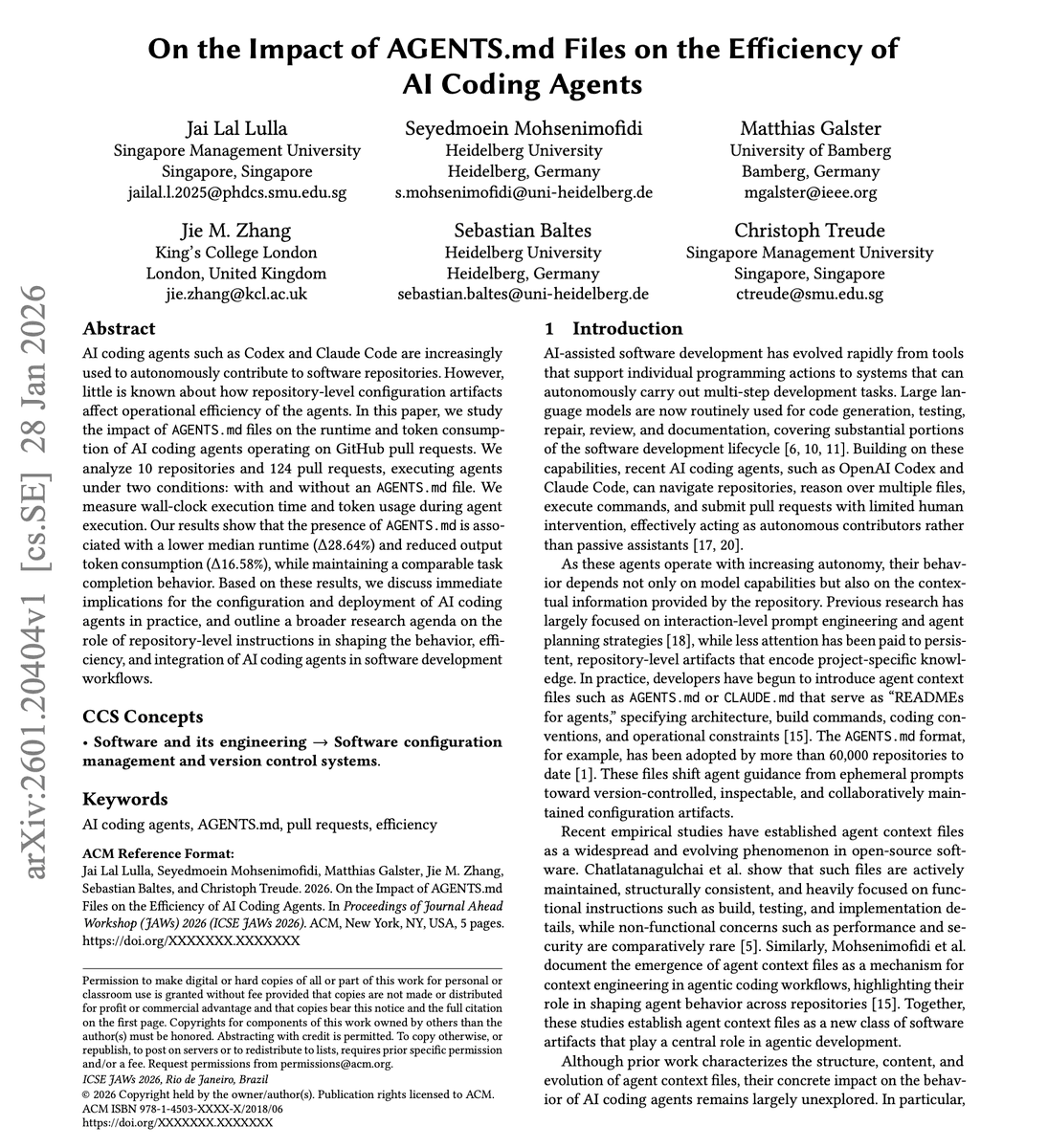
A fascinating development in AI-assisted programming has emerged from recent research examining how coding agents interact with repository documentation. According to a study testing OpenAI Codex across 10 repositories and 124 pull requests, the presence of specialized documentation files—specifically named "AGENTS.md"—can significantly improve agent performance, though not in the straightforward way many developers might expect.
The Documentation Effect: Quantifying the Impact
Researchers conducted identical coding tasks twice: once with AGENTS.md files present in repositories, and once without. The results revealed substantial efficiency gains when documentation was available. Median runtime dropped by 28.64%, while output tokens decreased by 16.58%. This translates to faster task completion at lower computational cost—a significant consideration given the expense of running large language models for development work.
Importantly, task completion rates remained comparable regardless of documentation presence. The agents achieved similar results either way, but they reached those results more efficiently when guided by appropriate documentation. This suggests that documentation doesn't necessarily improve the quality of AI-generated code, but rather optimizes the path to that code.
Not a Universal Accelerator: The Nuanced Reality
The research uncovered a crucial nuance that challenges simplistic assumptions about documentation benefits. The efficiency gains weren't uniformly distributed across all tasks. Instead, AGENTS.md files primarily reduced costs in a small number of very high-cost runs rather than uniformly lowering expenses across all operations.
This pattern suggests that documentation files function more as guardrails against worst-case "thrashing"—situations where AI agents might otherwise engage in inefficient, circular reasoning or generate excessive unnecessary code. By providing contextual boundaries and project-specific guidance, these files prevent the most extreme inefficiencies rather than providing a constant performance boost.
Strategic Implementation: When and How to Use Documentation
The study's authors caution against blindly adding AGENTS.md files to every repository. The effectiveness appears to depend on task complexity and requirements. For relatively simple coding tasks, documentation may provide minimal benefit, while for complex projects with specific architectural patterns or constraints, the guidance can be invaluable.
Researchers recommend keeping documentation lean and focused when implemented. Overly verbose or poorly structured documentation might actually hinder rather than help AI agents. The optimal approach appears to be concise, well-organized guidance that addresses the specific challenges and patterns relevant to a particular codebase.
Implications for Development Workflows
This research has significant implications for how development teams might structure their repositories in an increasingly AI-assisted programming environment. As coding agents become more integrated into development workflows, repository documentation may need to evolve beyond human-centric formats to include AI-optimized guidance.
Teams working with AI coding assistants might consider:
- Creating targeted documentation for complex or frequently modified components
- Testing documentation effectiveness with their specific AI tools and workflows
- Maintaining documentation discipline to ensure it remains relevant and concise
- Monitoring performance metrics to validate that documentation provides actual efficiency gains
The Broader Context: AI Documentation Standards
This research contributes to an emerging conversation about how we should structure information for AI systems. Just as human-readable documentation follows certain conventions and best practices, AI-readable documentation may develop its own standards and patterns. The AGENTS.md filename itself suggests a potential convention emerging within the developer community.
As AI systems become more sophisticated at parsing and utilizing structured information, we may see the development of specialized documentation formats optimized for machine consumption alongside traditional human-oriented documentation.
Future Research Directions
The study opens several avenues for further investigation. Future research might explore:
- Optimal documentation structures and formats for different types of AI coding agents
- How documentation effectiveness varies across different AI models and architectures
- The interaction between human-readable and AI-optimized documentation
- Whether similar principles apply to other domains beyond coding
Practical Recommendations for Developers
Based on the research findings, developers working with AI coding agents should:
- Consider adding AGENTS.md files for complex projects where AI agents frequently struggle
- Focus documentation on project-specific constraints and patterns rather than general programming concepts
- Keep documentation concise and well-structured to maximize its utility for AI systems
- Monitor performance metrics to validate that documentation provides tangible benefits
- Avoid documentation bloat—more isn't necessarily better for AI comprehension
Conclusion: Smarter Documentation for Smarter Coding
The research demonstrates that thoughtful documentation can significantly improve the efficiency of AI coding agents, though not as a universal performance enhancer. Instead, well-crafted documentation serves as a guardrail against inefficient processing, particularly for complex tasks where AI agents might otherwise engage in computational "thrashing."
As AI-assisted programming continues to evolve, the relationship between documentation and agent performance will likely become an increasingly important consideration for development teams. The most effective approach appears to be strategic, targeted documentation rather than blanket implementation—a principle that aligns with good documentation practices for human developers as well.
Source: Research testing OpenAI Codex across 10 repositories and 124 PRs, as discussed by Omar Sar on X/Twitter