What Happened
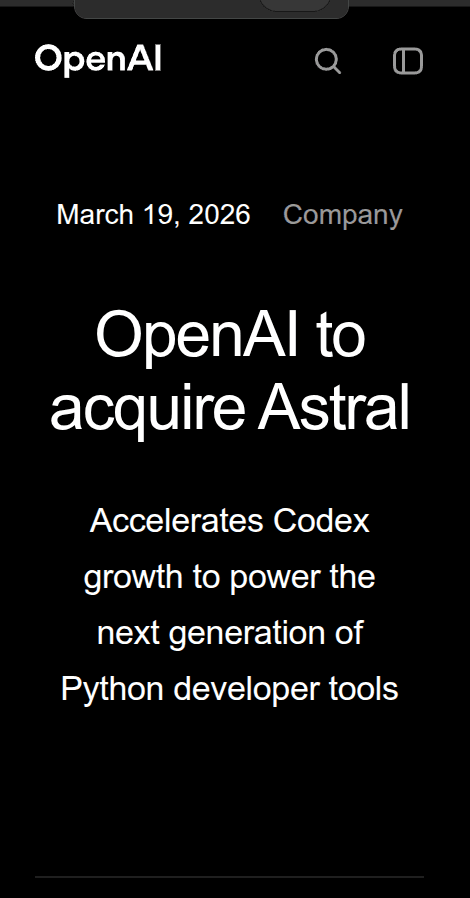
OpenAI has acquired developer tooling startup Astral, according to an announcement. Astral is best known for creating and maintaining two high-performance, open-source Python developer tools: Ruff, an extremely fast Python linter and code formatter written in Rust, and uv, a fast Python package installer and resolver.
The company also developed ty, a tool designed to help programmers ensure data is used correctly throughout their projects, likely referring to type checking or data validation.
OpenAI stated it plans to continue supporting Astral's open-source projects, meaning Ruff, uv, and ty will remain freely available. The deal is pending government regulatory checks before the Astral team officially joins OpenAI.
Context
Astral was founded in 2022 by Charlie Marsh, who previously worked at Sourcegraph. The company quickly gained prominence in the Python ecosystem for its focus on performance. Ruff, launched in late 2022, positioned itself as a drop-in replacement for Flake8, isort, and Black, but often orders of magnitude faster due to its Rust implementation. Uv, launched in 2024, aimed to be a faster alternative to pip and pip-tools.
The acquisition is framed as a "boost for OpenAI's Codex team." Codex is the model family powering GitHub Copilot, OpenAI's flagship AI-powered code completion tool. Integrating Astral's tooling expertise could enhance the underlying infrastructure, analysis capabilities, or developer experience surrounding Codex and Copilot.
What to Watch
The primary question is how Astral's technology and team will be integrated. Potential areas include:
- Enhanced static analysis for Codex: Using Ruff's fast parsing and linting capabilities to provide better context or more accurate suggestions within Copilot.
- Improved dependency management for AI coding agents: Leveraging uv to manage virtual environments and dependencies for AI-driven coding workflows.
- Internal tooling: Using Astral's tools to improve OpenAI's own development processes for its AI models.
The commitment to open-source support will be closely monitored by the developer community, which relies heavily on Ruff and uv. Any perceived shift in development priorities or licensing could impact their adoption.