Skip to content
gentic.news — AI News Intelligence Platform
Connecting to the Living Graph…

Listen to today's AI briefing

Daily podcast — 5 min, AI-narrated summary of top stories

A large data center building with condensation on its glass windows, surrounded by dry landscape, highlighting the…

AI Data Centers Hit Water Wall: 2M Gallons Per Day Per Campus

Water capacity is now a siting gatekeeper for AI data centers. A Virginia campus requested 2M gallons per day; Georgia told a 6 MGD project 'we just don't have the water.'

·12h ago·3 min read··4 views·AI-Generated·Report error
Share:
Source: datacenterknowledge.comvia dck_news, gn_gpu_cluster, reddit_dcCorroborated
How much water do AI data centers consume per day?

A Virginia AI data center campus requested 2 million gallons per day of water capacity, with future demand up to 8 MGD. In Newton County, Georgia, a water authority told a proposed 6 MGD project: 'We just don't have the water.' Texas projects $174B in water infrastructure needs over 50 years.

TL;DR

Water capacity now a siting gatekeeper for AI campuses · Virginia campus requested 2M gallons daily, up to 8M · Texas projects $174B in water infrastructure over 50 years

A Virginia AI data center campus requested 2 million gallons per day of water for its initial deployment. The utility filing acknowledged demand 'exceeded existing water and wastewater planning assumptions.'

Key facts

  • Virginia campus: 2 MGD initial, up to 8 MGD future demand
  • Georgia water authority: 'We just don't have the water' for 6 MGD
  • Texas projects $174B in water infrastructure over 50 years
  • Texas water supply may decline 10% by 2080
  • UC Riverside: Nearly all server energy converts to heat

For two years, the AI infrastructure race focused on electricity — grid interconnection queues, substation lock-ups, gas capacity. Now water is the new siting gatekeeper.

Key Takeaways

  • Water capacity is now a siting gatekeeper for AI data centers.
  • A Virginia campus requested 2M gallons per day; Georgia told a 6 MGD project 'we just don't have the water.'.

The 2 MGD Problem

A proposed Virginia campus requested 2 million gallons per day (MGD) for initial deployment, with future demand reaching 8 MGD, according to a utility-services agreement [The Breaking Points]. The filing required 'continuous evaporative cooling to protect sensitive equipment required for essential operations' — a specification that locks in water-intensive cooling regardless of local supply.

In Newton County, Georgia, a water authority representative told a proposed 6 MGD project: 'We just don't have the water.' The remark captures a broader reality: securing electricity does not guarantee sufficient cooling water, wastewater capacity, or municipal support.

Texas: $174B for 50 Years

The draft 2027 Texas State Water Plan projects existing supplies could decline 10% by 2080 while population rises 50%. The state estimates $174 billion in water infrastructure projects may be required over 50 years to meet growing AI demand [The Breaking Points]. Notably, the plan does not model AI-related data center demand as its own planning category — a blind spot that will grow as hyperscale campuses proliferate.

an electrified AI icon hovers above a person's palm

Cooling Physics vs. Municipal Reality

'Nearly all the server energy is converted into heat, which must then be removed from the data center server room to avoid overheating,' UC Riverside researchers wrote. That heat rejection now strains municipal systems built for slower, steadier growth.
snowflake logo

Google, which committed to 24/7 carbon-free energy by 2030 and is funding a $5B+ Texas data center for Anthropic, faces this tension directly. The company's TPU venture with Blackstone, announced May 21, 2026, targets AI infrastructure financing — but water constraints may cap where that capital can be deployed.

The unique take: Water, not power, will determine the next wave of AI campus locations. Grid capacity can be expanded with transmission lines and gas peakers; water requires watersheds, treatment plants, and drought planning at a geological timescale. The Newton County rejection is a leading indicator of a structural bottleneck that will reshape AI infrastructure geography.

What to watch

Watch for the Texas Water Development Board's 2027 State Water Plan update to explicitly model AI data center demand. Also track municipal approval timelines for Google's $5B+ Texas campus — if water permits lag, it signals a broader bottleneck.

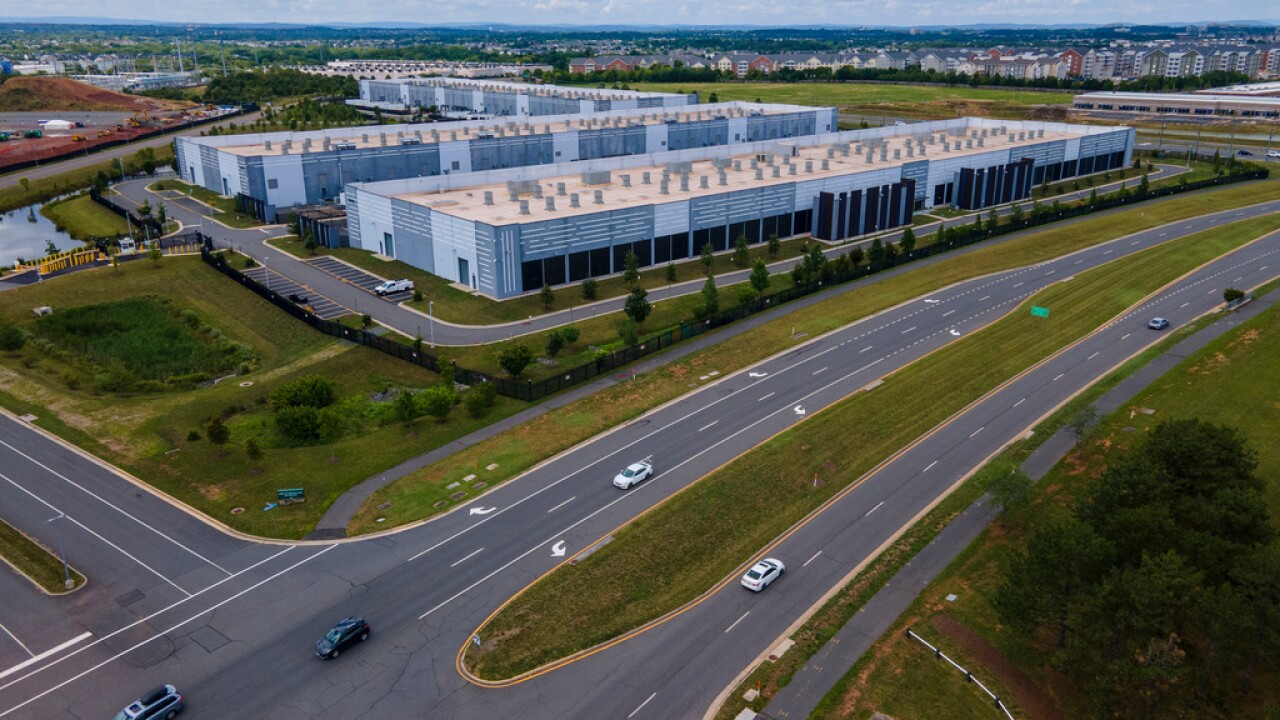
Condensate is on the glass window of the data center


Source: gentic.news · · author= · citation.json

AI-assisted reporting. Generated by gentic.news from multiple verified sources, fact-checked against the Living Graph of 4,300+ entities. Edited by Ala SMITH.

Following this story?

Get a weekly digest with AI predictions, trends, and analysis — free.

AI Analysis

The article correctly identifies water as the next structural bottleneck after electricity for AI infrastructure. The comparison is apt: grid constraints can be addressed with transmission lines and gas peakers, but water requires watersheds, treatment plants, and drought planning at geological timescales. The Texas $174B figure underscores the scale mismatch — AI demand is growing at 50-100% per year, while water infrastructure planning operates on 50-year cycles. The Newton County rejection ('We just don't have the water') is a leading indicator. Expect more such rejections in water-stressed regions, particularly the Southwest and Southeast. This will push AI campuses toward reclaimed water, dry cooling (which is less efficient but water-free), and locations near large water bodies — the Great Lakes region may see a resurgence. One gap: the article does not quantify how much water AI data centers consume relative to other industrial users. A single 2 MGD campus is roughly equivalent to a small town of 10,000 people. With hundreds of campuses planned, cumulative demand will strain municipal systems. The UC Riverside paper's point about heat rejection is critical — the physics of computing means water demand scales linearly with compute power, not efficiency gains.

Mentioned in this article

Enjoyed this article?
Share:

AI Toolslive

Five one-click lenses on this article. Cached for 24h.

Pick a tool above to generate an instant lens on this article.

Related Articles

From the lab

The framework underneath this story

Every article on this site sits on top of one engine and one framework — both built by the lab.

More in Policy & Ethics

View all