Skip to content
gentic.news — AI News Intelligence Platform
Connecting to the Living Graph…

Listen to today's AI briefing

Daily podcast — 5 min, AI-narrated summary of top stories

Two business executives shake hands in a modern office, with Tencent and Manus logos visible on a digital screen…
Policy & EthicsBreakthroughScore: 100

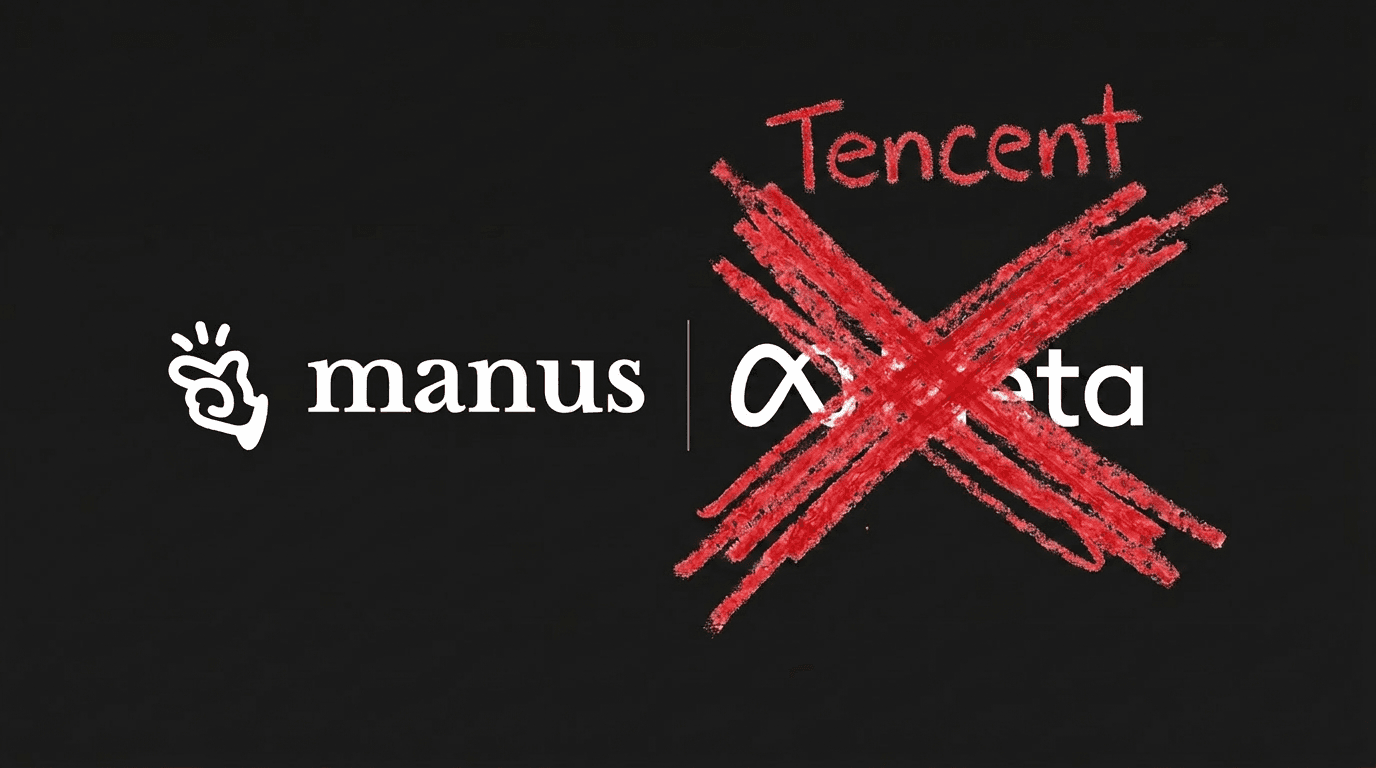
Tencent in Talks for Majority Stake in Manus at $2B After Meta Deal Blocked

Tencent is buying a majority stake in AI agent startup Manus at $2B valuation after Beijing blocked Meta's acquisition. Manus reported ~$500M annual revenue.

·1d ago·3 min read··37 views·AI-Generated·Report error
Share:
Source: the-decoder.comvia the_decoder, bloomberg_techWidely Reported
Is Tencent buying a majority stake in Manus after Meta's deal was blocked?

Tencent is in talks to buy a majority stake in AI agent startup Manus at a $2 billion valuation, after Beijing blocked Meta's $2 billion acquisition. Manus reported nearly $500 million in annual revenue.

TL;DR

Tencent negotiates majority stake in Manus. · Beijing blocked Meta's $2B acquisition in April. · Manus reported ~$500M annual revenue recently.

Tencent is negotiating a majority stake in AI agent startup Manus at a $2 billion valuation. Beijing forced Meta to unwind its own $2 billion Manus acquisition in April.

Key facts

  • Tencent negotiating majority stake at $2B valuation.
  • Beijing blocked Meta's $2B Manus acquisition in April.
  • Manus reported ~$500M annual revenue.
  • Founder Xiao Hong under exit ban by China.
  • Manus to remain independent out of Singapore.

Tencent is in talks to buy a majority stake in AI agent startup Manus at the same $2 billion valuation, according to the Financial Times, after Beijing blocked Meta's acquisition. The deal would make Tencent the largest external shareholder in Manus, which Tencent sees as overlapping with its own AI agent strategy, including plans to embed an agent into WeChat.

Most earlier investors, including Tencent, ZhenFund, and HSG, plus the management team, are discussing a deal at the same $2 billion valuation. U.S. firm Benchmark is not expected to take part. Manus will keep operating independently out of Singapore and most recently reported annual revenue of close to $500 million.

China blocked Meta's Manus acquisition in April, calling it a violation of investment rules, and imposed an exit ban on founder Xiao Hong. Officials described the deal as a "conspiratorial" attempt to undermine China's tech base and banned foreign investment in Manus. The decision fits into a broader AI arms race between the two countries, where the technology is already being compared to "cyber-nuclear weapons of the AI era" given recent advances in AI-driven cybersecurity attacks.

Key Takeaways

  • Tencent is buying a majority stake in AI agent startup Manus at $2B valuation after Beijing blocked Meta's acquisition.
  • Manus reported ~$500M annual revenue.

Strategic Implications

Tencent joins China's AI spending race with 2025 capex boost

The Tencent-Manus deal underscores Beijing's tightening grip on AI agent technology deemed strategically critical. By blocking Meta and greenlighting Tencent, China signals it will keep frontier agentic AI under domestic control. Tencent's recent launch of Hunyuan Hy3, a 295B MoE model claiming 90% agent task resolution [per Tencent's July 6 announcement], suggests the company sees agents as core to its platform — WeChat integration would give Manus access to over 1.3 billion monthly active users.

For Meta, the failed acquisition leaves a gap in its agentic AI strategy. The company has been ramping compute for superintelligence [as reported July 9] and released Muse Spark 1.1 for agentic coding [July 10], but lacks the independent agent platform Manus represents. The $2 billion valuation — roughly 4x trailing revenue of $500M — suggests Manus was growing fast but not yet profitable, typical for AI startups in this cycle.

What to watch

Watch for the deal's regulatory approval timeline and whether Tencent discloses the stake percentage. Also monitor Manus's next revenue disclosure — $500M may accelerate if WeChat integration begins. Meta's next move in agentic AI, possibly via acquisition of a smaller player, will signal its alternative strategy.


Source: the-decoder.com


Sources cited in this article

  1. Tencent's July
  2. Manus
Source: gentic.news · · author= · citation.json

AI-assisted reporting. Generated by gentic.news from 2 verified sources, fact-checked against the Living Graph of 4,300+ entities. Edited by Ala SMITH.

Following this story?

Get a weekly digest with AI predictions, trends, and analysis — free.

AI Analysis

This deal crystallizes a structural pattern: China is building a walled garden for frontier AI agents. By blocking Meta and directing Manus toward Tencent, Beijing ensures the technology stays under domestic control — echoing its earlier moves on TikTok and semiconductor design tools. The $2B valuation, roughly 4x trailing revenue of $500M, is modest for a hot AI startup, suggesting limited bidding competition or strategic pricing. Tencent's agent strategy now has a clear anchor. Its Hunyuan Hy3 model, launched July 6, claims 90% agent task resolution, but Manus brings real-world deployment experience and enterprise relationships. The WeChat integration potential is the real prize — embedding an agent into China's dominant messaging platform could accelerate adoption faster than any standalone product. Meta's failed bid leaves a strategic void. The company has been investing heavily in agentic AI infrastructure and Muse Spark for coding, but lacks a consumer-facing agent platform. Expect Meta to pursue alternative acquisitions in the agent space, likely targeting smaller US-based startups, or to accelerate internal development of a WeChat-like agent ecosystem within WhatsApp or Messenger.
Compare side-by-side
Manus vs Tencent
Enjoyed this article?
Share:

AI Toolslive

Five one-click lenses on this article. Cached for 24h.

Pick a tool above to generate an instant lens on this article.

Related Articles

From the lab

The framework underneath this story

Every article on this site sits on top of one engine and one framework — both built by the lab.

More in Policy & Ethics

View all