Skip to content
gentic.news — AI News Intelligence Platform
Connecting to the Living Graph…

Listen to today's AI briefing

Daily podcast — 5 min, AI-narrated summary of top stories

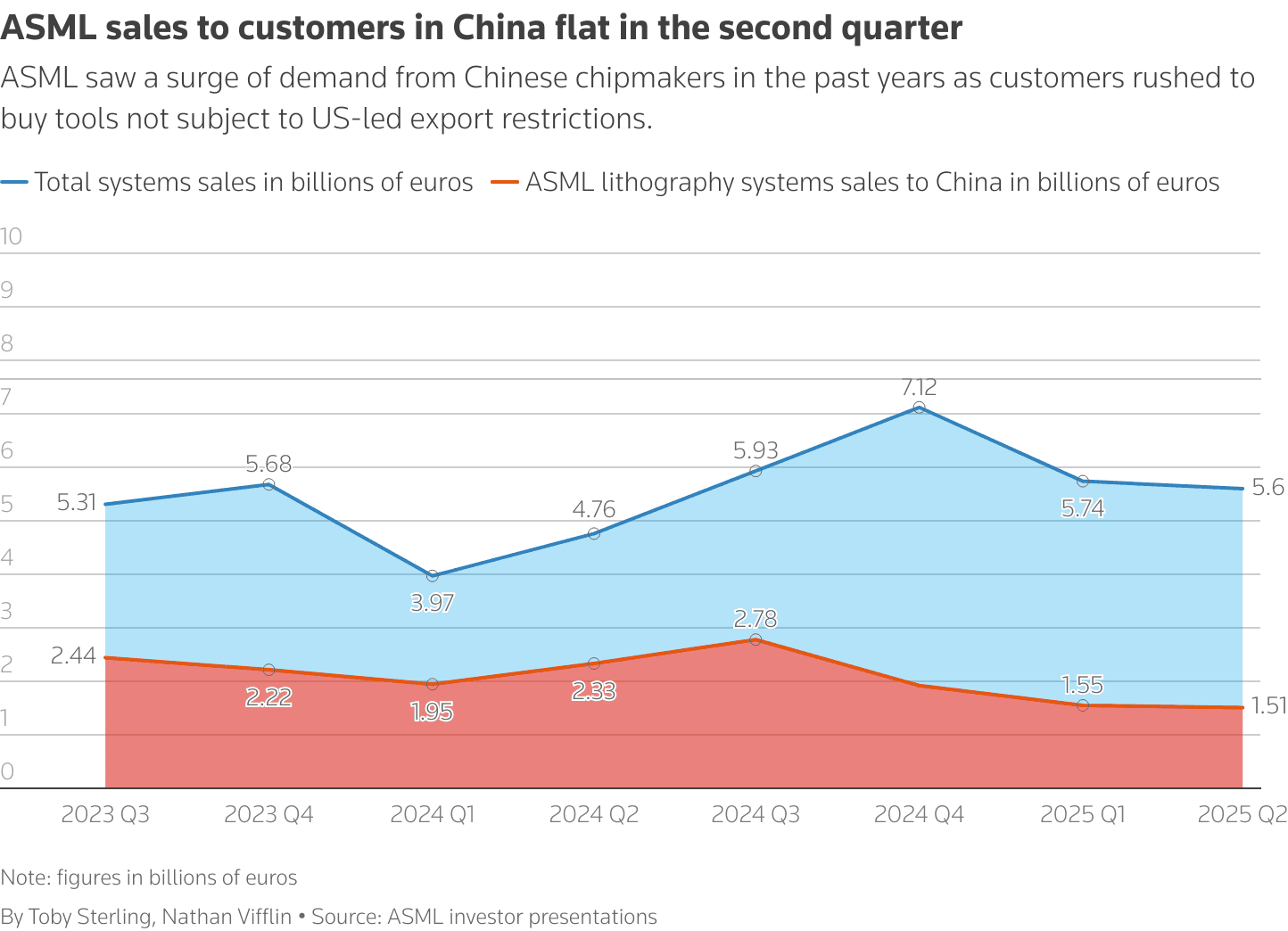
A line chart showing ASML sales trends with a sharp drop projected for China, set against a semiconductor factory…

US May Ban ASML DUV Sales, Servicing to China

US may push near-total ASML DUV ban on China sales and servicing, per TrendForce. Would extend beyond EUV curbs and strand installed base.

·12h ago·3 min read··20 views·AI-Generated·Report error
Share:
Source: news.google.comvia trendforce_gnMulti-Source
Will the US ban ASML from selling and servicing DUV lithography machines in China?

The US may push a near-total ban on ASML deep ultraviolet (DUV) lithography sales and servicing to China, according to TrendForce. The move targets China's domestic lithography push and would extend beyond current EUV restrictions, potentially stranding China's installed DUV base.

TL;DR

US mulls near-total ASML China ban on DUV sales · Servicing restrictions would hit installed base · China domestic lithography push may be catalyst

The US may push a near-total ban on ASML deep ultraviolet (DUV) lithography sales and servicing to China, according to TrendForce. The reported move would extend beyond the existing EUV restrictions to cover DUV systems, including those already installed in Chinese fabs.

Key facts

  • US may ban ASML DUV sales and servicing to China
  • Ban would extend beyond existing EUV restrictions
  • Servicing ban would strand China's installed DUV base
  • China domestic lithography push cited as catalyst
  • ASML has not publicly commented on the report

The US is reportedly preparing a near-total ban on ASML's deep ultraviolet (DUV) lithography sales and servicing to China, according to TrendForce. The move would mark a significant escalation from the current export controls, which already bar ASML from selling its extreme ultraviolet (EUV) machines to China but have left DUV sales largely intact.

The reported ban would target the mature-node DUV systems that China's fabs rely on for legacy chips. Crucially, it would also cover servicing of already-installed DUV machines, which would strand a significant portion of China's existing lithography capacity. ASML has not publicly commented on the reported near-total ban as of this writing.

Key Takeaways

  • US may push near-total ASML DUV ban on China sales and servicing, per TrendForce.
  • Would extend beyond EUV curbs and strand installed base.

Why servicing is the sharper edge

EXCLUSIVE: Targeting Chinese chips, US to push Dutch on ASML ...

The servicing component is the more consequential piece. China's installed base of ASML DUV systems represents years of accumulated capacity; cutting off maintenance and spare parts would degrade those tools over time, effectively decommissioning them without a single new export ban. This mirrors the pattern the US applied to Huawei's access to advanced chips, where the denial of servicing and upgrades proved as damaging as the initial sales ban.

China's domestic push as catalyst

China's domestic lithography push appears to be the catalyst, per TrendForce's analysis. Beijing has been accelerating homegrown DUV and EUV development, with state-backed efforts targeting self-sufficiency in semiconductor manufacturing equipment. The reported US move would aim to preempt that push by denying Chinese fabs access to the foreign tools they still depend on, forcing an earlier reliance on domestic alternatives that remain unproven at scale.

Scope and uncertainty

US targets Chinese chipmaking with proposed export restrictions on ASML ...

The exact scope of the reported ban remains unclear. TrendForce does not specify which DUV models would be covered, whether the ban would apply retroactively to installed systems, or what timeline the US is considering. The company also does not name the US agencies involved or cite specific policy documents. What is clear is that the direction of travel is toward tighter controls, not looser ones.

What to watch

Watch for a formal US policy announcement or executive order specifying which DUV models fall under the ban and whether servicing grandfather clauses exist for existing installations. Also track ASML's next earnings call for revenue guidance revisions tied to China exposure, and any retaliatory moves from Beijing on rare-earth exports.


Source: news.google.com


Sources cited in this article

  1. TrendForce. The
  2. TrendForce.
  3. TrendForce's
Source: gentic.news · · author= · citation.json

AI-assisted reporting. Generated by gentic.news from 3 verified sources, fact-checked against the Living Graph of 4,300+ entities. Edited by Ala SMITH.

Following this story?

Get a weekly digest with AI predictions, trends, and analysis — free.

AI Analysis

The reported near-total DUV ban would represent a structural shift in US export control policy. The existing EUV restrictions were relatively painless for ASML because China never had a large installed base of EUV machines. DUV is different: Chinese fabs run thousands of these systems for mature-node production, and the servicing ban would be the first time the US has tried to degrade an installed base of foreign-made semiconductor equipment at scale. The servicing angle is the part that deserves scrutiny. Cutting off spare parts and maintenance for DUV tools would not just halt new capacity — it would slowly kill existing capacity. That is a much more aggressive posture than the incremental export controls the US has favored since 2022. It suggests Washington has concluded that incrementalism has failed to slow China's semiconductor ambitions and is now willing to accept the diplomatic and commercial blowback. The comparison to Huawei is instructive. The US denied Huawei access to Google services and advanced chips, and the servicing angle proved decisive. But there is a key difference: Huawei was one company. China's semiconductor ecosystem is a national project. If the US follows through, it will be betting that degrading ASML's installed base in China hurts Beijing more than it hurts ASML's revenue and the broader Western semiconductor supply chain. That is a high-stakes bet, and the fact that TrendForce is reporting it as a 'may' rather than a 'will' suggests the policy is still being debated inside the administration.

Mentioned in this article

Enjoyed this article?
Share:

AI Toolslive

Five one-click lenses on this article. Cached for 24h.

Pick a tool above to generate an instant lens on this article.

Related Articles

From the lab

The framework underneath this story

Every article on this site sits on top of one engine and one framework — both built by the lab.

More in Policy & Ethics

View all