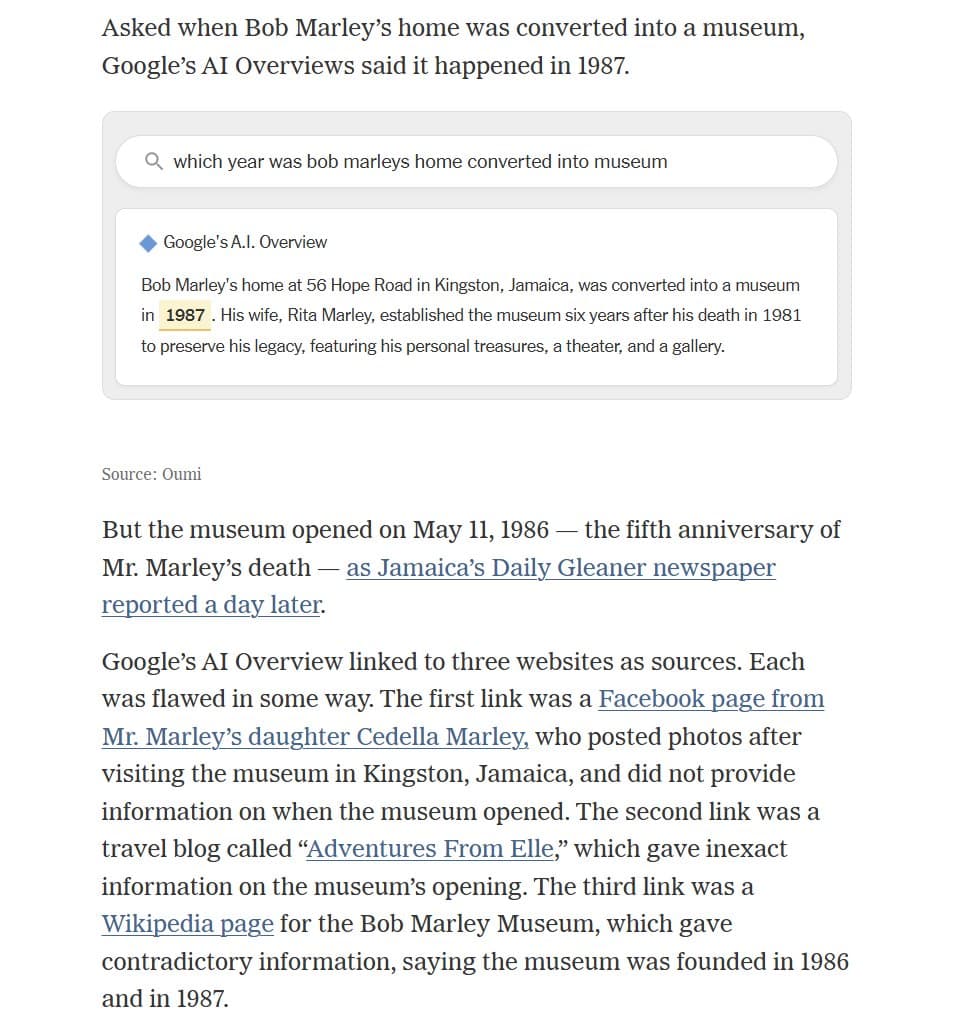
A recent analysis shared by researcher Ethan Mollick underscores a fundamental challenge in evaluating large language models (LLMs): their performance is notoriously difficult to measure in a meaningful way. The case study focuses on Google's AI Overviews feature, which generates concise summaries in response to search queries.
The core finding is that factual errors appearing in AI Overviews are often also present in Wikipedia, a primary source for many LLM training datasets. This creates a layered problem for benchmarking. First, it suggests the AI is accurately reflecting its source material, which is itself flawed. Second, the AI's presentation—a synthesized summary—makes tracing and verifying those sources more difficult for a user than clicking through a traditional search result link. Third, and most ambiguously, the AI-generated answer might still be better than what a typical user would find through unaided searching, despite its errors.
This triad of issues—faithful reproduction of source errors, opaque sourcing, and ambiguous comparative utility—makes it unclear what standard performance metrics like factual accuracy actually measure in real-world deployment.
The Core Measurement Problem
The case study illustrates that standard LLM benchmarks, which often test for factual recall against a verified corpus, may not capture real-world performance. If a model correctly cites an error from its training data, it scores highly on faithfulness-to-source metrics but delivers incorrect information. Conversely, if it corrects the error using reasoning not present in its training data, it might be penalized by some benchmarks for "hallucination" or deviating from source text.
Furthermore, the user experience is fundamentally different. A Wikipedia page often contains discussion tabs, edit histories, and citations that signal potential controversy or uncertainty about a claim. An AI Overview typically presents information as a confident, consolidated answer, stripping away these crucial meta-signals about information quality.
What This Means in Practice
For developers and researchers, this highlights the insufficiency of static, question-answer benchmarks for evaluating production AI systems. The real test involves the entire information retrieval and synthesis pipeline, including source transparency and the user's ability to assess credibility.
For users, it reinforces the need for critical engagement with AI-generated summaries, treating them as a starting point for investigation rather than a definitive endpoint, even when they sound authoritative.
gentic.news Analysis
This analysis directly touches on a critical thread we've been tracking: the evaluation crisis in modern AI. As we covered in our piece on "Benchmark Saturation: When LLMs Outgrow Their Tests", many standard academic benchmarks have become saturated, with top models achieving near-perfect scores that mask persistent real-world shortcomings like reasoning errors or poor source grounding. Mollick's observation about AI Overviews and Wikipedia exemplifies this—the model may be "benchmark accurate" by parroting its training data, yet systemically propagate errors.
This connects to Google's specific challenges. Following the rocky launch of AI Overviews in May 2024, which featured viral errors like recommending glue on pizza, Google has been in a continuous cycle of tuning and guardrail implementation. This new insight suggests part of the problem is foundational: when your model is trained on a corpus containing common myths and inaccuracies (like Wikipedia), and your product design obscures sources, errors are a structural inevitability, not just a tuning bug.
The trend here is the industry's slow pivot from pure capability metrics (MMLU, GPQA) toward trust and safety metrics and real-world user studies. Competitors are taking note. Perplexity AI, for instance, has built its entire product around cited sources, a direct counter to the opacity problem highlighted here. Meanwhile, OpenAI's approach with ChatGPT includes features like browsing with citations, indicating a shared recognition of the sourcing transparency problem. The key takeaway for practitioners is that the next frontier of LLM evaluation isn't about more questions, but about better frameworks for assessing information fidelity, traceability, and comparative utility in open-ended tasks.
Frequently Asked Questions
What are AI Overviews?
AI Overviews is a Google Search feature that uses an LLM to generate a concise, direct answer to a search query at the top of the results page. It synthesizes information from websites and other sources to create a summary, aiming to save users from clicking through multiple links.
Why do AI Overviews make the same mistakes as Wikipedia?
Large language models like Gemini are trained on massive datasets that include public internet content, with Wikipedia being a significant and high-quality component. If a factual error is prevalent on Wikipedia, the model learns it as a fact. When generating an overview, the model reproduces this learned information, effectively mirroring the error from its source material.
How does this make measuring AI performance hard?
It creates a conflict in evaluation. Standard accuracy metrics might reward the AI for correctly outputting what's in its training data (even if that data is wrong). Other metrics might penalize it for not "knowing" the correct fact. Furthermore, if the AI's answer is more coherent and useful than a raw search results page—despite containing an error—traditional benchmarks fail to capture this nuanced trade-off between factual precision and overall utility.
What should users do when they see an AI Overview?
Treat it as a helpful starting point, not a final answer. Use the information as a guide for further research, and critically check key claims, especially for health, financial, or important factual topics. Look for the "source" links Google sometimes provides, and be aware that the confident tone of an AI summary does not guarantee accuracy.