This week's AI research landscape reveals significant progress across multiple domains, with particular emphasis on improving reasoning capabilities, training efficiency, and real-world applicability. From massive video understanding datasets to novel paradigms for controlling computational resources, researchers are pushing boundaries in how AI systems process information and make decisions.
The Video Understanding Revolution
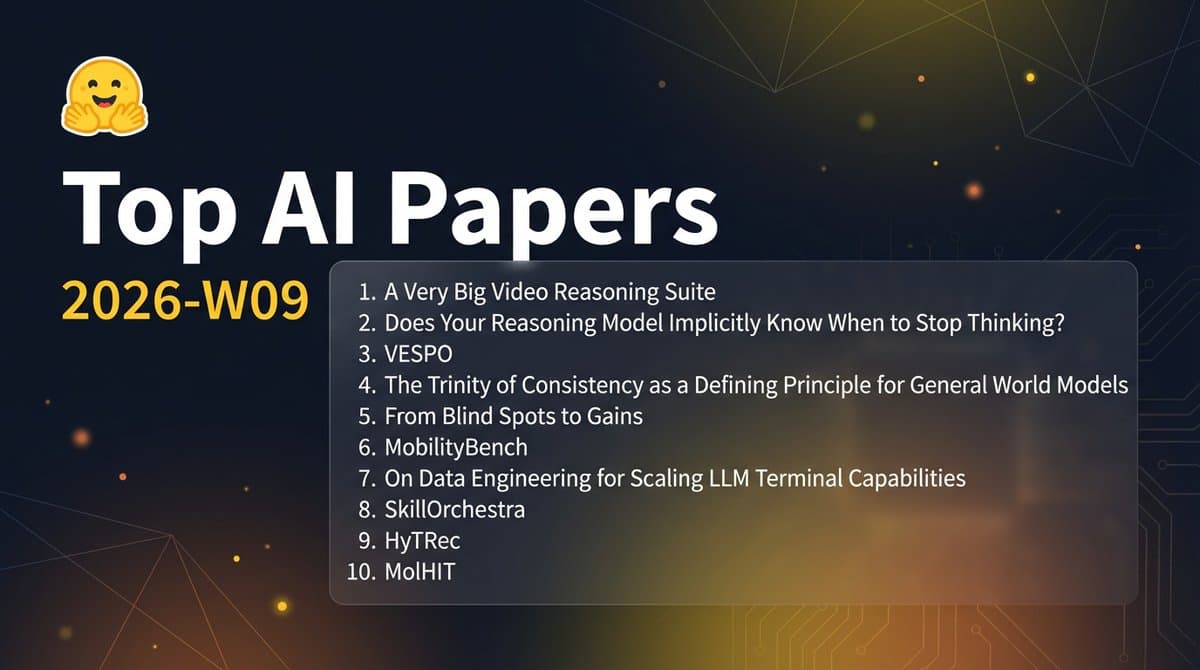
At the forefront is "A Very Big Video Reasoning Suite," a monumental dataset containing over 200 tasks and 1 million video clips specifically designed for video reasoning research. This represents one of the most comprehensive resources ever created for training and evaluating video understanding models. Unlike previous video datasets that focused primarily on classification or captioning, this suite emphasizes reasoning—requiring models to understand temporal relationships, causality, and complex narratives across extended video sequences.
The scale and diversity of this dataset could accelerate progress in video AI, which has traditionally lagged behind image and text understanding due to computational complexity and data scarcity. With applications ranging from autonomous vehicles to content moderation and medical diagnostics, improved video reasoning capabilities could transform numerous industries.
Knowing When to Stop: The SAGE Paradigm
Perhaps the most conceptually intriguing development comes from the paper "Does Your Reasoning Model Implicitly Know When to Stop Thinking?" which introduces the SAGE (Stop-After-Good-Enough) paradigm. This research addresses a fundamental challenge in AI reasoning: determining when additional computation yields diminishing returns.
Current large language models typically use fixed computation budgets regardless of problem difficulty, leading to inefficient resource allocation. The SAGE approach enables models to dynamically determine when they've reached a sufficiently confident answer, potentially reducing computational costs by 30-70% depending on task complexity. This has significant implications for deploying AI systems in resource-constrained environments and could dramatically improve the cost-effectiveness of AI services.
Agent Training Without Full Retraining
The "AgentFly" paper presents a clever solution to a persistent problem in AI agent development: how to improve agent performance without expensive full model fine-tuning. Traditional approaches require retraining the entire language model when adapting agents to new tasks, which is computationally intensive and risks catastrophic forgetting of previously learned capabilities.
AgentFly introduces a modular approach where only specific components related to agent behavior are adjusted, leaving the core language understanding capabilities intact. This allows for rapid iteration and specialization while maintaining general knowledge. Early results suggest this approach can achieve comparable performance to full fine-tuning with only 10-20% of the computational cost.
Efficiency Breakthroughs in Mathematical Reasoning
Microsoft's "rStar2-Agent" achievement of 80.6% on the challenging AIME24 mathematical reasoning benchmark with just 14 billion parameters represents a significant efficiency milestone. The AIME (American Invitational Mathematics Examination) problems require sophisticated multi-step reasoning that has traditionally demanded massive models with hundreds of billions of parameters.
This result suggests that architectural improvements and training techniques may be as important as sheer scale for certain reasoning tasks. The model's strong performance with relatively modest parameters could make advanced mathematical reasoning more accessible and deployable in educational and research applications.
Diagnostic-Driven Training for Multimodal Models
The paper "From Blind Spots to Gains: Diagnostic-driven iterative training for LMMs" addresses a critical challenge in multimodal AI: identifying and correcting systematic weaknesses in large multimodal models. Rather than using generic training approaches, this method employs targeted diagnostics to identify specific failure modes, then designs training interventions to address them.
This approach represents a shift from "more data" to "smarter training" in AI development. Early applications show significant improvements in handling edge cases and complex multimodal reasoning tasks that often trip up current systems.
Conversational Speech Synthesis Breakthrough
"VibeVoice: Synthesizing 90-minute multi-speaker conversational speech" pushes the boundaries of speech generation by creating extended, natural-sounding conversations between multiple synthetic voices. Previous speech synthesis systems have struggled with maintaining consistency and natural flow over extended dialogues, particularly with multiple participants.
This technology could revolutionize content creation, accessibility tools, and interactive entertainment. The ability to generate natural multi-speaker conversations opens possibilities for automated podcast production, personalized audiobooks, and more sophisticated voice assistants.
Real-World Route Planning Benchmark
Alibaba's "MobilityBench" provides a much-needed standardized evaluation for real-world route-planning agents. Unlike simplified academic benchmarks, MobilityBench incorporates complex real-world factors like traffic patterns, weather conditions, and user preferences. This moves AI evaluation closer to practical applications in logistics, transportation, and urban planning.
Scaling Strategies and Training Stability
NVIDIA's paper on data engineering strategies for scaling LLM terminal capabilities offers practical insights for organizations deploying large language models at scale. Meanwhile, "VESPO: Variational sequence-level soft policy optimization for stable RL training" addresses the notorious instability problems in reinforcement learning, potentially making RL more practical for real-world applications.
Beyond Simple Evaluation Metrics
The "Beyond Pass@1" research introduces self-play with variational problem synthesis to create more robust evaluation frameworks for reasoning systems. This approach generates progressively challenging problems to test the limits of AI systems, moving beyond simple binary success/failure metrics toward more nuanced understanding of capabilities and limitations.
Source: HuggingPapers compilation of top AI papers (Feb 24 - Mar 2)
The Broader Implications
Collectively, these developments signal several important trends in AI research. First, there's a clear shift toward efficiency—doing more with less computation through smarter architectures, training methods, and resource allocation. Second, evaluation is becoming more sophisticated, with benchmarks that better reflect real-world complexity. Third, modular and targeted approaches are gaining traction over monolithic retraining.
These advances come at a crucial time as AI systems are increasingly deployed in production environments where computational costs, reliability, and specific capability requirements are paramount. The emphasis on reasoning—whether in video, mathematics, or general problem-solving—reflects the field's maturation beyond pattern recognition toward more genuinely intelligent behavior.
As these technologies develop, we can expect more capable yet efficient AI systems that better understand when they're confident in their answers, adapt to new tasks without complete retraining, and handle complex real-world scenarios with greater sophistication. The coming months will likely see these research advances translated into practical applications across industries.