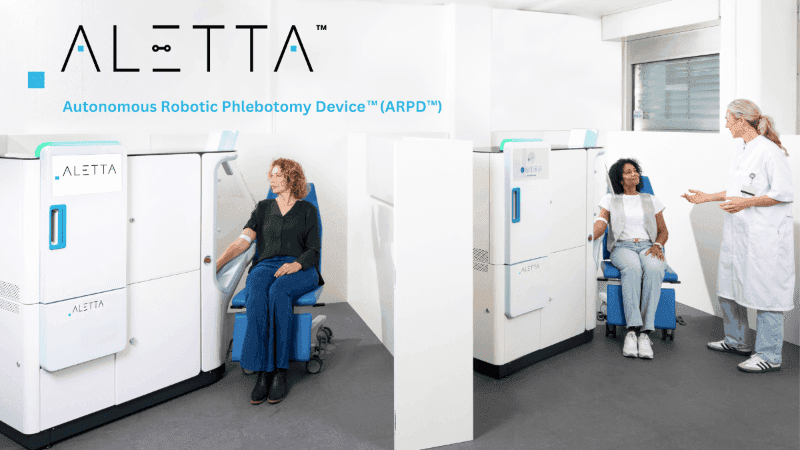
A new robotic system named Aletta aims to fully automate one of the most common yet challenging clinical procedures: the blood draw. The system, highlighted in a recent social media post by AI commentator Rohan Paul, represents a significant step in applying robotics and AI to repetitive, high-volume healthcare tasks.
What the Robot Does
Aletta is designed to perform a complete venipuncture—the process of drawing blood from a vein—without human intervention. According to the demonstration, the workflow is as follows:
- Patient Positioning: The patient sits and places their arm in the designated area.
- Vein Mapping: The robot uses an integrated ultrasound system to scan and locate a suitable vein.
- Arm Guidance: It then helps position the patient's arm for optimal access.
- Sample Collection: A robotic needle performs the blood draw.
- Post-Procedure: The system applies a bandage to the puncture site.
The entire sequence is described as "fully automated," suggesting a closed-loop system where AI processes the ultrasound imagery, plans the needle path, and executes the physical task.
The Technical Challenge
Automating phlebotomy is a non-trivial robotics problem. It requires:
- Perception: Reliably interpreting ultrasound images to distinguish veins from arteries, tendons, and other tissue, and to gauge depth and size. This is complicated by variations in patient physiology, hydration, and movement.
- Precision: Guiding a needle to a small, deformable target that can roll or collapse under pressure, requiring sub-millimeter accuracy and real-time adjustment.
- Safety: Ensuring patient comfort and avoiding complications like nerve damage or hematomas, necessitating force sensing and potentially haptic feedback.
While the source material does not provide technical specifications for Aletta's AI models or robotic actuators, the use of ultrasound for guidance is a known approach in research. Academic and commercial projects have previously demonstrated robotic needle steering under ultrasound guidance, but a fully integrated, start-to-finish system for clinical use is a more advanced productization of that research.
The Healthcare Context
Failed or difficult venous access is a major problem in hospitals and clinics. Studies suggest first-stick failure rates can be as high as 20-30% for adults and even higher for pediatric, elderly, or critically ill patients. This leads to patient discomfort, delayed care, increased workload for nurses and phlebotomists, and higher costs.
An automated system like Aletta promises several potential benefits:
- Consistency: A robot does not fatigue or have "off days," potentially offering a more consistent success rate.
- Staff Augmentation: It could free up skilled clinical staff for higher-value tasks, a crucial advantage in environments facing staffing shortages.
- Data Integration: As a digital system, it could automatically log procedure data (time, vein selected, success/failure) into electronic health records.
The primary challenges for adoption will be regulatory clearance (like FDA 510(k)), proving clinical efficacy and safety in trials, cost, and integration into existing clinical workflows.
gentic.news Analysis
This development fits squarely into the accelerating trend of procedural automation in healthcare, a sector we've tracked closely. It follows the trajectory of systems like the Siemens Healthineers' ARTIS pheno for interventional radiology and Intuitive Surgical's da Vinci SP for single-port procedures, but targets a far more ubiquitous and logistically burdensome task. The use of AI for ultrasound interpretation is particularly noteworthy. This aligns with our previous coverage on Butterfly Network's work in democratizing ultrasound with AI-assisted diagnostics ("Butterfly Network Unveils New AI Tools for Point-of-Care Ultrasound," March 2025). Aletta essentially applies a similar perceptual AI layer to a specific robotic manipulation task.
Furthermore, this announcement intersects with another key trend we've documented: the rise of vertical AI robotics. Instead of building general-purpose humanoids, companies are increasingly developing specialized systems for single, high-value workflows. This is evident in logistics (Boston Dynamics' Stretch), agriculture (Tortuga AgTech's harvesters), and now healthcare. Aletta competes indirectly with other blood-draw assist devices like VascuLogic's VeinViewer (which only provides vein visualization) but aims to own the entire physical procedure.
The critical unanswered question is benchmark performance. For this technology to move from a compelling demo to clinical adoption, it must demonstrate a statistically significant improvement over human phlebotomists in first-stick success rates across a diverse patient population, especially "difficult stick" cases. The next milestone to watch for will be peer-reviewed clinical trial results or a regulatory filing.
Frequently Asked Questions
How does the Aletta robot find a vein?
Aletta uses an integrated ultrasound probe to image the patient's arm. AI algorithms then analyze the ultrasound feed in real-time to identify a suitable vein, distinguishing it from arteries and other structures, and calculating its depth and diameter to plan the needle insertion.
Is robotic blood drawing safe?
Safety would be the paramount concern for any regulatory approval. While the source material does not provide safety data, a system like Aletta would require extensive clinical validation to prove it can avoid complications like nerve damage, arterial puncture, or excessive hematoma formation. It would likely incorporate multiple safety features like force sensors, real-time path monitoring, and immediate stoppage protocols.
Will this replace phlebotomists and nurses?
In the near to medium term, the goal is more likely augmentation, not replacement. An automated system could handle routine, standard draws in high-volume settings (like outpatient labs), freeing up skilled human staff to manage complex cases, patient care, and other clinical duties. It could also be deployed in settings with limited access to trained phlebotomists.
What stage of development is the Aletta robot in?
The available information shows a working demonstration system. The path to widespread clinical use would require steps including: refining the prototype, conducting formal clinical trials to establish efficacy and safety, obtaining regulatory clearance (e.g., from the FDA), and scaling manufacturing. The timeline for these steps is not specified in the source.