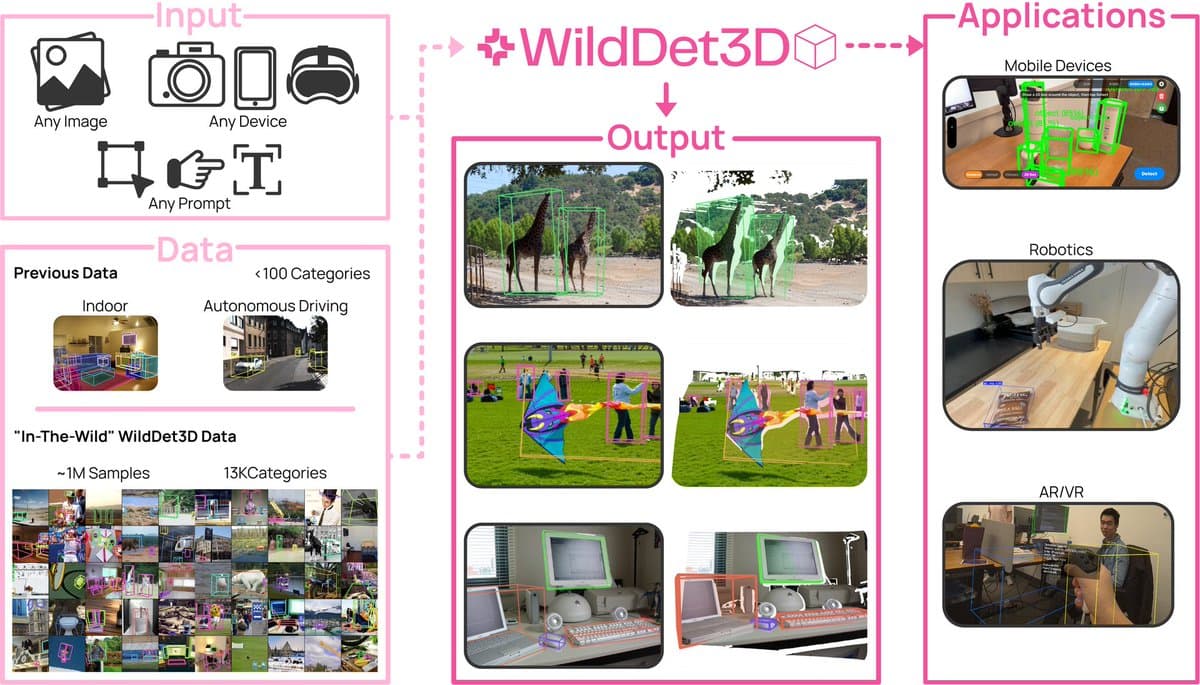
The Allen Institute for AI (AllenAI) has released WildDet3D, a new model for promptable 3D object detection from a single RGB image. The model takes a standard 2D photograph and predicts the 3D position, size, and orientation of objects within it, outputting a 3D bounding box. Its key innovation is a flexible prompting system that allows users to specify the target object via text descriptions, 2D points, or 2D bounding boxes. The model can also optionally integrate sparse depth data if available, potentially improving accuracy.
Key Takeaways
- Allen Institute for AI (AllenAI) has open-sourced WildDet3D, a model for promptable 3D object detection from single RGB images.
- It predicts 3D bounding boxes using flexible prompts and can integrate optional depth data.
What the Model Does
WildDet3D addresses a core challenge in computer vision: moving from 2D image understanding to 3D scene reasoning without requiring specialized sensors like LiDAR or stereo cameras. Given a single RGB image, the model outputs a 3D oriented bounding box for a prompted object. This box is defined in a camera-coordinate system, providing metrics like distance from the camera (depth), width, height, length, and yaw rotation.
The prompting mechanism is designed for practical, interactive use:
- Text Prompt: A natural language description of the object (e.g., "a red car").
- Point Prompt: A user clicks on a pixel within the object in the image.
- Box Prompt: A user draws a 2D bounding box around the object.
This flexibility allows the model to be integrated into various workflows, from automated systems using text queries to interactive annotation tools where a human provides a click.
Technical Approach & Architecture
While the source tweet and linked paper provide the high-level capabilities, the core technical achievement is enabling 3D reasoning from 2D data with user guidance. The model must overcome the inherent ambiguity of monocular 3D detection—a single 2D image can correspond to infinitely many 3D scenes. The prompts help resolve this ambiguity by precisely identifying which object to localize in 3D.
The optional integration of sparse depth suggests the architecture likely fuses visual features from a vision backbone (like a Vision Transformer or CNN) with geometric cues. The text prompting capability indicates the use of a vision-language model component to align textual concepts with visual regions.
Training such a model requires a large-scale dataset of images annotated with 3D bounding boxes, which is scarce compared to 2D detection data. AllenAI likely employed a combination of real-world datasets (like nuScenes or KITTI) and possibly synthetic data to teach the model geometric reasoning.
Potential Applications & Impact
WildDet3D's capability has immediate implications for several fields:
- Robotics & Autonomous Systems: Providing 3D object awareness from standard cameras, reducing dependency on expensive depth sensors.
- Augmented Reality (AR): Accurately placing virtual objects in real-world scenes by understanding the 3D layout of existing objects.
- Content Creation & 3D Modeling: Quickly generating 3D asset placements from reference images.
- Data Annotation: Semi-automating the creation of 3D bounding box labels for training other models, where a human annotator provides a simple point or box prompt.
By open-sourcing WildDet3D, AllenAI is providing a foundational tool for research and development in 3D scene understanding, lowering the barrier to entry for monocular 3D perception tasks.
Limitations and Considerations
As a monocular system, WildDet3D's accuracy, especially in depth estimation, will have inherent limits compared to systems using LiDAR or stereo vision. Performance will vary based on object type, distance, and image quality. The "in the wild" aspect suggests it is trained on diverse, real-world imagery, but its robustness across all possible environments and edge cases remains an open question. The true benchmark will be its performance on standardized 3D detection datasets compared to existing state-of-the-art methods.
gentic.news Analysis
AllenAI's release of WildDet3D is a strategic move in the increasingly competitive field of 3D foundation models. This follows a series of notable releases in the 2024-2025 period, including Meta's 3D Gen for asset creation and Google's Lumiere for 3D video generation. Unlike these generative models, WildDet3D focuses on a discriminative task—3D perception—which is a more direct enabler for robotics and embodied AI. This aligns with AllenAI's historical strength in vision-language models and structured reasoning, as seen in their prior work on VLMs like Flamingo and OLMo.
The push towards promptable 3D understanding mirrors the evolution of 2D vision models, which moved from fixed-category detection to open-vocabulary, promptable systems like CLIP and Grounding DINO. WildDet3D applies this interactive paradigm to the geometrically richer 3D domain. Its release as open-source research continues AllenAI's institutional mission of providing public, non-profit counterweights to the closed models developed by large tech corporations.
For practitioners, the key trend to watch is the convergence of multimodal prompting with 3D geometric reasoning. WildDet3D represents a step towards AI systems that can follow intuitive, natural instructions to parse and interact with the 3D world from simple visual inputs. The next frontier will be scaling this capability to whole-scene reconstruction and dynamic interaction prediction, critical steps for developing general-purpose robotic agents.
Frequently Asked Questions
What is WildDet3D?
WildDet3D is an open-source AI model from the Allen Institute for AI that detects and localizes objects in 3D space from a single 2D photograph. It predicts an object's 3D position, size, and orientation based on a user's text, point, or box prompt.
How is WildDet3D different from other 3D AI models?
Unlike generative 3D models that create new 3D assets, WildDet3D is a perception model that analyzes existing images. Its key differentiator is its flexible prompting system, allowing users to specify which object to localize interactively, rather than detecting a pre-defined set of object categories.
What can WildDet3D be used for?
Primary applications include robotics and autonomous navigation (for obstacle detection), augmented reality (for placing virtual objects accurately), and automated 3D data annotation. It allows systems to gain 3D scene understanding using only a standard camera.
Do I need special hardware or depth sensors to use WildDet3D?
No. WildDet3D is designed for monocular (single-camera) RGB images. While it can optionally use sparse depth data if available, its core functionality works with ordinary photos, making it accessible for a wide range of applications.