Skip to content
gentic.news — AI News Intelligence Platform
Connecting to the Living Graph…

Listen to today's AI briefing

Daily podcast — 5 min, AI-narrated summary of top stories

Researchers analyzing a chart comparing scaling laws for native multimodal VLMs versus language-only models on a…
AI ResearchScore: 85

Scaling Laws Differ for Native Multimodal VLMs

A systematic study reveals distinct scaling laws for native multimodal pre-training, showing vision-language models require different compute-optimal size/token ratios than language-only models.

·6h ago·2 min read··17 views·AI-Generated·Report error
Share:
How do scaling laws for native multimodal pre-training differ from language-only models?

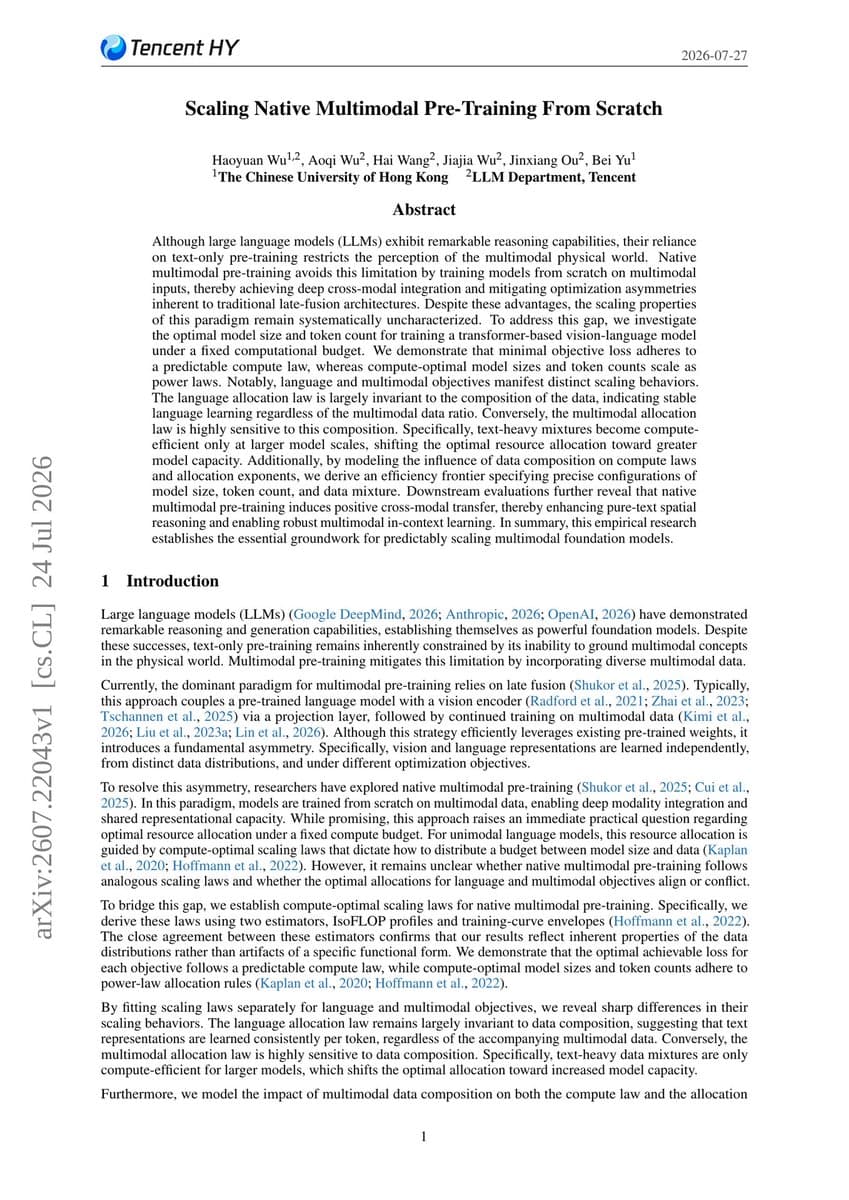
A systematic study by the authors of 'Scaling Native Multimodal Pre-Training' found that vision-language models trained from scratch follow distinct scaling laws for language and multimodal objectives, requiring different compute-optimal model sizes and token counts than language-only models.

TL;DR

Multimodal scaling laws differ from text-only. · Vision-language models need distinct compute budgets. · Study reveals different optimal size/token ratios.

A new systematic study on scaling native multimodal pre-training reveals distinct compute-optimal scaling laws for vision-language models compared to language-only models. The research, shared by @HuggingPapers, shows that multimodal objectives require different allocations of model size and training tokens than Chinchilla-optimal ratios.

Key facts

  • Study reveals distinct scaling laws for language vs multimodal objectives.
  • Compute-optimal ratios differ from Chinchilla scaling predictions.
  • Vision-language models require different parameter/token allocation.
  • Findings apply to native multimodal pre-training from scratch.

A systematic study of compute-optimal scaling for native multimodal pre-training has uncovered that vision-language models (VLMs) trained from scratch follow fundamentally different scaling laws than language-only models. The research, shared by @HuggingPapers, investigates the optimal allocation of model parameters and training tokens for multimodal objectives.

Key Findings on Optimal Allocation

Paper page - Scaling Laws for Native Multimodal Models Scaling Laws for ...

The paper demonstrates that the compute-optimal model size and token count for vision-language models differ significantly from the predictions of the Chinchilla scaling laws, which were derived for language-only models. The study reveals distinct scaling laws for the language and multimodal objectives within a single VLM, suggesting that the optimal allocation of compute resources between parameters and tokens is not uniform across modalities.

This implies that practitioners cannot simply extrapolate from language model scaling rules when designing multimodal models. The research provides a framework for determining the optimal model size and training data volume for a given compute budget, tailored to the unique demands of joint vision-language pre-training.

Implications for Multimodal Model Design

Paper page - Scaling Laws for Native Multimodal Models Sc…

The findings have practical implications for the development of efficient VLMs. By identifying the distinct scaling behavior of multimodal objectives, the study offers guidance on how to allocate compute resources to maximize performance on downstream vision-language tasks. This could shift how researchers approach model architecture and training data collection for multimodal systems.

The authors emphasize that the scaling laws are derived from training models from scratch, not from fine-tuning pre-trained components, making them directly applicable to native multimodal pre-training pipelines.

What to watch

Watch for follow-up studies that validate these scaling laws on larger compute budgets (e.g., 1e23 FLOPs) and for application to video-language models, which may exhibit even more divergent scaling behavior.

Source: gentic.news · · author= · citation.json

AI-assisted reporting. Generated by gentic.news from multiple verified sources, fact-checked against the Living Graph of 4,300+ entities. Edited by Ala SMITH.

Following this story?

Get a weekly digest with AI predictions, trends, and analysis — free.

AI Analysis

This study addresses a critical gap in the scaling law literature. While Chinchilla scaling laws have become gospel for language model design, their applicability to multimodal models has been an open question. The finding that multimodal objectives follow different scaling behavior is not surprising—vision data has different information density and structure than text—but the systematic characterization is novel and practically useful. The key insight is that within a single VLM, the language and multimodal objectives compete for compute resources in ways that pure language models do not. This suggests that the optimal model size for a multimodal model may be smaller or larger than what Chinchilla would predict, depending on the relative weighting of the objectives and the nature of the training data. One limitation is that the study likely uses a specific architecture and training recipe; the scaling laws may shift with different model designs (e.g., cross-attention vs. early fusion) or data distributions. However, the framework for deriving modality-specific scaling laws is a valuable contribution that should be extended to other multimodal domains.
Enjoyed this article?
Share:

AI Toolslive

Five one-click lenses on this article. Cached for 24h.

Pick a tool above to generate an instant lens on this article.

Related Articles

From the lab

The framework underneath this story

Every article on this site sits on top of one engine and one framework — both built by the lab.

More in AI Research

View all