Andrej Karpathy Analysis: AI Poses High Risk to 57 Million US Jobs, ~40% of Workforce
AI ResearchScore: 85

Andrej Karpathy Analysis: AI Poses High Risk to 57 Million US Jobs, ~40% of Workforce

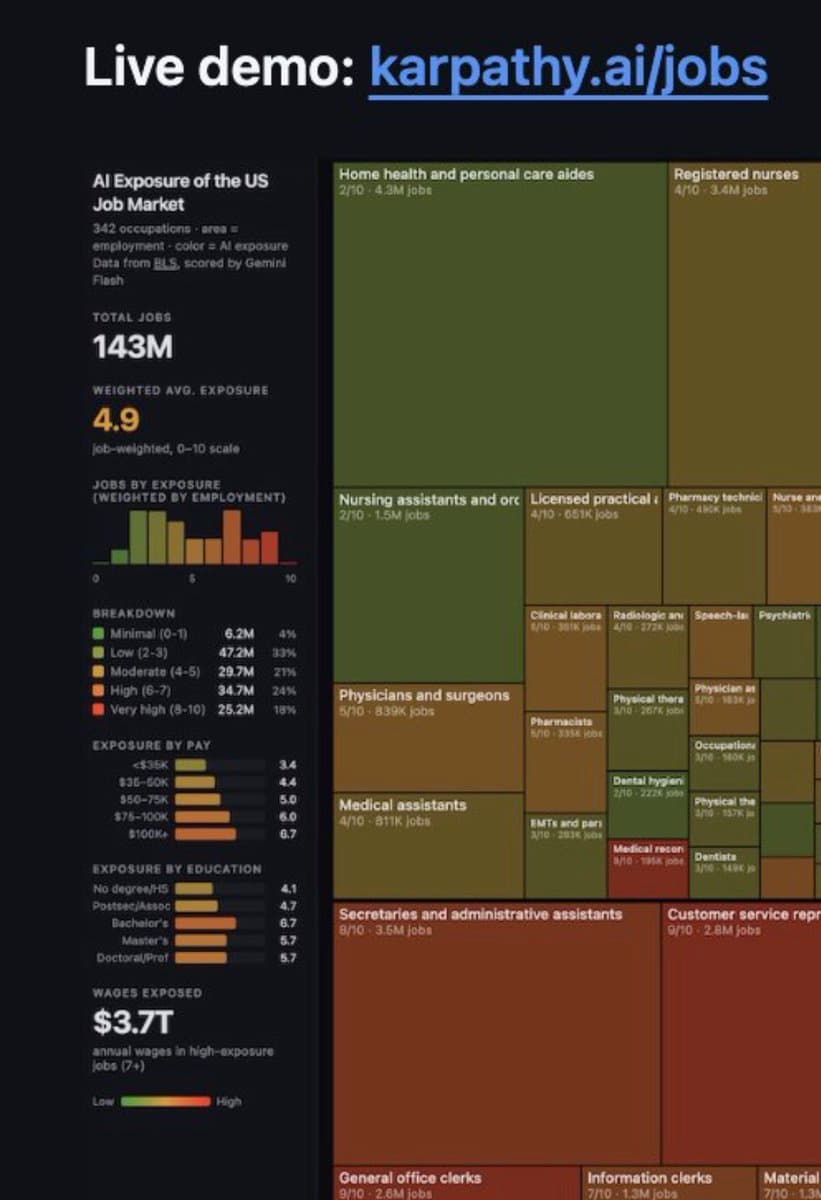
Andrej Karpathy's analysis concludes AI puts 57 million US workers at high to very high risk of negative job impact. This ~40% figure contextualizes recent tech layoffs and discussions around universal high income.

23h ago·2 min read·16 views·via @kimmonismus
Share:

What Happened

Andrej Karpathy, former Senior Director of AI at Tesla and a founding member of OpenAI, has conducted an analysis on AI's impact on the US workforce. According to a summary shared on social media, Karpathy used AI to evaluate job risk and concluded that approximately 57 million people out of a total of 143 million working people in the US are at "high to very high risk" of their jobs being negatively impacted by AI. This represents roughly 40% of the current workforce.

The source emphasizes that Karpathy is "by no means interested in hype or exaggeration," suggesting his analysis is methodical and grounded.

Context

The post frames this finding against two other developments: Meta's reported consideration of laying off 20% of its workforce for "efficiency reasons," and Elon Musk's assertion that "universal high income is coming." The implication is that Karpathy's large-scale risk assessment provides a macro-economic backdrop for understanding individual corporate decisions and broader societal proposals.

The source material does not provide a link to Karpathy's original analysis, its methodology, the specific AI tools used, or a breakdown of which occupations are considered high-risk. The core reported figures are the 57 million at-risk workers and the 40% proportion of the workforce.


AI Analysis

Karpathy's entry into workforce impact analysis is notable given his technical credibility and historical aversion to hype. The reported 40% high-risk figure is a significant, concrete estimate that aligns with—and potentially quantifies—concerns from other economists and researchers about AI's disruptive potential. Without the underlying methodology, however, it's impossible to evaluate the rigor of the classification into "high to very high risk." Key questions include the definition of "negative impact" (full displacement vs. task augmentation) and the time horizon considered. The juxtaposition with Meta's potential layoffs is provocative but correlative. It suggests a narrative where AI-driven efficiency gains are already influencing corporate planning at scale. Musk's mention of "universal high income" points to the growing discourse around systemic economic solutions to potential mass job displacement, a conversation that is gaining traction as foundational AI models demonstrate increasingly broad capabilities.
Original sourcex.com

Trending Now

More in AI Research

View all