New data from Anthropic's Economic Index reveals how user behavior with Claude evolves over time. According to findings shared via the company's official Twitter account, longer-term Claude users demonstrate distinct behavioral shifts compared to newer users.
What the Data Shows
The key findings from the Anthropic Economic Index indicate:
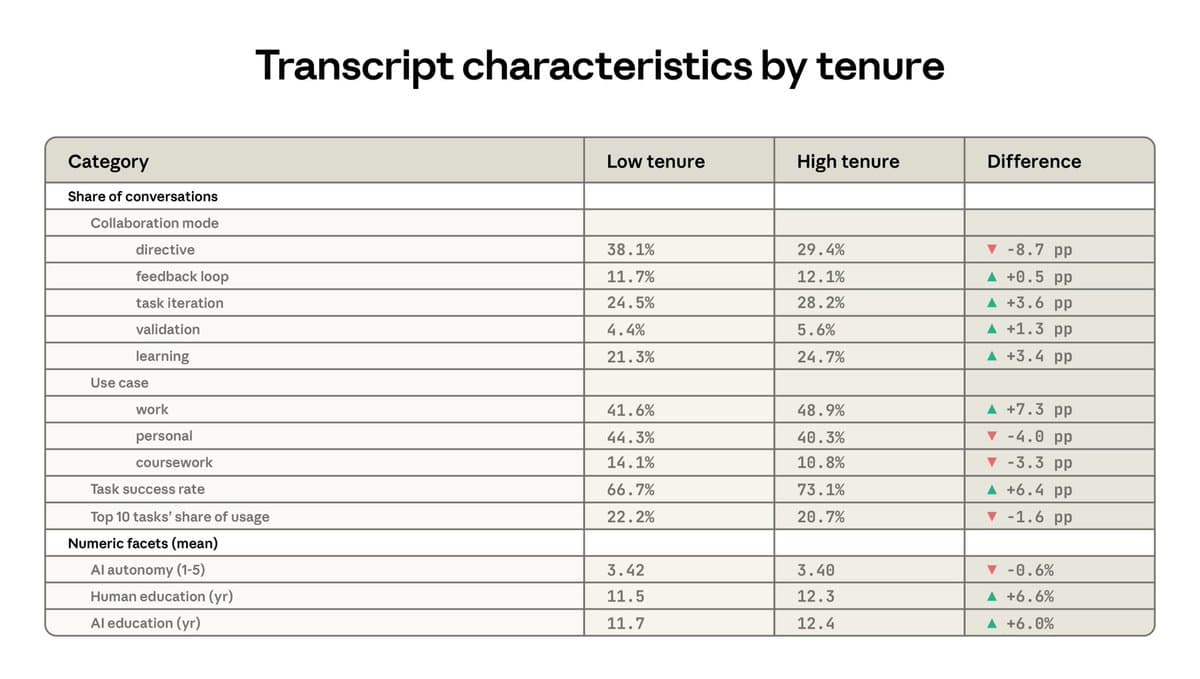
- Increased Iteration: Experienced users are "more likely to iterate carefully with Claude" rather than providing single prompts and accepting initial outputs.
- Reduced Autonomy: These users are "less likely to hand it full autonomy," suggesting they maintain more active oversight and direction in the collaboration process.
- Higher-Value Tasks: Longer-term users "attempt higher-value tasks" with the AI assistant.
- Greater Success Rates: These users "receive more successful responses," indicating either improved prompting skills or better task selection.
Context and Methodology
While the tweet provides limited technical detail about the Economic Index methodology, this appears to be part of Anthropic's ongoing effort to measure and understand how AI assistants create economic value in real-world usage scenarios. The company has previously positioned the Economic Index as a tool for tracking productivity gains and usage patterns across different user segments.
What This Means for AI Assistant Design
The findings suggest several implications for AI assistant development:
User sophistication increases with experience: Users don't simply use AI assistants more—they use them differently and more effectively over time.
The optimal user-AI relationship may be collaborative rather than autonomous: The data indicates users move away from "set it and forget it" approaches toward more interactive, iterative workflows.
Success metrics should account for user evolution: Benchmarks that assume static user behavior may miss important dynamics in how human-AI collaboration matures.
gentic.news Analysis
This data point from Anthropic's Economic Index arrives at a critical juncture in the AI assistant market. Following Anthropic's Claude 3.5 Sonnet launch in June 2024, which introduced significant improvements to coding and reasoning capabilities, the company appears to be doubling down on understanding real-world usage patterns rather than just benchmark performance.
The shift from autonomy to iteration aligns with broader industry trends we've observed. OpenAI's recent ChatGPT o1 model family emphasizes step-by-step reasoning over direct answers, suggesting both leading AI companies are converging on similar insights about optimal human-AI collaboration patterns.
This data also provides context for Anthropic's competitive positioning against Google's Gemini and Microsoft's Copilot. While those platforms often emphasize automation and integration into existing workflows, Anthropic's findings suggest there may be untapped value in designing specifically for iterative, high-value collaboration—a potential differentiation point as the assistant market matures.
The timing is particularly notable given the increased regulatory scrutiny on AI autonomy and safety. By demonstrating that experienced users naturally reduce AI autonomy, Anthropic may be positioning Claude as a more controllable, collaborative alternative to fully autonomous systems—a potentially valuable narrative as policymakers consider AI governance frameworks.
Frequently Asked Questions
What is the Anthropic Economic Index?
The Anthropic Economic Index is a research initiative by Anthropic that tracks how people use Claude AI assistant in real-world scenarios, measuring productivity gains, usage patterns, and economic value creation. It appears to combine quantitative usage data with qualitative insights about how user behavior evolves over time.
How do experienced Claude users differ from new users?
According to the latest data, experienced Claude users are more likely to engage in iterative prompting (refining and building upon Claude's responses), less likely to give the AI full autonomy, attempt more complex and valuable tasks, and achieve higher success rates with those tasks compared to newer users.
Why would users reduce AI autonomy as they gain experience?
Several factors likely contribute to this trend: experienced users better understand the AI's limitations and strengths, develop more sophisticated workflows that combine human and AI capabilities, and learn which tasks benefit from human oversight versus full automation. This mirrors patterns seen in other professional tools where expertise leads to more nuanced, rather than simply more, automation.
How might this data influence future AI assistant development?
The findings suggest AI assistants should be optimized for collaborative iteration rather than just autonomous task completion. This could influence interface design (better support for multi-turn conversations), model training (prioritizing helpfulness in collaborative contexts), and feature development (tools that support rather than replace human judgment in complex tasks).